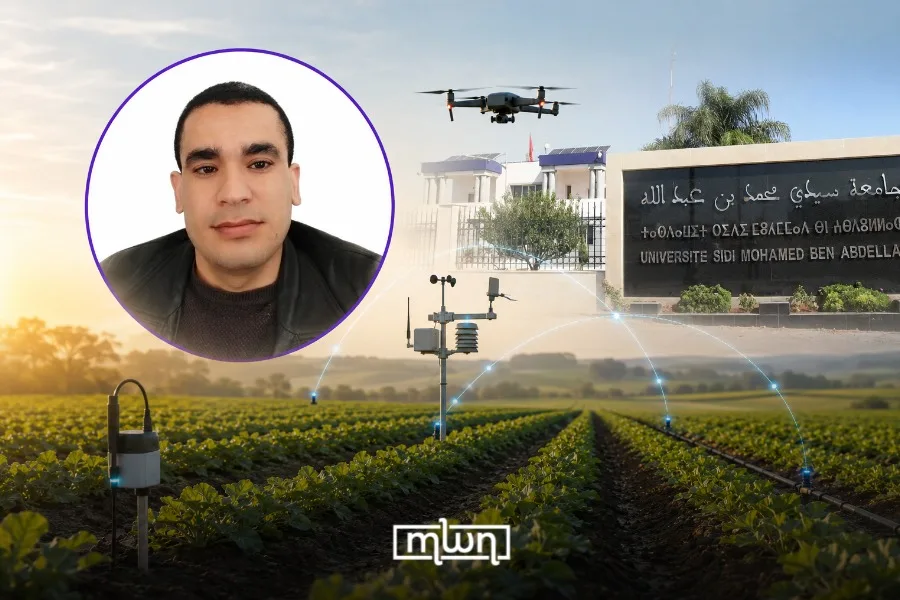
Fez — Moroccan researcher Abdennabi Morchid has co-authored a major scientific paper that places Sidi Mohamed Ben Abdellah University (USMBA) in Fez within an urgent global debate: how farms can produce more food while using less water and energy.
The paper, titled “Precision Irrigation Based on IoT and Energy Management: Driving Future Sustainable Water Management in Farming,” was written by Morchid, Mohammed Nabil Kabbaj, and Mohammed Benbrahim from the Laboratory at the Faculty of Sciences (LIMAS), Dhar El Mahraz. It was published on June 16 in “Renewable and Sustainable Energy Reviews,” Volume 240.
Material shared with Morocco World News (MWN) described the publication as an unprecedented milestone for the Faculty of Sciences at Sidi Mohamed Ben Abdellah University, pointing to the journal’s high international standing in sustainability, energy systems, and advanced technologies.
Why the study matters now
The research arrives at a moment when water is no longer only an environmental concern, but a major agricultural, economic, and social challenge.
Morocco has recently received relief from improved rainfall after years of drought, but its long-term water stress remains severe. The World Bank has described Morocco as one of the world’s most water-scarce countries, with water availability near 620 cubic meters per person per year.
Globally, the pressure is also rising. The Food and Agriculture Organization (FAO) has projected that feeding the world by 2050 will require raising overall food production by around 70%.
This is where Morchid’s paper becomes particularly salient. It does not conceptualize smart irrigation as a mere technocratic adjunct or isolated instrumental device. Rather, it reconceptualizes it as a comprehensive, systematically integrated agro-ecological and technological framework.
“The main idea of this research is to move beyond traditional irrigation systems by proposing a fully integrated smart agricultural framework,” Morchid told MWN in an interview.
He explained that the study does not look at irrigation “only as a water management problem,” but as a connected system where water use, energy consumption, environmental data, and climate resilience are optimized together.
Beyond sensors and automatic pumps
For ordinary readers, the simplest way to understand the idea is this: a farm should not irrigate because a clock says it is time. It should irrigate because the soil, crop, weather, and energy conditions show that irrigation is needed.
In traditional systems, farmers may rely on fixed schedules, habit, or visual inspection. In a smart system, soil sensors can measure moisture, weather data can anticipate rainfall or heat, and connected platforms can recommend when to irrigate.
“In practical terms, this system would significantly reduce manual decision-making,” Morchid explained to MWN.
He said farmers could move away from fixed irrigation schedules and toward systems that continuously analyze soil conditions, weather data, and crop water needs. Irrigation would then be recommended or triggered only when necessary.
The energy behind every drop
One of the strongest points in the paper is its focus on energy. Irrigation requires pumps, valves, motors, batteries, control systems, and sometimes solar or wind power.
A system can be water-efficient but still expensive if it ignores energy use.
“Energy plays a fundamental role because irrigation systems depend heavily on pumping and operational energy,” Morchid maintained.
“Without considering energy consumption, even water-efficient systems may remain costly and unsustainable,” he added.
The paper explains that energy management can include solar photovoltaic pumps, batteries, grid interaction, energy planning, and microgrids. It also describes IoT-based systems that can adjust pump cycles based on energy availability, battery storage, and peak electricity demand.
The Internet of Things, or IoT, simply means connected sensors and devices.
The research connects IoT, artificial intelligence, cloud platforms, edge computing, embedded systems, renewable energy, digital twins, and blockchain into one framework for future irrigation.
What the paper actually reviews
Morchid and his co-authors analyzed 153 scientific articles selected through a structured methodology inspired by the PRISMA model. The paper began with 1,200 references, removed duplicates and irrelevant studies, and then narrowed the review to studies focused on precision irrigation, IoT integration, and energy management.
The review’s central argument is that existing research often remains fragmented. Some studies focus on sensors. Others focus on crop monitoring, water-saving technologies, or renewable energy. Fewer studies connect all three dimensions: precision irrigation, IoT architecture, and energy management.
The authors situate their contribution around three pillars: precision irrigation as a decision-making base, IoT as the system for sensing and communication, and integrated water-energy management as the driver of sustainability and feasibility.
A timeline of agricultural technology
The paper also gives the reader a historical view of how irrigation technology evolved.
Morchid said the study traces precision irrigation from 1950 to 2025, IoT integration from 2000 to 2025, and energy management solutions from 1980 to 2025.
“This chronological perspective helps place these technologies within their historical context,” he told MWN, saying it also shows their gradual convergence toward intelligent and sustainable agricultural systems.
The energy timeline is especially useful. It shows how irrigation moved from manual and electric pumping toward variable-speed drives, solar pumps, energy storage, hybrid microgrids, and AI-based energy optimization.
For a lay reader, the point is that the farm of the future will know when crops need water, when energy is available, and how to avoid wasting both.
Promise and limits
The paper is optimistic, but not naïve.
It argues that AI can help predict soil moisture, detect leaks, identify sensor failures, and improve irrigation decisions. Digital twins can simulate irrigation networks, pumps, and renewable energy systems before farmers make physical changes. Blockchain could help protect data, track consumption, and build trust in decentralized agricultural systems.
At the same time, the authors warn that these technologies must prove their value in real conditions. Digital tools can become expensive, complicated, or disconnected from farmers’ needs if they remain purely theoretical.
Morchid said wider adoption in Morocco would require “reducing the cost of IoT technologies, improving digital infrastructure in rural areas, strengthening farmer awareness and training,” and building stronger collaboration between universities, policymakers, and the agricultural sector.
That may be the real test. Smart irrigation cannot remain only a laboratory concept. It must become affordable, teachable, and usable for farmers who face daily pressure from drought, costs, and market uncertainty.
For Morocco, the broader message is clear. The future of agriculture will not depend only on finding more water. It will also depend on using every drop more intelligently, while managing the energy that makes that possible.