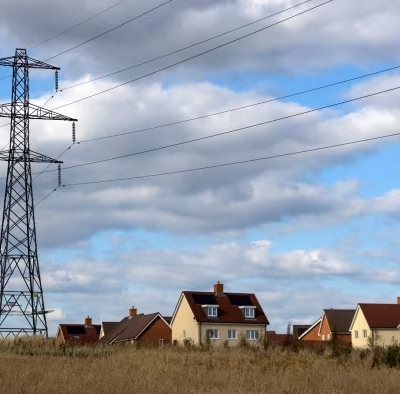
Whoever walks into 10 Downing Street must focus squarely on reducing energy costs as the cornerstone of their economic strategy.
A more comprehensive, business-focused plan on energy bills and electrifying growth would help unlock investment across the economy. Our high streets, industrial heartlands and industries of the future depend on it. Britain’s businesses are once again paying the price for volatility far beyond their control. Electricity costs have jumped, margins are under pressure, and investment decisions are being put on hold.
As the Prime Minister steps down and a leadership transition begins, the incoming administration must recognise that it’s a top priority from day one to focus on reducing these crippling energy costs
We’ve seen ministers to date respond with targeted support for energy-intensive industries in the form of the British Industrial Competitiveness (BIC) and Supercharger schemes. That will help those it reaches – but it is limited in scope. This raises the question of what should be done for the “squeezed middle” of SMEs that make up much of the economy.
Recent research carried out by the British Chambers of Commerce has shown that 75% of firms expect their energy bills to increase over the next 12 months. Over a third (36%) of businesses are anticipating they’ll find it difficult to pay their energy bills over the next year.
We need to tackle the underlying structural problems in the system, rather than simply managing the symptoms. In short, we need electrification. Electrification offers the opportunity to combine three bills – electricity, gas and fuel – into a single, efficient and affordable energy system, made even more robust against global shocks as we build out more renewable generation.
Most businesses will not be eligible for the BIC and Supercharger schemes and still face higher electricity costs than those in many other European countries. They also pay for the support schemes that benefit their larger peers – creating not just an affordability problem, but a competitiveness and growth one too.
This matters because electrification is about far more than long-term decarbonisation. Done properly, it can deliver greater price stability, reduce exposure to volatile global energy markets and give businesses the certainty they need to invest.
The UK’s investment in renewables is already acting as a buffer. Without the renewables already operating on our system, we estimate wholesale electricity prices today would be about 30 per cent higher.
The prize is significant. Latest estimates suggest the UK’s net zero economy generates around £105 billion in Gross Value Added for the UK economy. Yet current government policy isn’t doing enough to encourage businesses to invest in electrification – from manufacturers and retailers to pubs, restaurants and the high street.
Even before events in the Middle East pushed wholesale energy markets higher, British Chambers of Commerce data showed that over half (52%) of firms were already under pressure to raise prices to cover rising energy costs. That pressure feeds directly into inflation, weakens competitiveness and constrains growth across the economy.
We recognise there are no easy choices for the Government here, with the public finances under pressure, so what should happen next? There are three practical levers the government could use quickly to support investment and electrify growth.
First, extend targeted support to small and medium-sized businesses – the backbone of the UK economy. The decision in the Budget to extend the Renewables Obligation discount to households was sensible. Extending equivalent relief to SMEs would help level the playing field and deliver immediate bill savings for firms currently under the greatest pressure.
Second, ensure policy incentivises electrification rather than penalising it. Take the Climate Change Levy. Introduced two decades ago, it made sense as a tax on energy use to cut emissions. Today’s challenge is different. We need to electrify heat, transport and industry. Without reform, the levy risks discouraging electrification. It is electrification that will both reduce emissions and tackle future energy costs.
Third, avoid a system that creates winners and losers in different parts of the economy. Supporting energy-intensive industry is important, but so too is supporting our SMEs, and the government should look again at where policy costs land. Taken together, these steps could make a material difference. Our analysis shows that for a typical SME, such as a pub or restaurant, action in these areas could deliver real-world bill savings of around £1,000 a year.
In volatile times, Britain needs a clear route to growth and a shield from global shocks. Electrification offers one: greater resilience, improved competitiveness and protection from future price spikes. But it will only deliver if policy keeps pace with ambition.
____________________
Shevaun Haviland is Director General of the British Chambers of Commerce and Nikki Flanders is Managing Director of Energy Customer Solutions at SSE plc.
LBC Opinion provides a platform for diverse opinions on current affairs and matters of public interest.
The views expressed are those of the authors and do not necessarily reflect the official LBC position.
To contact us email opinion@lbc.co.uk