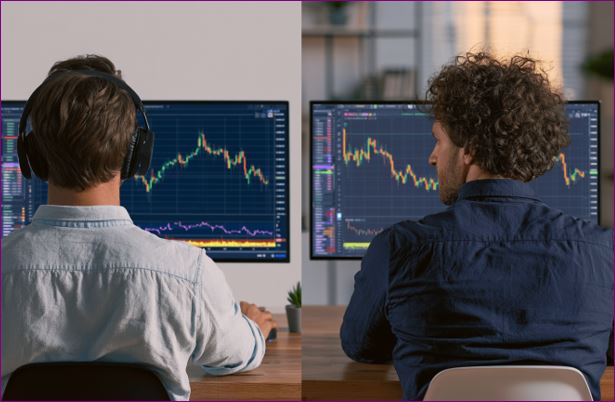
Most traders who blow up their first live account were profitable on demo. That gap does not come from a flawed strategy — it comes from everything strategy alone cannot teach. Whether your money will actually prepare you for live conditions depends almost entirely on what the program covers, and not every curriculum treats the demo-to-live transition as its own subject.
All investments carry some degree of risk, and how traders manage that risk under real conditions determines whether they survive long-term. A peer-reviewed study of 360,000 traders found fewer than 1% were consistently profitable, and fewer than 7% remained active after five years. The demo record often looks fine. Behavior under real financial pressure is where it falls apart.
This is the gap that paid guidance is built to close. Most traders who lose money in live markets knew the theory. They understood setups, had tested risk rules, and had logged profitable demo sessions. What they lacked was structured, repeated preparation for the very specific behavioral shift that live trading creates — and that is precisely what a properly matched trading mentorship program delivers.
Why demo success rarely transfers on its own
Simulator practice is useful. You learn platform mechanics, test entry logic, and develop chart-reading habits without financial risk. The trouble is that demo trading removes the one variable that changes everything: real consequence.
When early live trades produce normal statistical losses, the brain reads them as threats. That trigger does not exist on demo. Revenge trading — taking larger, faster positions to recover a loss — is one of the most destructive patterns in live trading, and it is almost entirely absent in simulation because the emotional pressure that causes it simply is not there.

Traders who averaged consistent demo gains often describe the live experience as a different activity entirely — same charts, same setups, a completely different emotional load. The mismatch between what you practiced and what you actually face is the core problem the demo-to-live transition creates, and the core problem mentorship should address.
What a structured trading mentorship program actually addresses
A solid mentorship program is not a library of recorded lessons. It is a supervised process that mirrors real trading conditions and holds you accountable inside them. Programs that skip live market exposure or lean on unrealistic profit claims tend to produce traders who look good on demo and collapse on a funded account.
The curriculum inside a program built around the demo-to-live gap typically covers three phases: consolidating demo skills, practicing under simulated pressure, and supervised live deployment with hard risk limits. Each phase should have specific, measurable exit criteria — not just a module completion checkbox.
Accountability is the other piece most programs underdeliver. A mentor who watches trades but never reviews your journal is observing, not coaching. The distinction matters when your capital is on the line.

The psychology layer: Where most programs cut corners
Overconfidence after a demo winning streak is a real and documented phenomenon. Traders move to live accounts expecting the same results, encounter normal losses, and either abandon their plan or start overleveraging to recover. Without preparation for that moment, the strategy becomes irrelevant.
Mentorship that treats psychology as a core subject will cover:
- Personal emotional triggers: loss aversion, fear of missing out, and the specific patterns that cause you to break your own rules.
- Pre-market routines that stabilize decision-making before the session begins.
- Post-loss protocols that prevent a single bad trade from cascading into a damaged account.
- A journaling structure that separates what your plan called for from what you actually did.
These are trainable behaviors. A mentor who reviews your journal weekly and ties feedback to specific trade decisions gives you something lasting — not just vocabulary around psychology.
When this layer is absent from trading education, traders arrive at the live market knowing what to do but not how to act under pressure. That gap costs real money.
Risk management: The non-negotiable core of trading education
Professional traders size positions between 1–5% of account value and hold a minimum risk-reward ratio of 1:2. These numbers were tested across decades and multiple market conditions. They are the floor, not the ceiling, of what mentorship should install before you touch a live account.
The contrast between solid and weak risk training is usually visible before you sign up, if you know what to look for:
| Risk Management Component | Adequate Mentorship | Inadequate Mentorship |
| Position sizing | Taught with formulas tied to account size | Mentioned but not practiced |
| Stop-loss placement | Reviewed on individual trade setups | Generic rules only |
| Risk-reward ratio | Tracked across sessions | Discussed once in curriculum |
| Drawdown limits | Hard limits set before live trading | Left to trader’s discretion |
| Leverage guidance | Market-specific, conservative defaults | Not covered or understated |
FINRA’s day-trading risk disclosure states directly that accounts below $50,000 significantly impair a trader’s ability to profit — a consequence of having no real buffer against normal drawdown sequences. Position discipline, installed through repetition rather than read once in a rulebook, is what creates that buffer.
Risk management is not a module you complete. It is a habit that mentorship should build through repeated practice and review.
Trade journaling and performance review
The most underrated tool in the demo to live trading transition is a properly structured trade journal — not a spreadsheet of entries and exits, but a record of the decision-making process: what the setup was, what the plan required, what you did, and what the outcome revealed.
A mentor’s role in journaling is not passive. They should:
- Define the journaling format at the start of the program.
- Review entries at least weekly, not just before major check-ins.
- Identify behavioral patterns across multiple sessions, not just individual trades.
- Use journal data to adjust the training focus going forward.
Without that review loop, journaling is busywork. With it, the journal becomes the primary diagnostic tool between you and your mentor — the place where the difference between a strategy problem and an execution problem actually becomes visible.
The staged capital approach: From simulator to small live account
The move from demo to live trading should not happen in a single step. A structured mentorship program defines a staged deployment framework with specific risk parameters and minimum time requirements at each level.
| Stage | Account Type | Max Risk Per Trade | Minimum Duration |
| Stage 1 | Demo account | N/A | 3 consecutive profitable months |
| Stage 2 | Micro live ($500–$1,000) | 0.5% per trade | 60–90 days |
| Stage 3 | Small live ($2,000–$5,000) | 1% per trade | 3–6 months |
| Stage 4 | Scaled live account | 1–2% per trade | Ongoing with mentor review |
The advancement criteria should be written down before the program begins, not decided informally as you go. Any program pushing you toward a funded account in weeks deserves scrutiny.
The staged model matters because it is the only way to expose yourself to the emotional reality of real-money trading while keeping losses small enough to survive the learning curve.

What to ask before enrolling in any mentorship program
The questions you bring to a discovery call will tell you more than any sales page. A mentor worth the investment answers these without hedging:
- Do you trade live with your own capital, and can you show documented results?
- Does the program include live trade reviews, or only recorded content?
- How is my journal reviewed, and how often?
- What are the specific criteria for moving from demo to live?
- What drawdown limit triggers a pause in my live trading?
Look for mentors who share both past performance and realistic expectations — including losing periods. If answers are vague or redirect to testimonials, the program is selling the idea of trading rather than teaching it.
The real cost of skipping proper mentorship
Most traders who wash out were not underprepared in theory. But they are not ready for the behavioral demands of live trading — the losing streak that often triggers revenge trades, the winning streak that inflates position sizes, or the spiral that turns a recoverable drawdown into a blown account.
Those outcomes are not inevitable. The traders who last are not necessarily smarter. Many of them simply had access to feedback, accountability, and a process that held up when their emotions did not — which is exactly what good trading education and mentorship is built to provide.
The difference between a profitable trader and a former trader is rarely the strategy. It is what surrounds the strategy: the risk rules that held during a losing streak, the journal that identified a behavioral pattern, the mentor who told you to size down before you sized up.
DISCLAIMER – “Views Expressed Disclaimer – The information provided in this content is intended for general informational purposes only and should not be considered financial, investment, legal, tax, or health advice, nor relied upon as a substitute for professional guidance tailored to your personal circumstances. The opinions expressed are solely those of the author and do not necessarily represent the views of any other individual, organization, agency, employer, or company, including NEO CYMED PUBLISHING LIMITED (operating under the name Cyprus-Mail