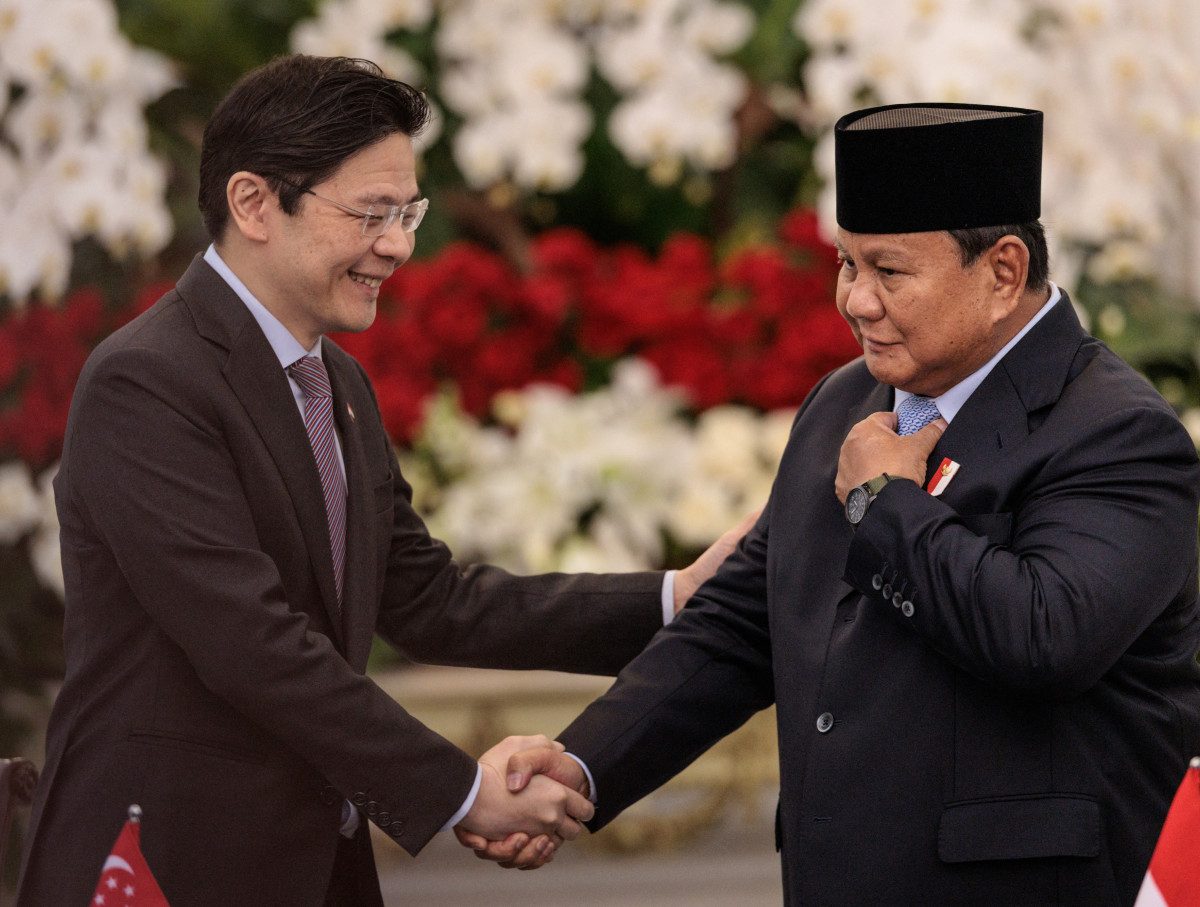
nergy cooperation and supply chain resilience took center stage on Monday during Singapore Prime Minister Lawrence Wong’s visit to President Prabowo Subianto, where the two countries announced dozens of new bilateral agreements, as the conflict in the Middle East continues to disrupt global trade and energy markets.
Arriving in Jakarta on Sunday evening for his second leaders’ retreat with Prabowo, Wong and his delegation received a ceremonial welcome at the Merdeka Palace on Monday before joining Prabowo for a luncheon and closed-door talks.
In their meeting, the leaders discussed a wide range of regional and global issues, according to their joint statement, including food security, defense, ASEAN cooperation, the security of the Malacca Strait and energy cooperation. They later witnessed their ministers presenting 26 signed new agreements and memorandums of understanding (MoUs), 10 of which were dedicated to energy cooperation.
“Recent developments in the Middle East have reminded us of the importance of energy security and diversification. Indonesia has tremendous potential in renewable energy, and Singapore would like to partner with Indonesia in unlocking this potential,” Wong said.
Among the energy-related agreements are those centering on the launch of Indonesia’s first biomethanol pilot production project in North Sumatra, and an MoU between Jakarta’s sovereign wealth fund Danantara and Singapore’s Keppel Electric, Sembcorp Industries and Singapore Energy Interconnections to develop a cross-border electricity project.
“[The MoU] will provide a road map for negotiations and discussions between the parties, paving the way for our cross-border electricity project. We believe such a project is a win-win for both countries and it will also be an important building block for a wider ASEAN power grid,” Wong said.
The two countries also expressed their commitment to expediting the ratification of the ASEAN Petroleum Security Agreement (APSA), which provides a framework for emergency fuel sharing among member states during supply disruptions.