

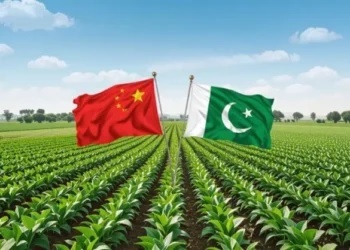
China and Pakistan opened the Belt and Road Joint Laboratory for Biological Resources and Green Smart Agriculture in Arid Regions, targeting AI-powered farming, germplasm research, and technology transfer for food security.
-
Joint Belt and Road initiative to drive AI-powered farming, precision agriculture, technology transfer and research collaboration
-
New laboratory links top Chinese and Pakistani institutions, advancing germplasm research, training and sustainable agriculture across arid regions
BEIJING: China and Pakistan have taken another significant step towards expanding their strategic partnership in modern agriculture with the inauguration of the Belt and Road Joint Laboratory for Biological Resources and Green Smart Agriculture in Arid Regions in northwest China’s Shaanxi Province, a landmark initiative aimed at advancing research, innovation, technology transfer and capacity building to promote sustainable agricultural development across arid regions.
Established by Northwest A&F University, the research consortium brings together leading Pakistani institutions, including the University of Agriculture Faisalabad, Pir Mehr Ali Shah Arid Agriculture University, Ayub Agricultural Research Institute and Sindh Agriculture University, China Economic Net (CEN) reported.
According to Prof. Zhang Lixin, the Chinese director of the laboratory and a professor at Northwest A&F University, the joint platform will focus on six major research areas: germplasm resources and intelligent breeding, smart crop selection, agricultural data platforms, intelligent farming and livestock production, precision farmland management, and AI-assisted decision-making for sustainable crop production.
“In the field of germplasm resources and breeding, the initial collection of arid-region crop germplasm from countries such as Pakistan and Uzbekistan has been completed, gathering over 120 unique crop germplasm samples.
A standardized germplasm resource bank has been initiated, and a preliminary breeding system combining ‘space-induced mutation + intelligent design’ has been established.
This effort has led to the development and screening of 11 new, high-quality stress-resistant germplasms and varieties suitable for South and Central Asia, including wheat, rapeseed, sesame, vegetables and forage crops,” Zhang said.
In the field of green intelligent technology, a series of innovations—including integrated water and fertilizer systems supported by technical and management decision-making tools, smart orchard production systems, an AI model for agricultural equipment, and technologies for straw biodegradation and organic fertilizer preparation—have also been developed.
These technologies are now being localized through parameter optimization and are beginning to be demonstrated and promoted in countries such as Pakistan and Uzbekistan.
Zhang revealed that dedicated training programmes focusing on smart agriculture and bio-health technologies for arid regions will also be launched.
The first training session is scheduled for the second half of 2026 and will bring together 12 young researchers from Belt and Road partner countries.
Through a combination of theoretical instruction, field practice and site visits, the programme aims to improve training outcomes, cultivate skilled local researchers and technicians, strengthen local talent retention, and enhance the research and development capabilities of local technical experts.
Hafiz Saad Bin Mustafa, Principal Scientist at Ayub Agricultural Research Institute, told CEN that one of the key priorities of the collaboration is the transfer of advanced agricultural technologies, including modern equipment such as precision seed planters, harvesting machines, inter-cultivation machinery, combine harvesters and specialized germplasm-processing equipment.
He said the other two important areas of cooperation include agricultural processing and capacity building through specialised training programmes for researchers.
Highlighting the laboratory’s academic progress, Zhang said that since December 2025, more than ten postgraduate students from Pakistan, Bangladesh and Indonesia have been admitted to pursue studies at the facility.
He said two doctoral students from PMAS-Arid Agriculture University, Rawalpindi, had joined the laboratory for six-month collaborative research projects.
In addition, five Chinese postgraduate students were selected to undertake field internships and needs assessments in Pakistan, while two SCI-indexed research papers have already been published in international journals with the joint laboratory listed as the primary affiliation.
During the conference, a monograph on biological and healthy agricultural product production technology was also released, providing guidance on crop cultivation and livestock production through advanced biotechnology and modern production techniques.
The University of Sindh and the University of Punjab in Pakistan, along with one university each from Bangladesh and Indonesia, have formally joined the Silk Road Agricultural Education and Research Innovation Alliance to further strengthen scientific and technological cooperation and academic exchanges.