From concert tickets to limited-edition collectibles, scalping has become an increasingly familiar part of modern consumer culture in Singapore. But beyond inflated prices lies a bigger question. What does it say about the kind of society we’re becoming when every scarce opportunity is seen as a chance to make a profit?
There’s a particular kind of disappointment that’s become familiar to Singaporeans. You join the queue hours before tickets go on sale, clear your schedule, refresh your browser at exactly the right moment, and still walk away empty-handed. Within minutes, the very thing you wanted appears online for three times the price.
We’ve seen it happen with BTS concert tickets, CJ Hendry’s Singapore-exclusive felt flowers and even the Swatch x Audemars Piguet launch. It isn’t a new problem either. The Pride was writing about scalpers hovering around Ed Sheeran and Coldplay tickets years before Dear You made headlines.
Each event followed the same pattern. People who genuinely wanted the experience lost out to those who saw an opportunity to profit, raising questions about whether we’ve become less gracious as a society.
When profit comes first
Globally, bots account for nearly 40% of all traffic to ticketing websites, allowing scalpers to snap up thousands of tickets within minutes of sales opening. While Singapore has taken steps to curb the problem, including the Singapore Police Force removing scalping listings on platforms such as Carousell and X, enforcement alone cannot solve it.
The usual defence is familiar: buy low, sell high, it’s just business. Nobody forces fans to pay inflated prices, after all. Buyers do ultimately make the choice to pay, and reselling a single unwanted ticket at face value isn’t the same as buying in bulk purely to flip for profit.
@wekaypoh The CJ Hendry Flower Market brought in over 30 types of plush flowers, including Singaporea-exclusive designs which people were very quick to snag… Visitors could also redeem a stalk for free, and purchase additional stalks at $7 each. #sgnews #flowermarket #CJHendry #flowers #wekaypoh ♬ original sound – weKaypoh
But that distinction gets lost in the BTS fan who saved for months, only to lose to a bot before she could even check out, or the art lover who wanted one of CJ Hendry’s Singapore-exclusive flowers as a keepsake, only to watch people walk away with bags full of them to resell for hundreds of dollars.
Where do we draw the line?
I’ve never bought from a scalper, but I’ve encountered them often enough to recognise the pattern. Take Dear You, the Teochew film that’s become a surprise hit in Singapore, with senior citizens queuing for tickets in snaking lines outside cinemas.
@aliciatadah 😭 they started queuing at 1 pm for the tickets , that’s 2 hours of waiting. I see elderly folks in wheelchairs & canes , just standing there chatting about how they can’t wait to watch this movie in teochew. I believe we can do better for our pioneer generation. #tiktoksg #dearyou #teochew ♬ original sound – Ally
I was one of the people trying my luck to snag them online. After 45 minutes, I managed to secure mine. Almost immediately, I wondered: “Surely no one would scalp movie tickets?” A quick search on Carousell proved me wrong. Tickets that usually sold for S$18.50 were listed for as much as S$170.
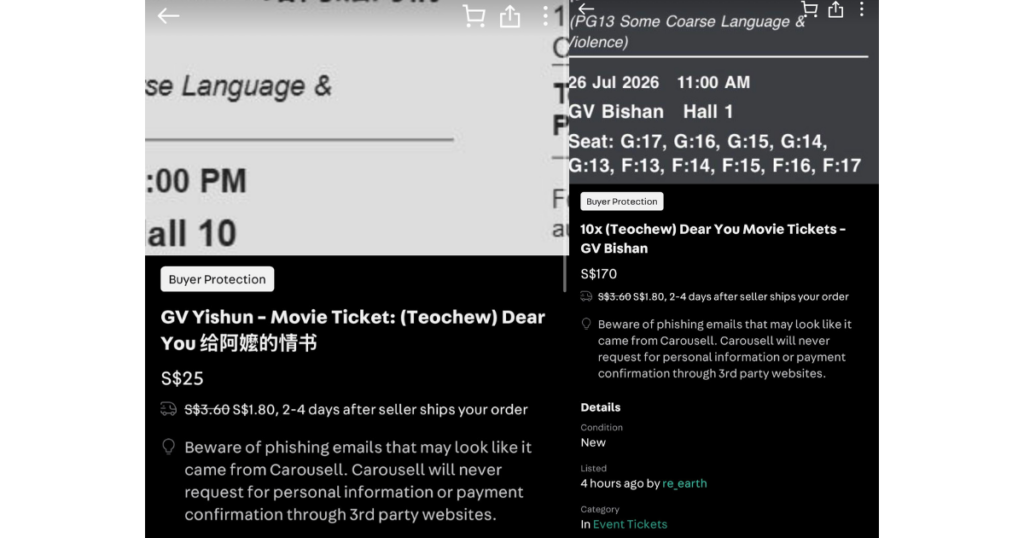
On r/singapore, the reaction was pointed, with users comparing the Dear You scalping to long-running frustrations over concert tickets and Pokémon cards, and some only half-joking that watching the film in Johor Bahru was now the easier option.
That was perhaps the most disappointing part. If even a film, one that many elderly viewers had patiently queued for, is treated as another opportunity to make a quick dollar, it says something about how transactional we’ve become.
That’s what was being resold for S$170 a ticket: not just two hours in a cinema, but someone’s last living connection to a language and a place they left behind.
A society where every shortage becomes an opportunity for profit is also one where trust slowly erodes. We stop seeing one another as fellow concertgoers, collectors or moviegoers, and start seeing one another as customers. When that happens, the experience itself becomes secondary to what it can be sold for.
Graciousness isn’t always tested in moments of abundance. It’s also tested in moments of scarcity, when there’s only so much to go around and you have to decide whether your claim to it matters more than someone else’s. Being a more gracious society means recognising that not every opportunity to make money needs to be taken.
We often think graciousness is about giving up a seat on the train or holding the lift, but it also shows up in less obvious moments, like resisting the temptation to profit from someone else’s disappointment. It means choosing not to buy solely for resale, refusing to support scalpers even when it means missing out, and remembering that behind every sold-out ticket, limited-edition item or collectible is someone who genuinely hoped to experience it.
Where do we go from here?
The next time a concert sells out in minutes or a limited-edition release disappears before most people even have a chance, we’ll probably blame the bots, the platforms or the scalpers. And they do deserve scrutiny. But it’s also worth asking a harder question: what kind of culture are we rewarding?
Every marked-up ticket exists because someone chose to exploit scarcity, and someone else felt they had no choice but to pay. The more we accept that as normal, the more we risk turning every shared experience into a transaction.
Not everything that is valuable has to be valued in dollars. Sometimes, its true worth lies in the memories it creates, the communities it brings together and the joy of knowing it ended up with someone who genuinely wanted it.
Is refusing to buy from a scalper restraint, or just easy to say from the sidelines?
Share your thoughts with us