The area that surrounds Ouarzazate in southern Morocco is a place of unforgettable geological contrasts.
The town is perched on a Mars-like rocky plateau and framed by the snow-capped Atlas mountains to the north. To the south are the vast empty sands of the Sahara, giving it its nickname: the “door to the desert”. Lush palm-filled river valleys snake for hundreds of miles east and west.
Could something man-made contend with such a natural spectacle? The Noor solar park, a 25-minute drive down a pot-holed road out of town, must come close.
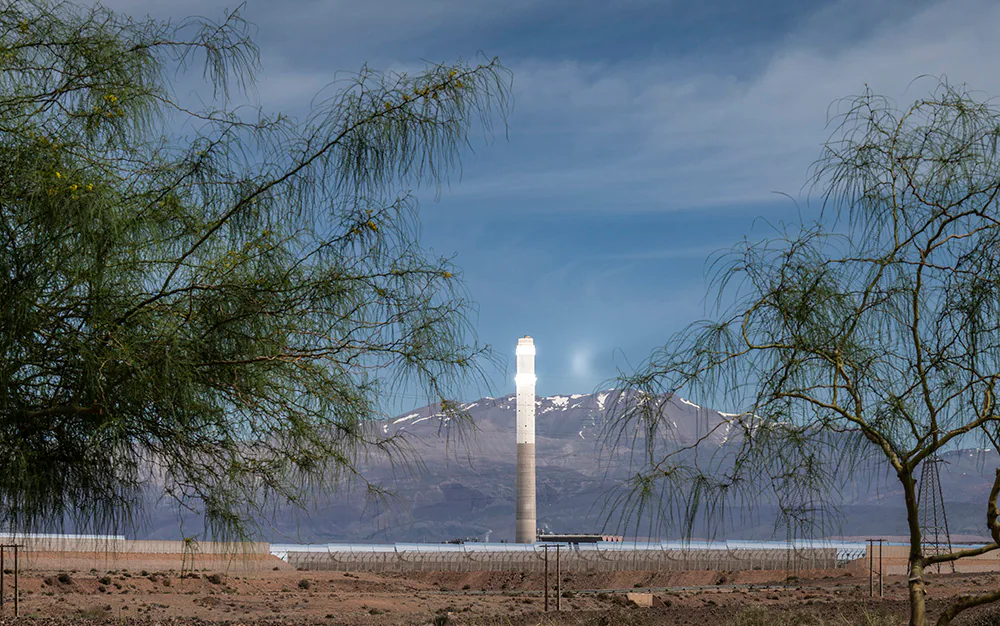
At the centre of Noor, meaning “light” in Arabic, is a 243-metre tower that turns a stunning bright white once it has harnessed enough of the sun’s energy to heat up the molten salt contained within its core.
Reports claim the half a million mirrors across the 3,000 hectare site, along with the central tower, reflect so much light that astronauts and earth-imaging satellites can capture its glow from space. To glimpse at it from the ground for even a second with the naked eye is to fear lasting damage to one’s retinas.

Mustapha Sellam, site director
Credit: Simon Townsley/The Telegraph
“When we finished it [in 2017], it was the tallest building in Africa,” Mustapha Sellam, site manager said from a five-story viewing platform built to enable monitoring of the site.
The Noor column has since been surpassed by Egypt’s Iconic Tower, Algeria’s Great Mosque, and Morocco’s own Mohammed VI Tower in Rabat, but this engineering marvel remains “a huge source of pride … for the people of Morocco,” says Yasmina Benmessaoud, strategy director at the Moroccan Agency for Sustainable Energy.
Yet Noor is much more than just an impressive spectacle. It is the cornerstone of Morocco’s renewable energy strategy; a strategy that aims to ensure that more than half the country’s electricity comes from renewable sources by the end of the decade.

The tower turns bright white once it has harnessed enough of the sun’s energy
Credit: Simon Townsley/The Telegraph
Built in four phases, the vast complex has acted as a springboard for the country’s unlikely transformation from fossil fuel dinosaur to green pioneer at the vanguard of Africa’s surging solar power revolution.
After a series of false starts, experts believe a continent blessed with near-perfect conditions for harnessing the sun’s rays, is now in the throes of an epoch-defining solar energy boom.
Noor is just one of hundreds of solar projects either already built, under construction, or in the planning stages, that could transform the lives of many of the near-600m Africans who still lack access to reliable electricity, say green energy proponents.
Sonia Dunlop, chief executive of the Global Solar Council, said: “Africa’s solar revolution is here. Growth is spreading to new markets across the continent. Solar power is now a 24/7 energy source and a powerful engine for economic growth across Africa.”

Noor produces enough power to light up roughly 1m homes
Credit: Simon Townsley
The scale and speed of Morocco’s green power boom is remarkable. The four plants at Noor produce a combined 580 megawatts of power – enough to light up roughly 1m homes – but the country’s ambitions stretch much further.
A proposed export project known as X-Links is about as visionary as can be found anywhere in the world, positioning a country that has long relied on fossil fuel imports for 90pc of its energy needs to one day become a net exporter of renewable power.

Fireman Omar El Massaou, on duty at the plant
Credit: Simon Townsley/The Telegraph
A consortium of UK investors, led by former Tesco boss Sir Dave Lewis, has proposed taking solar and wind power generated in Morocco’s Tan-Tan region, close to the contested Western Sahara region, and transmitting it at hyper speed through 4,000km of hi-tech underwater cables to the Devon coast. From there, it is envisaged the project could power as many as 7m British homes.
Sir Dave told the Telegraph last year the company chose Morocco because “the sun shines every day and the wind blows every evening … It’s geographically perfect”.
Though the scheme is currently on hold after Ed Miliband failed to give it his blessing, X-Links is testament to Morocco’s willingness to think big when it comes to weaning itself off fossil fuels.

The project could one day power as many as 7m British homes
Credit: Simon Townsley/The Telegraph
At the offices of Masen, in Rabat, officials pull up a map of the country on a giant, wall-mounted TV. Dots representing the dizzying array of green energy schemes it is spearheading on behalf of the government pepper the screen.
In 2009, King Mohammed VI announced that in a bid to reduce a heavy dependency on expensive, imported hydrocarbons, Morocco would utilise its natural geography and turn to renewables.

Workers at the plant
Credit: Simon Townsley/The Telegraph
The country gets an estimated 3,500 hours of sunlight a year in some regions – more than double the European average – and boasts a 2,200 mile coastline with constant natural trade winds along much of it, meaning it is well-placed to meet the Crown’s demand for 52pc of Morocco’s electricity to come from renewables by 2030.
As part of the shift, Masen was created and handed a specific objective enshrined in law to install 6GW of renewable energy capacity by the end of the decade – half of what Morocco hopes to build. The government has also set aside 1m hectares of land for clean power schemes.
With 5.6GW already installed – the majority from projects the agency has overseen – Morocco is already at the stage where it’s helping neighbouring countries get projects off the ground.
“We have signed 14 agreements across the continent to provide assistance in some shape or form,” Nabil El Asraoudi, Masen’s director of international development said.

Power reserves are monitored at the plant
Credit: Simon Townsley
A delegation has just returned from Mali. “We sent our people to help to help them identify projects, and facilitate all the work that needs to be done: technical expertise, and man hours, as opposed to actual investment,” he said.
The solar boom is being repeated across much of the African continent as the costs of solar power plummet.
Of the 322 energy projects announced across Africa last year, 173 were solar, 46 were hydropower, 34 were wind, and 14 were so-called hybrid schemes, according to Electron Intelligence, an energy research firm. Just 22 – equivalent to 6pc – were gas.
Yet the revolution is not without its doubters. Technical problems at Noor in Ouarzazate, along with the huge costs of repairs, have led to questions about whether solar power can be adopted at the magnitude required to be truly transformative.
Meanwhile, China’s almost total dominance of the supply chain has revived longstanding fears about who stands to benefit most from Africa’s energy transition.
Africa’s sudden clamour for solar power couldn’t be fulfilled without the factories of China. Four fifths of the world’s solar panels now originate from China.
While big utility projects like Noor are vital if Africa is to wean itself off fossil fuels, their effectiveness is constrained by aging, unreliable power grids that are prone to blackouts, chronic intermittency, and load shedding where the power supply is deliberately turned down to relieve stress on a creaking grid. As more gigawatts are added to the system, those limitations become more acute.
And yet there is a second – off grid – solar revolution happening too.

A growing number of Africans will power their homes independently
Credit: Simon Townsley/The Telegraph
A collapse in the price of solar panels is enabling rapidly growing numbers of Africans to power their homes, farms and small businesses independently and disconnect from the network entirely.
“Rooftop and distributed systems are putting power directly into the hands of households and businesses,” the Solar Council said.
The best measure of the shift that is taking place can be found in the export figures provided by the Chinese Communist Party.

A night market in Marrakesh
Credit: Simon Townsley/The Telegraph
In November 2024, analysts at Ember, a UK energy think tank, spotted a sudden spike in Chinese solar panel imports into Africa. The increase continued the following month but they put it down to panicked manufacturers offloading panels at knock-down prices as part of a dash to meet end-of-year targets.
“They were really high numbers and we thought they [Chinese producers] were just dumping solar panels,” Dave Jones, Ember’s co-founder and chief analyst, said.
But the trend continued uninterrupted. In the 12 months to the end of June 2025, Africa’s imports of Chinese solar panels leapt 60pc to 15GW, according to Ember.
For the whole of 2025, the Solar Council estimates the figure to be more than 18GW, dwarfing the 4.5GW of government-led solar power projects that were added to the grid.
The uptake is happening across the continent. Outside of South Africa, which has long been the dominant purchaser, imports came close to trebling, while 20 countries set new records for solar panel imports over the period.

Mirror fields at the Noor Solar Plant capture intense Saharan sunlight to generate renewable power
Credit: Simon Townsley
In some countries the growth rate was exceptionally high. In Algeria, they rose 33-fold. In Zambia it was eightfold, Botswana sevenfold, Sudan sixfold, and in Liberia, DRC, Benin, Angola and Ethiopia numbers tripled.
“The data now indicates this is part of a broader, structural trend,” Ember said in a report published in August of the same year. “The take-off…is a pivotal moment,” it added.
If all those purchased are installed, the impact in some countries has the potential to be truly transformative. Sierra Leone’s solar panel imports in 2025 were equivalent to 61pc of the country’s annual electricity usage.
The continental surge is being driven primarily by a collapse in costs resulting from ever-increasing production levels – mainly in China. Under Wright’s Law of innovation, every doubling of global cumulative capacity results in a 20pc decline in solar panel prices.

The North Africa regional office of Chinese tech giant Huawei, in Casablanca
Credit: Simon Townsley/The Telegraph
This exponential change has resulted in the price of solar modules plummeting 99.6pc in the four decades to 2024 from from $106 to $0.38 per watt, according to Max Roser, Professor at the University of Oxford’s Blavatnik School of Government.
“It means you can go and buy a solar panel for $60, and you can put it on the roof of your hut. What that does is it fundamentally shifts the power away from utilities to customers: people, homes, families, and businesses, so I think it’s a really powerful and positive force,” Matt Tilleard, founder of CrossBoundary Energy, a Nairobi-based renewable energy investor, said.
The energy shocks of the Ukraine crisis, and the Middle East conflict, have acted as a further catalyst for growing numbers of households and businesses to take matters into their own hands.

An advert for a Chinese vehicle in Casablanca
Credit: Simon Townsley/The Telegraph
Nearly one in two people lack access to reliable power, and the vast majority of those are reliant on costly diesel generators as their main source of energy generation, leaving ordinary Africans heavily exposed to global price swings.
“The Iran war has reminded people that the status quo is not super resilient, it’s actually pretty fragile and so not only are we saving vastly more money for our customers, I think they also increasingly view solar and batteries as insurance, not risk,” Tilleard said.
Using satellite imagery, Ember found solar panels being rapidly deployed on shops, offices, churches, government buildings and small factories across many African cities.

A Chinese trader in Derb Omar, Casablanca
Credit: Simon Townsley/The Telegraph
But Jones believes the data vastly underestimates the true scale of adoption. “No one in Africa really knows the scale of what’s going on. None of this is being tracked anywhere. There’s no ‘national inventory of solar’.”
A simultaneous decline in the price of batteries and other forms of storage has the potential to be similarly transformative, if not more so, experts believe.
If Africa can crack the storage conundrum then that is when solar power becomes a real game-changer. The Global Solar Council, now talks about “solar-plus-storage”, rather than just solar.
Yet, Mugwe Manga, founder of geothermal development firm Olsuswa Energy, cautions against being too dismissive of projects like Noor.
“I see no contest. Distributed solar, mini grids and rooftops will keep spreading, and they should, because they reach households the grid never will,” he said.
“But you cannot run a textile mill, an agri processing plant or a data centre on a rooftop panel. That needs firm, grid scale power, the geothermal and hydro that run around the clock. The small projects win access. The big ones win prosperity,” Manga added.
For all the excitement about a new solar dawn, multiple obstacles stand in the way of Africa’s quest for energy independence.
For one, the cost of mega projects like Noor are often so vast that they are prohibitive for most African countries without generous external financing, something that the continent has long struggled to access.
The construction of Noor was a truly international effort. Funding came from many of the big multilateral lenders: The World Bank; The International Bank for Reconstruction and Development; and The European Investment Bank, along with the government-backed French Development Agency, private banks such as Germany’s KfW Development Bank, and corporate sponsors including Saudi firm ACWA Power and Spanish engineer Sener.

Signs of Chinese influence in Morocco
Credit: Simon Townsley/The Telegraph
Yet, a Stanford University study published in 2023 found that 23 additional facilities identical to Noor would be required in order to replace Morocco’s current power capacity entirely with renewables. “This would come out to a total investment of $59.2bn,” it said.
Tilleard says the ability of developers to get renewables projects off the ground more quickly is making them more attractive to investors. He points to a project CrossBoundary is overseeing in the Democratic Republic of Congo to build two $50m solar plants on behalf of Ivanhoe Mines, which took around 15 months from the signing of a Power Purchasing Agreement to the electricity coming online.

Chinese companies have become increasingly visible, backing major projects
Credit: Simon Townsley/The Telegraph
“It’s fast now. If you want to add hydro to your grid, it’s going to take decades. Building a new coal-fired power station is also going to be difficult and take a long time. In the DRC, we signed the PPA in March [2025], and it is delivering power this month [June]: 220 megawatts of solar panels and 550 megawatt hours of battery providing base load power. The speed is pretty remarkable,” he said.
Nevertheless, there remains a huge funding gap. For Africa to achieve universal access to electricity, a rapid scaling-up of investment is needed – an estimated $15bn a year, the International Energy Agency estimates.
Although there was a 20pc increase in backing for what it calls “essential alternatives” such as mini-grids and stand-alone systems between 2019 and 2023, less than $2.5bn a year was being directed to sub-Saharan Africa for electrification as of 2024, it found.

A shipment of Chinese products is delivered to a business in Casablanca
Credit: Simon Townsley/The Telegraph
What’s more, where African nations are able to tap the debt markets for renewable energy projects, borrowing costs are steeper as a result of higher interest rates, risk penalties, and currency hedging.
The cost of capital for energy projects in African countries is at least two to three times higher than in advanced economies, according to the IEA. Observers have dubbed it the “Africa Premium”.
The United Nations estimates some African countries pay up to eight times more to borrow on international markets.
“In Africa, the solar panel is no longer the expensive part. The money is. Our cost of capital runs two to three times higher than Europe’s, not because our projects are riskier to build, but because of how country risk is priced. The next frontier is not a cheaper panel, it is cheaper capital,” Manga said.
Amid the vacuum, African countries continue to lean heavily on China not just for funding, but raw materials and manpower too, building on the first influx of Chinese who came in the early 2000s shortly after the country’s admittance to the World Trade Organisation.
Among the first wave were Chinese traders, many of whom can be found in the hidden alleyways of Casablanca’s frenetic Derb Omar district hawking cheap goods from their homeland to Moroccan shopkeepers.

Chinese traders in Derb Omar, Casablanca
Credit: Simon Townsley/The Telegraph
Weng arrived in 2015 from Fujian and was educated in an American school in the city. He now sells branded trainers, football boots, and sliders but complains about his margins being “squeezed”.
“Customers only care about one thing now: price,” he said in near-perfect English. The Government has also put up taxes too. He thinks it’s “to pay for the World Cup” that Morocco is hosting with Portugal and Spain in 2030.
Morocco has gone to great lengths to boost ties with China further, including abolishing visas for Chinese visitors a decade ago. Growing numbers of Chinese travellers can also be found at tourist hotspots like Aït Benhaddou, an ancient clay-brick village where Game of Thrones was filmed.

Weng sells branded trainers, football boots and sliders
Credit: Simon Townsley/The Telegraph
Yet China’s presence in Africa’s energy transition is causing angst in the corridors of Brussels. EU officials are particularly nervous about the billions of dollars Chinese companies are ploughing into Morocco. They fear Beijing’s real motive is to use Morocco as a launch pad to flood Europe with heavily subsidised goods. Morocco has free trade agreements with both the EU and the US.
At Noor, the Moroccan government quickly discovered that relying too heavily on China can come with other pitfalls too. Chinese companies provided the know-how, the technology, and much of the materials for the tower at Noor 3 to be built. Hundreds of engineers were flown in to spearhead the construction, filling up the few hotels that can be found in the town.
The Concentrated Solar Power technology Masen chose to use was considered something of a phenomenon when it was built a decade ago. Its ability to store heat meant the plant was better equipped to supply electricity during peak hours.

Many Chinese traders can be found in the alleyways of Derb Omar district
Credit: Simon Townsley/The Telegraph
“In industrial countries peak hours start more or less at 9am to 12am and from 3pm to 6pm. The big hours in Morocco start at sunset, when people begin activities like watching television. That lasts for something like three hours,” Sellam said.
However, the excitement has been overshadowed by a series of major technical difficulties. In 2021, a leak from its central tower together with the failure of a steam generator forced the plant offline for a year. The facility faced another year-long outage in 2024.
When the Telegraph visited repairs were still taking place, and there was a palpable sense of anxiety about the scrutiny the problems had attracted.
Though Sellam insists the decision to return to using basic PV solar panels when Masen built a fourth plant at Noor in 2017 was because “the cost of PV panels really started to decrease”, reports claim the shutdowns at Noor 3 prompted Morocco to rule out using CSP technology again.
In 2020, Morocco’s economic, social, and environmental council said MASEN was operating an $80m a year deficit at Noor Ouarzazate because it was selling power at a discount to the cost of production.

Noor is just one of hundreds of solar projects either already built, under construction, or in the planning stages across the continent
Credit: Simon Townsley
Proponents hope adoption will be sped up by a softening of the regulatory environment. Some countries such as South Africa have fiercely resisted the introduction of alternative power sources that pose a threat to the dominance of state-backed utility monopolies. Yet, such reluctance is beginning to wane.
“In South Africa changes to their regulatory regime allowed private off-take to a very significant rate, so companies are now able to procure power directly from power generators. Until then, constraints meant you could only buy from the utility Eskom,” Holger Rothenbusch, managing director at British International Investment, the development finance arm of the UK government, said.
“Companies were limited to one megawatt of energy generation, which is nothing. They basically have taken that away and several gigawatts of energy projects have already been constructed just because of that,” Rothenbusch added.

The country’s aging, unreliable power grids are currently prone to blackouts, chronic intermittency and load shedding
Credit: Simon Townsley/The Telegraph
Despite numerous challenges, those driving Africa’s solar and renewable boom remain convinced genuine energy security is within reach, and the prosperity that comes with it.
Comparisons have been made with the sweeping reforms that catapulted the Asian Tiger nations to export nation status and a new era of sustained wealth.
Rothenbusch points out that it will take more than renewable energy to end Africa’s status as a continent that others have long exploited for their own benefit.
“Economic growth doesn’t only rely on energy. It is also a question of broader industrialisation, education, infrastructure, transport, and the rule of law, so there’s a few different things that need to come together but reliable, affordable energy is one of the key ingredients”, he said.
Tilleard is less restrained. “The potential of solar together with [battery] storage is sovereignty: genuine energy sovereignty. It is a completely transformative opportunity for economies that have been fragile fuel importing places for so long. It’s impossibly exciting,” he said.
Manga is equally optimistic. “Cover just 1pc of the Sahara with solar and you could power the whole world,” he said.
Protect yourself and your family by learning more about Global Health Security