Toronto, Ontario–(Newsfile Corp. – July 29, 2026) – Abitibi Metals Corp. (CSE: AMQ) (OTCQB: AMQFF) (FSE: FW0) (“Abitibi” or the “Company“) is pleased to announce regional exploration results from its 100%-owned B26 Polymetallic Property (“B26” or the “Property”) in Québec, highlighted by hole 1274-26-383, which intersected a new potential volcanogenic massive sulphide (VMS) zinc-silver mineralized zone approximately 1.5 kilometres west of the B26 Deposit at 400 metres vertical depth. The 3,285-metre program, Abitibi’s first systematic test of the Property’s regional potential, targeted three of seven high-priority areas identified through a reinterpretation of historical drilling, legacy induced polarization (“IP”) surveys and the Company’s 2025 VTEM-MAG airborne survey (Figure 1). Abitibi now owns 100% of the B26 Project after exercising its option to acquire the remaining interest from SOQUEM Inc., a subsidiary of Investissement Québec (see news release dated June 11, 2026).
Highlights include:
- Regional exploration along trend from the B26 Zone has intersected a distal, VMS related, Ag-Zn mineralization within a geological and alteration setting analogous to the B26 Zone and 1.5km along strike to the west. This mineralization could represent the peripheral expression of a new B26 like VMS lens that could lead to a new massive sulphide body and associated copper stringer zone.
-
Mineralization intersected in hole 1274-26-383 closely resembles similar mineralization occurring within the peripheral Ag-Zn zonation surrounding the high-grade Cu-Au rich VMS lenses at the B26 Deposit.
-
Hole 1274-26-383, tested a new target 1.5 kilometres west of the B26 Deposit and intersected 14.25 metres (“m”) of 1.13% zinc (“Zn”) and 51.51 g/t silver (“Ag”) (0.74% CuEq) including 3.10 m of 2.82% Zn and 120.64 g/t Ag (1.73% CuEq) and 3.50 metres of 1.61% Zn and 82.49 g/t Ag (1.18% CuEq) at 400 metres below surface,
-
Follow up drilling targeting this horizon is being planned with the intention to further define the controls on mineralization and vector into the core, Cu-Au enriched centre of the lens.
-
Regional exploration along a parallel trend 4.5 km north of the B26 trend and along strike from the historical Selbaie Mine intersected a zone of high-grade Au/Ag and Zn mineralization providing evidence of additional VMS discovery potential along this trend.
-
Hole 1274-26-385, intersected 332 g/t Ag and 0.83 g/t Au over 1.0 metre below a broader interval of 8.85 metres of 0.47% CuEq (0.68% Zn, 21.21 g/t Ag),
-
Mineralization remains open in all directions; no prior drilling had tested this corridor below 200 metres vertical depth.
-
-
Only three of seven priority regional targets have been tested with four drill holes to date, significant exploration upside remains across the Property, including a separate VMS corridor (Targets 5 – 7) trending toward the past-producing Selbaie Mine.
-
Upon resumption of work this week all regional holes will be pulsed to investigate larger off hole targets or extensions.
-
Drilling activities have resumed at the B26 Project following the temporary wildfire-related suspension.
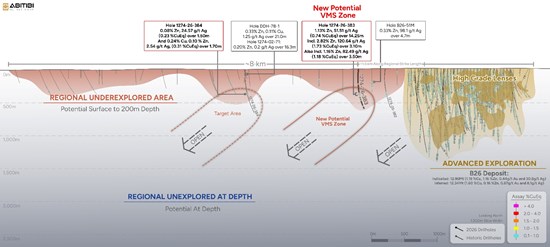
Figure 1. Longitudinal Section Looking North – 2026 Regional Drilling Results
To view an enhanced version of this graphic, please visit:
https://images.newsfilecorp.com/files/11775/307082_e7842059b46c8a92_001full.jpg
Jonathon Deluce, CEO of Abitibi Metals, commented: “We are highly encouraged by these initial regional exploration results at B26. This program marks a milestone for the Company, representing the first step in a systematic exploration strategy beyond the immediate brownfield footprint of the B26 Deposit. Hole 1274-26-383 confirms a zinc-silver system hosted in the same felsic volcanic package as the B26 Deposit, and we are increasingly seeing evidence that this is part of a broader cluster of mineralized systems, which we intend to keep testing. Given this setting, the potential for new lenses comes as no surprise, and these results support our conviction that we are at the early stages of building a world-class VMS camp. While expanding the B26 Deposit remains our primary objective, discoveries like this, returned from just 400 metres vertical depth, demonstrate our ability to create meaningful long-term value for our shareholders. This progress also reflects the strength of our exploration team, which is really starting to grow and come together, and its growing ability to add value across the Property.”
Table 1 – Mineral Intercepts from Regional Drilling
| Drill hole | From (m) | To (m) | Interval (m) | CuEq 2026 % | Cu (%) | Au (g/t) | Ag (g/t) | Zn (%) | CuEq Spot % |
| 1274-26-382 | 486.30 | 490.55 | 4.30 | 0.12 | 0.00 | 0.00 | 2.78 | 0.29 | 0.12 |
| Incl. | 486.30 | 486.75 | 0.50 | 0.52 | 0.01 | 0.00 | 3.80 | 1.49 | 0.45 |
| 1274-26-383 | 455.75 | 470.00 | 14.25 | 0.74 | 0.01 | 0.03 | 51.51 | 1.13 | 1.07 |
| Incl. | 456.65 | 459.75 | 3.10 | 1.73 | 0.00 | 0.01 | 120.64 | 2.82 | 2.48 |
| Incl. | 466.50 | 470.00 | 3.50 | 1.18 | 0.02 | 0.11 | 82.49 | 1.61 | 1.74 |
| 1274-26-383 | 468.00 | 470.00 | 2.00 | 1.53 | 0.02 | 0.11 | 106.10 | 2.18 | 2.23 |
| And | 537.30 | 538.40 | 1.10 | 0.70 | 0.55 | 0.03 | 16.80 | 0.03 | 0.84 |
| 1274-26-384 | 344.30 | 344.75 | 0.50 | 0.24 | 0.00 | 0.04 | 29.20 | 0.01 | 0.47 |
| And | 384.00 | 385.50 | 1.50 | 0.23 | 0.00 | 0.04 | 24.57 | 0.08 | 0.42 |
| And | 417.30 | 419.00 | 1.70 | 0.31 | 0.24 | 0.02 | 2.54 | 0.10 | 0.32 |
| 1274-26-385 | 462.00 | 470.85 | 8.85 | 0.47 | 0.02 | 0.11 | 21.21 | 0.68 | 0.62 |
| Incl. | 463.50 | 468.20 | 4.70 | 0.68 | 0.02 | 0.16 | 26.03 | 1.04 | 0.84 |
| And | 501.00 | 502.00 | 1.00 | 3.01 | 0.01 | 0.83 | 332.00 | 0.17 | 5.72 |
Note 1: The intercepts above are not necessarily representative of the true width of mineralization. Local interpretation indicates that the mineralized lens’ true width generally corresponds to 60% to 80% of core length.
Note 2: Copper equivalent (CuEq 2026) values are calculated using metal prices of US$4.50/lb Cu, US$1.50/lb Zn, US$28.00/oz Ag and US$3,000/oz Au, with recoveries per the SGS CACGS-P2017-047 metallurgical test: 98.3% Cu, 90.0% Au, 96.1% Zn, 72.1% Ag.
Note 3: Intervals are generally composited using a 0.1% Zn cut-off, allowing up to three consecutive samples below cut-off grade.
Note 4: CuEq Spot values are calculated using metal prices of US$5.60/lb Cu, US$1.50/lb Zn, US$75.00/oz Ag and US$4,650/oz Au, with the same recovery factors as Note 2.
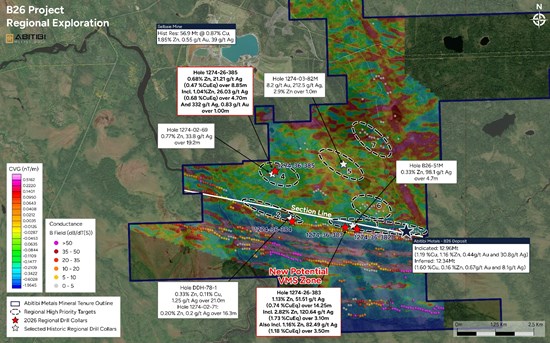
Figure 2. Plan Map of B26 Regional Exploration Targets
To view an enhanced version of this graphic, please visit:
https://images.newsfilecorp.com/files/11775/307082_e7842059b46c8a92_002full.jpg
Discussion of Results
The 2026 regional drilling program tested downdip extension of shallow historical zinc-silver anomalies at approximately 400 metres vertical depth across three of the Property’s seven identified priority targets (Figure 1). Only four drill holes have been completed to date, underscoring the early stage of this exploration effort on a property where historical drilling remains largely limited to the upper 200 metres, with no prior holes testing the system at 400 metres vertical depth outside of the B26 Deposit itself (Figure 2).
The most encouraging results were returned from Target 1 (Figure 1), which covers the western extension of the B26 stratigraphic horizon over approximately 1.5 kilometres west of the current deposit. This corridor exhibits the same subdued magnetic signature as the B26 Deposit and includes historical drill hole B26-51M, which intersected 0.33% Zn and 98.1 g/t Ag over 4.7 metres within a B26-style alteration system that was never followed up. Two holes tested this corridor, approximately 500 metres and 1,500 metres west of the deposit; the latter, hole 1274-26-383, intersected 1.13% Zn and 51.51 g/t Ag over 14.25 m starting at 455.75 m depth, including 2.82% Zn and 120.64 g/t Ag over 3.10 m and 1.61% Zn and 82.49 g/t Ag over 3.50 m. The Zn-Ag mineralization is hosted in pyritized, locally semi-massive felsic ash and lapilli tuffs affected by medium to strong sericite, silica and iron carbonate alteration, the same host-rock package and alteration style as the B26 deposit sequence, though here it is more intensely altered and moderately foliated, distinguishing this occurrence from B26 itself.
Approximately 70 metres farther downhole to the north, hole 1274-26-383 also intersected a separate copper-rich interval grading 0.55% Cu over 0.60 metres associated with chalcopyrite stringers and black chlorite alteration, the signature style of the Cu Stringer zone at B26. Although narrow, this copper occurrence reproduces the same metal zonation observed at B26, where the zinc-silver-rich horizon sits adjacent to the main copper-gold-rich horizon. This architecture strengthens the interpretation that Target 1 hosts a fertile VMS system analogous to, but distinct from, B26, a new mineralized lens that remains open in all directions.
Approximately 5 kilometres farther west, Target 2 tested a 1.5-kilometre-long VTEM conductor hosted within the same favourable felsic volcanic sequence as B26. Historical drilling returned broad polymetallic halos, including 0.33% Zn, 0.11% Cu and 1.25 g/t Ag over 21.0 metres, suggesting leakage from a larger mineralized system at depth. The 2026 drill hole confirmed the favourable geological setting at 400 metres vertical depth and will be followed by downhole Pulse EM surveying to evaluate potential off-hole conductors.
The fourth hole tested Target 4 located approximately 4.5 kilometres northwest of B26, where historical drilling outlined an open zinc-silver mineralized system associated with a strong IP anomaly, including 0.77% Zn and 33.8 g/t Ag over 19.2 metres. The hole intersected additional sulphide mineralization at 400 metres vertical depth, confirming the continuation of the system and providing another platform for follow-up Pulse EM surveys. It also returned a high-grade precious metals intercept of 332 g/t Ag and 0.83 g/t Au over 1.0 metre from 501 metres downhole, pointing to an added precious-metals component to the regional potential. This result will be evaluated alongside other historical high-grade intercepts on the Property, including hole 1274-03-82M, which returned 8.2 g/t Au, 212.5 g/t Ag and 2.9% Zn over 1.0 metre at Target 5 (Figure 1). Beyond these targets, several highly prospective areas remain untested, including additional precious metal targets north of B26 and newly defined Targets 5 – 7 (Figure 1), which outline a separate VMS corridor extending toward the former Selbaie Mine.
Overall, this program represents only an initial test of the Property’s regional potential (Figure 2). While Targets 2 and 4 confirmed the continuation of known mineralized systems at 400 metres vertical depth, hole 1274-26-383 stands out as the key exploration success, pointing to a mineralized lens west of the B26 Deposit that is geologically related to, yet distinct from, B26 itself. Combined with the Property’s limited historical drilling and numerous untested targets, these results reinforce the significant regional exploration upside of the B26 Property. A follow-up program is being designed for execution in winter 2027, when frozen ground conditions allow access to the drill sites.
Table 2 – Regional Drill Hole Information
| Hole ID | UTM East | UTM North | Elevation | Azimuth | Dip | Start (m) | End (m) |
| 1274-26-382 | 651453 | 5513200 | 271 | 350 | -60 | 0 | 813 |
| 1274-26-383 | 651047 | 5513241 | 269 | 350 | -60 | 0 | 835 |
| 1274-26-384 | 649329 | 5513597 | 265 | 0 | -70 | 0 | 813 |
| 1274-26-385 | 648750 | 5515157 | 265 | 355 | -67 | 0 | 824 |
Note 1: Numbers have been rounded to the nearest whole number in the table above.
Quality Control & Quality Assurance
Core logging and QA/QC protocols were run and supervised by the Company’s technical team. Drill core was split in half and sent to AGAT Laboratories Ltd., with sample preparation in Val-d’Or, fire assay in Thunder Bay and 4-acid digestion / multi-element analysis in Calgary. Prepared samples are fused using standard fire assay techniques, cupelled and parted in nitric and hydrochloric acid; sample splits of 30 g are routinely used, though 50 g may also be used (AGAT Code 202 551). A 0.2 g split of each prepared sample is digested in a series of acids (HClO4, HF, HCl and HNO3) at approximately 200°C to incipient dryness, then heated with HNO3 and HCl and diluted to 12 mL with de-ionized water. Because solubility can depend on the mineral species present, data reported from 4-acid digestion represent only the leachable portion of a given analyte; some elements (B, As, Hg) show poor recovery due to volatilization. Analyses are run on PerkinElmer 7300DV/8300DV and Agilent 5900 ICP-OES instruments, with Inter-Element Correction applied to correct for spectral interferences, and AAS instruments used where applicable. Blanks, replicates, duplicates and internal reference materials are routinely inserted as part of AGAT’s quality assurance program.
Qualified Person
Louis Gariépy, P.Eng. (OIQ #107538), VP Exploration of Abitibi Metals, is the Qualified Person, as defined by National Instrument 43-101 – Standards of Disclosure for Mineral Projects, for the B26 Polymetallic Property. He has reviewed and approved the scientific and technical information contained in this press release.
About Abitibi Metals Corp.
Abitibi Metals Corp. is dedicated to acquiring and exploring mineral properties within Quebec, with a particular emphasis on high-quality base and precious metal assets that offer significant potential for growth and expansion.
The company’s flagship B26 Polymetallic project hosts a substantial and growing resource base1:
- Indicated: 12.96Mt at 2.08% CuEq (1.19% Cu, 1.16% Zn, 0.44 g/t Au and 30.8 g/t Ag)1
- Inferred: 12.34Mt at 2.20% CuEq (1.60% Cu, 0.16% Zn, 0.68 g/t Au and 8.1 g/t Ag) 1
The B26 Project is strategically located just 7 km southeast of the formerly producing Selbaie Mine, providing access to key infrastructure for potential future mine development.
ON BEHALF OF THE BOARD
Jonathon Deluce, Chief Executive Officer
The Company also maintains an active presence on social media and encourages shareholders and interested parties to follow along for the latest news, industry insights and corporate announcements:
Twitter/X: https://twitter.com/AbitibiMetals
LinkedIn: https://www.linkedin.com/company/abitibi-metals-corp-amq-c/
Neither the Canadian Securities Exchange nor its Regulation Services Provider accepts responsibility for the adequacy or accuracy of this release.
¹ Technical Report NI 43-101 Resource Estimation Update Project B26, Quebec, For Abitibi Metals Corp., By SGS Canada Inc., Yann Camus, ing., Olivier Vadnais-Leblanc, géo., SGS Canada – Geostat., Effective Date: November 1, 2024, Date of Report: February 26, 2025.
Forward-looking statement:
This news release contains certain statements, which may constitute “forward-looking information” within the meaning of applicable securities laws. Forward-looking information involves statements that are not based on historical information but rather relate to future operations, strategies, financial results or other developments on the B26 Project or otherwise. Forward-looking information is necessarily based upon estimates and assumptions, which are inherently subject to significant business, economic and competitive uncertainties and contingencies, many of which are beyond the Company’s control and many of which, regarding future business decisions, are subject to change. These uncertainties and contingencies can affect actual results and could cause actual results to differ materially from those expressed in any forward-looking statements made by or on the Company’s behalf. Although Abitibi has attempted to identify important factors that could cause actual actions, events or results to differ materially from those described in forward-looking information, there may be other factors that cause actions, events or results to differ from those anticipated, estimated or intended. All factors should be considered carefully, and readers should not place undue reliance on Abitibi’s forward-looking information. Generally, forward-looking information can be identified by the use of forward-looking terminology such as “expects,” “estimates,” “anticipates,” or variations of such words and phrases (including negative and grammatical variations) or statements that certain actions, events or results “may,” “could,” “might” or “occur.” Mineral exploration and development are highly speculative and are characterized by a number of significant inherent risks, which may result in the inability of the Company to successfully develop current or proposed projects for commercial, technical, political, regulatory or financial reasons, or if successfully developed, may not remain economically viable for their mine life owing to any of the foregoing reasons, among others. There is no assurance that the Company will be successful in achieving commercial mineral production and the likelihood of success must be considered in light of the stage of operations.

To view the source version of this press release, please visit https://www.newsfilecorp.com/release/307082
Source: Abitibi Metals Corp.
© 2026 Newsfile Corp.