
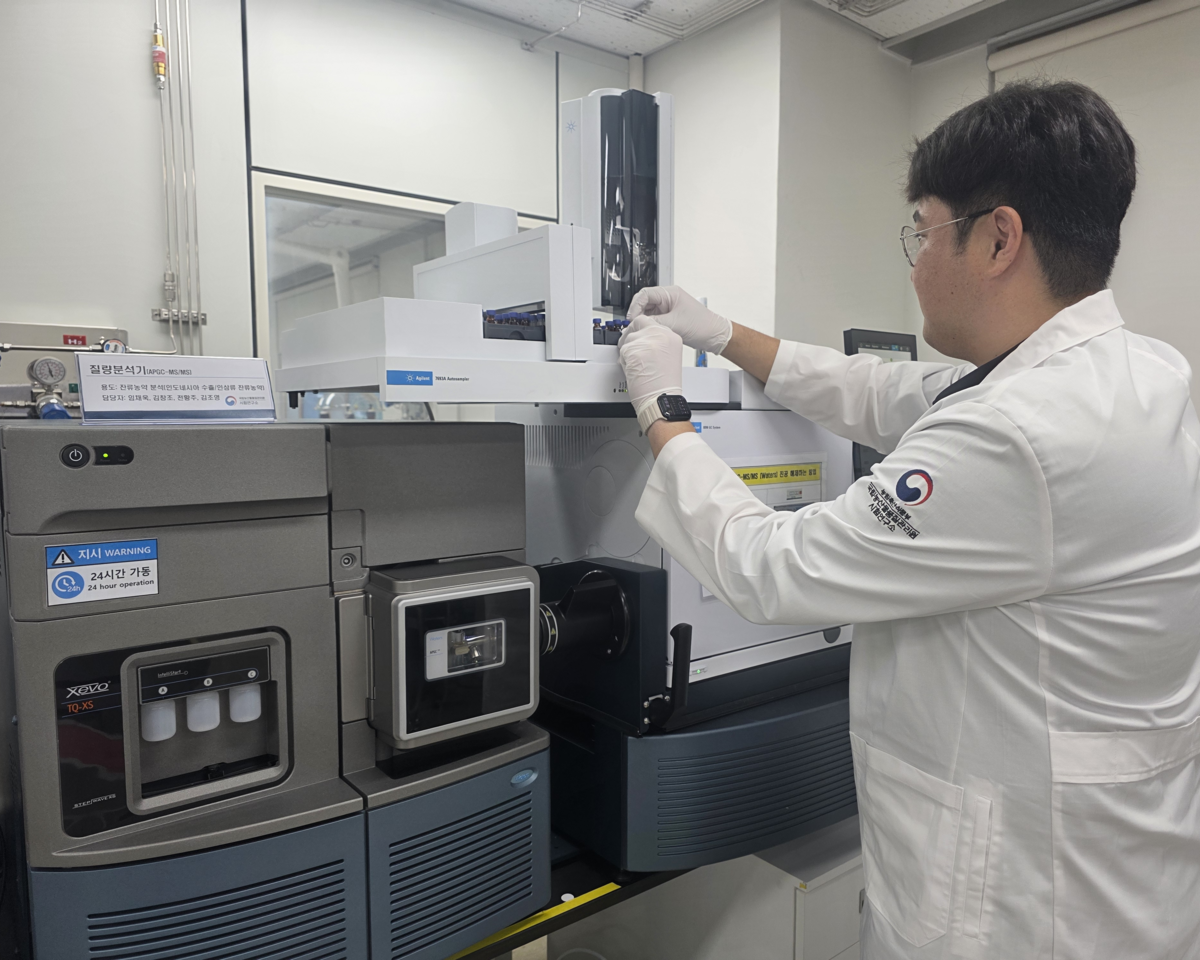
![A researcher at the National Agricultural Products Quality Management Service uses an atmospheric pressure gas chromatograph to test agricultural produce for pesticide residues. [National Agricultural Products Quality Management Service]](https://wimg.heraldcorp.com/news/cms/2026/08/24/news-p.v1.20260824.d71ef4a734a94a2d8f811eca3f5db838_P1.png)
The government is moving to verify whether the laboratories that test agricultural produce for pesticide residues, heavy metals and foodborne pathogens are actually detecting harmful substances accurately. The plan is to assess the analytical capabilities of 51 safety testing institutions across the country against international standards, strengthening public confidence in food safety test results.
The testing research institute of the National Agricultural Products Quality Management Service announced Monday that it will evaluate the hazardous-substance analysis capabilities of all 51 safety testing and certification institutions it designates and oversees nationwide, from Tuesday through October.
The assessment covers four areas: pesticide residues in agricultural produce, heavy metals in agricultural produce, pathogenic microorganisms, and heavy metals in soil. By category, 48 laboratories will participate in pesticide residue testing, 33 in agricultural heavy metals, seven in pathogenic microorganisms, and 26 in soil heavy metals. Because institutions may be accredited in more than one area, some will participate in multiple categories.
The agency will distribute evaluation samples Tuesday, then verify how accurately each institution analyzes the hazardous substances. These institutions carry out safety testing and certification for agricultural produce already in retail distribution or awaiting shipment. Their findings serve as the basis for safety measures such as delaying shipment or destroying produce that fails to meet standards.
The assessment follows a proficiency-testing methodology based on International Organization for Standardization (ISO) standards. The agency’s testing research institute has conducted the evaluation annually since 2015. An institution whose z-score for submitted analytical results falls within the statistically acceptable range — an absolute value of 2 or below (|z| ≤ 2) — is rated “satisfactory.”
Institutions that fall outside the acceptable range will not simply be assessed and left alone — the agency will follow up. It plans to identify the technical causes behind out-of-range results, provide support for improvement and take any necessary measures under applicable regulations. A training session to strengthen the skills of analysts at the institutions is also scheduled for October.
“Rigorous quality control of analytical institutions is an invisible safety net that allows the public to consume agricultural produce with confidence,” said Choi Su-a, head of the agency’s testing research institute. “We will continue to maintain an internationally recognized verification system to build trust in the results of agricultural safety analysis in Korea.”
adastra@heraldcorp.com
This content was produced with the assistance of AI translation services.