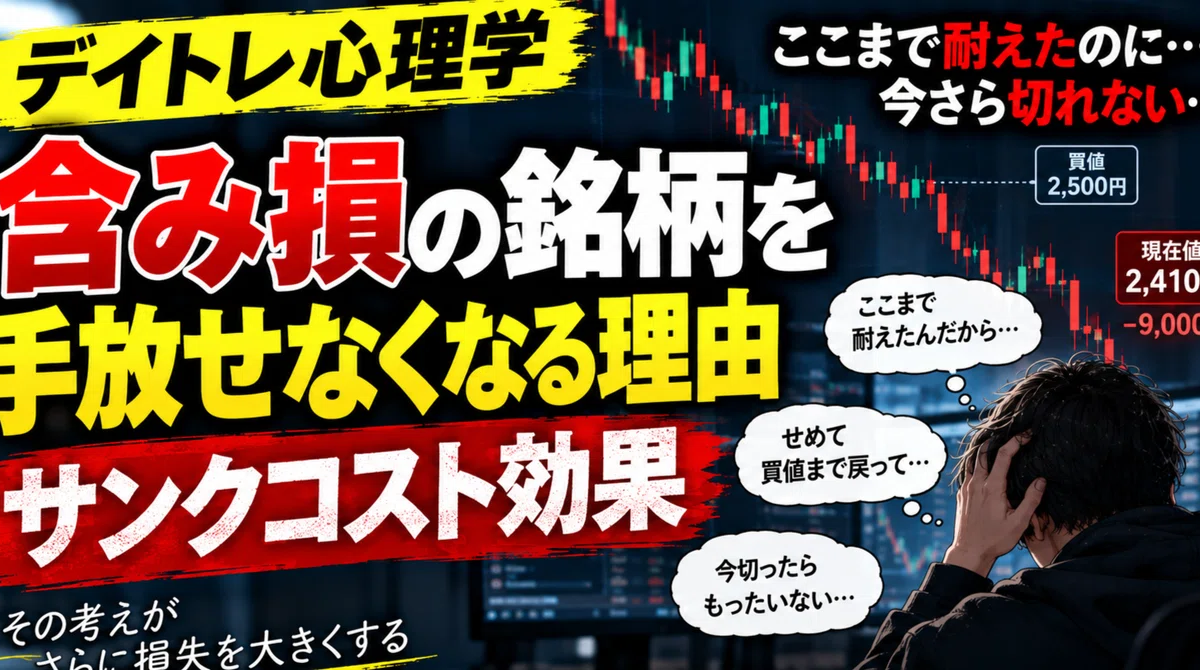
Have you ever had the experience of being unable to let go of a stock with an unrealized loss while day trading?
“I’ve endured this much, so I want to wait a little longer.”
“If I cut my losses now, the time I’ve spent waiting will have been wasted.”
“It’s dropped quite a bit, so it would be a waste to sell now.”
“I want to at least wait until it returns to near my buy price before I get out.”
Even though it started as a small unrealized loss, it becomes harder to cut losses as time passes.
Strangely, even though the loss has grown, your attachment to the position can sometimes become even stronger.
To understand this type of behavior, it is helpful to know about the “sunk cost effect.”
In this article, I will explain what the sunk cost effect is, why you might find it harder to let go of stocks with larger unrealized losses, and how you should deal with it in day trading.
What is a sunk cost?
A sunk cost is a cost that has already been paid and cannot be recovered regardless of current decisions.
In Japanese, it is called “maibotsu hiyou” (buried cost).
For example, suppose you are watching a movie at a theater.
You paid 2,000 yen for the ticket.
However, about 30 minutes after the movie starts,
“This isn’t interesting to me at all.”
you feel.
Normally, if you want to use the remaining time for something else, you are free to leave the theater.
However,
You might think, “I paid 2,000 yen for this, so it would be a waste not to watch it until the end.”
The important thing here is that whether you watch the movie to the end or leave halfway through, the 2,000 yen you paid will not come back.
You are letting the 2,000 yen that you can no longer recover dictate how you spend your subsequent time.
This is an easy-to-understand example of a decision influenced by sunk costs.
The same thing happens in day trading.
Let’s apply this to day trading.
You bought a stock for 2,500 yen.
However, contrary to your expectations, it dropped to 2,480 yen.
At this point,
“It’s not what I expected, so I’ll withdraw.”
If you can make that decision, the trade ends there.
However,
“Let’s wait a little longer.”
Suppose you continue to hold it.
2,470 yen.
2,460 yen.
2,450 yen.
Once it gets to this point,
“I’ve endured this much, so it would be a waste to cut my losses now.”
You might think.
Sometimes, this feeling arises.
However, the fact that you have endured this long is not a basis for the stock price to rise afterward.
It will go up because I waited 10 minutes.
It will go up because I waited 30 minutes.
It will rebound because I have a 5,000 yen unrealized loss.
There is no such mechanism.
Even so, the desire not to waste the time you have already spent or the losses you have already incurred can make it difficult to let go of a position.
The fact that it has dropped this much is not a reason to buy
When an unrealized loss grows, a common thought that emerges is,
“It has dropped this much, so it should return soon.”
This is the mindset.
However,
“It has dropped 100 yen since I bought it”
is a fact, and
“It will go up from here”
is a separate matter.
A stock that has fallen from 2,500 yen to 2,400 yen may return to 2,500 yen later.
Conversely, it may fall further to 2,300 yen or 2,200 yen.
What is important is
“how much it has fallen”
not only that, but
is “Is there a reason to buy that stock right now?”
.
What is the index doing?
What is its position relative to the VWAP?
What is the volume like?
What does the 5-minute chart look like?
What does the daily chart look like?
Is capital flowing into the sector?
Does the original reason for entry still hold?
You need to look at this current information.
The more time you spend on a trade, the harder it is to let go
In day trading, not just money, but “time” can also become a sunk cost.
Entered at 9:05 AM.
9:10 AM, still holding a loss.
9:20 AM, still hasn’t recovered.
9:30 AM, it recovered a little but then fell again.
Even at 10:00 AM, still holding a loss.
When this happens,
“I’ve been watching this stock for an hour, so I want to make a profit somehow”
You may find yourself feeling this way.
However, the fact that you have monitored it for an hour is not a reason for the stock price to rise from here on.
In fact, there is a possibility that an opportunity occurred in another strong stock during that hour.
By letting your focus be stolen by a stock with an unrealized loss, you end up missing out on new opportunities.
This is also a point to keep in mind for day trading.
Sunk costs can also influence averaging down
The danger of the sunk cost effect is not just in holding onto a position.
It can sometimes lead to averaging down.
Buy 100 shares at 2,500 yen.
It drops to 2,480 yen.
“It’s cheap now that it’s dropped this far.”
Buy another 100 shares.
It drops to 2,450 yen.
“If I lower my average acquisition cost, it will be easier to get out when it recovers.”
Buy even more.
As the position grows like this,
“I’ve bought this much, so I don’t want to lose.”
The feeling of this may become stronger.
Of course, planned entries where you decide the price and number of shares in advance are different from averaging down done because you don’t want to admit to an unrealized loss.
I also sometimes enter positions in multiple stages.
However, that is something you do after thinking about where and how many shares to buy from the start.
“I’m in trouble because it went down, so I’ll add more”
is a different meaning.
The important thing is to distinguish whether the reason for buying more is based on your “original plan” or “the emotion of not wanting to admit a loss.”
The purchase price is irrelevant to the market
Suppose you bought at 2,500 yen.
When you have an unrealized loss,
“I hope it goes back to 2,500 yen”
is what you end up thinking.
However, from the perspective of market participants, the fact that you bought at 2,500 yen is irrelevant.
In the market,
there are people who bought at 2,450 yen.
People who bought at 2,400 yen.
People who have held it from even lower prices.
People who are short selling.
People who are thinking of buying now.
There are various participants.
The “purchase price” that is important to you is not a special price for the market.
Therefore,
“Will it return to the purchase price?”
Instead of that,
you need to look at “Is this stock strong based on the current share price?”
you need to look at that.
Once you hold a position, it is easy to feel that “withdrawing equals failure”
One of the reasons why the sunk cost effect becomes stronger is
the feeling that “if I withdraw here, it means all my previous decisions were wrong.”
that is the feeling.
However, I believe that the fact that the entry was wrong and the decision to withdraw are separate things.
The conditions were good at the time of entry.
After that, the situation changed.
The index collapsed.
It fell below the VWAP.
The trading volume disappeared.
The strength of the individual stock vanished.
In that case, withdraw.
This is not denying your initial decision.
You are just updating your judgment based on new information.
The market is always moving.
There is no need to stick with your initial decision until the end.
“If I didn’t have it right now, would I buy it?”
There is a way of thinking that I find very easy to understand as a countermeasure against sunk costs.
When you have an unrealized loss,
“If I didn’t own any shares of this stock right now, would I buy it at this price?”
This is a method of thinking.
If the answer is,
“I wouldn’t buy it”
then,
why are you still holding it?
Because you want it to return to your purchase price.
Because you’ve endured this much.
Because you don’t want to take a loss.
Because it’s already a large unrealized loss.
If these are the only reasons left, you may be bound by your past actions rather than the current market.
Conversely,
“Even if I didn’t own it now, I would want to buy it at this level”
If you can think that way, there may still be a basis for holding it.
By asking this question, it becomes easier to shift your perspective back to the “now” instead of the past.
Rethink if the reason for entry has disappeared
Regarding stop-losses, I don’t just think about the amount of money, but rather,
“Why did I enter the trade?”
I place importance on.
Because the index was strong.
Because the daily chart looked good.
Because it was above the VWAP.
Because the trading volume was high.
Because it pulled back to the level I was targeting on the 5-minute chart.
Because the sector was strong.
If you bought for these reasons, check if those reasons still hold true.
For example, you bought because of its correlation with the index, but the index has clearly turned downward.
The individual stock has also fallen below the VWAP and cannot recover.
Trading volume is also decreasing.
Even so,
“Because I’ve held it this long”
If you hold onto it for that reason alone, it has become something different from your initial trade.
It is important to judge based on the current situation, not on how much time or money you have spent in the past.
The reason for using a breakeven exit
I also use a breakeven exit as a rule.
After buying,
“It’s not as strong as I thought”
“The index has become questionable”
I sometimes feel that
the individual stock is not keeping up with the index
or that buying momentum is not continuing.
At such times,
I do not think,
I’ll wait until it becomes profitable since I went through the trouble of entering.
If it returns to near my buy price, I may exit there.
It is not a failure just because I didn’t make a profit.
If I was able to close a position that I felt was dangerous without a loss, that is also a result.
I believe it is important not to be bound by the thought that I went through the trouble of entering.
It is okay if the price goes up after cutting losses
One of the reasons that makes cutting losses difficult
is the feeling that
I would hate it if it went up right after I sold.
In reality, stock prices do sometimes rise immediately after cutting losses.
However, that alone does not mean the stop-loss was a mistake.
If it met your exit criteria at that point, you simply acted according to your rules.
Subsequent price movements are a separate matter.
If the conditions improve again after you have cut your losses, you have the option to enter again.
It is not the case that you can never buy it again once you have sold.
That is precisely why
there is no need to think, “If I cut it now, the time I spent enduring this will be wasted.”
You can reset your position and look at the market again with a flat perspective.
Think about the “future,” not the past.
I believe the most important countermeasure for the sunk cost effect is to change the time horizon when making decisions.
“How much have I lost so far?”
“How many minutes have I waited?”
“How many times have I added to the position?”
“How much have I researched this stock?”
These are all pieces of information from the past.
Instead, think about
“Is there a basis for it to go up from here?”
“Is there value in holding this position from this point on?”
Think about these things.
To put it extremely,
even if you have only held it for one minute, if the basis for the trade has collapsed, you should withdraw.
Even if you have held it for an hour, do not continue to hold it for that reason.
Think about future price movements, not the time you have spent in the past.
I believe that even just doing this will change how you view trading.
This is the end of the text.
Summary | “I’ve endured this much” is not a reason to hold
Understanding the sunk cost effect makes it a little easier to see the psychology behind why you can’t let go of stocks with unrealized losses.
“Because I’ve endured this much”
“Because it has dropped quite a bit”
“Because if I cut it now, everything up to this point will have been for nothing”
“Because I want it to at least return to my buy price”
However, these are all matters on your side.
The market does not know how many minutes you have waited, nor does it know how much unrealized loss you are holding.
That is why I believe it is important to look at:
“Is there a reason to hold this position now?”
instead of:
“How much have I spent in the past?”
I believe this is important.
If you are hesitant, try thinking:
“Would I buy this stock right now if I didn’t already own it?”
And then check the index, daily chart, VWAP, 5-minute chart, volume, sector, and so on once more.
If the rationale remains, make your decision based on that rationale.
If the rationale is gone, do not continue holding it just because you have “endured this much.”
What is important in day trading is not justifying your past decisions.
What is important is making the best decision for the present moment.
Look at the current market and make your next decision.
Do not be bound by sunk costs; if necessary, withdraw once and return to a neutral state.
I believe that flexibility is also a necessary skill for long-term success in day trading.
For those who want to learn more about day trading
On YouTube, I hold a day trading LIVE stream every morning from 8:30.
While watching the actual market, I explain indices like the Nikkei 225, as well as decisions on entries, profit-taking, and withdrawals in real-time.
▶ Click here for YouTube
[YouTube Link]
For those who want to learn in more detail
In YouTube membership, I release content that cannot be fully covered in regular videos or LIVE streams through exclusive videos.
Past videos and LIVE streams are also moved to members-only access after a certain period has passed since their release.
▶ Click here for membership details
[Membership Link]
For those who want to practice day trading with a game
I believe that day trading is not just about memorizing knowledge, but also about repeating decisions such as “buy, sell, wait, or withdraw” while watching the market.
Therefore, I have released a day trading game where you can practice the concepts I prioritize in my actual trading, such as indices, market sentiment, and supply and demand, in a game format.
▶ Click here for the day trading game
[Link to game sales note]
https://note.com/nihonnkaburabo/n/nc925792b480d
I also update day trading articles on note
I write articles about day trading techniques, mindsets, trading psychology, and points I am conscious of in the actual market.
If you find the articles helpful, please follow me on note as well.
*This article is provided for the purpose of learning knowledge and ways of thinking related to investment, and does not recommend the buying or selling of specific stocks or financial products. Investment carries the risk of loss, including the loss of principal. Please make actual investment decisions based on your own judgment and responsibility.