
In day trading, choosing the right stock is extremely important.
One of the things you want to check is the “price range”.
Even for stocks with the same share price of 3,000 yen,
a stock that only moves 50 yen in a day
and
a stock that moves 300 yen in a day
make a big difference in how easy it is to day trade.
If the price movement is too small, the range in which you can aim for profit also becomes small.
On the other hand, if the price movement is large, opportunities increase, but the potential for loss also increases accordingly.
This time, I will explain
-
what price range is
-
why we look at price range in day trading
-
the difference between stocks that move and stocks that don’t
-
the reason why you shouldn’t compare price ranges based on share price alone
-
points to note for stocks with too large a price range
-
the relationship between market conditions and price range
.
What is price range?
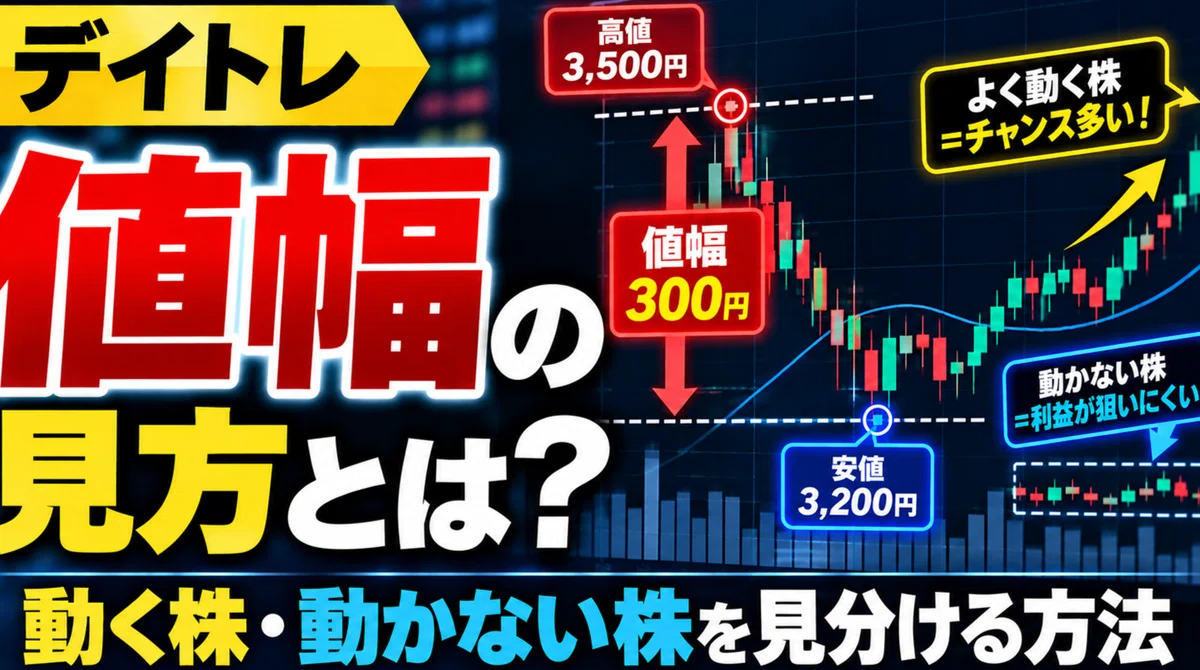
Simply put, price range represents how much a stock price has moved.
For example, if a stock, within a single day, has a
high of 3,300 yen and a
low of 3,000 yen
…
the price range is 300 yen
.
On the other hand, if it has a
high of 3,050 yen and a
low of 3,000 yen
,
the price range is 50 yen
.
Even for stocks with a similar share price around 3,000 yen, there is a significant difference in price movement.
In day trading, it is important to know “how much a stock moves.”
Why is the price range important in day trading?
Day trading basically aims to profit from the price movements of the day.
Therefore, if the share price hardly moves in the first place, the potential profit range becomes small.
For example, if a 3,000 yen stock is just moving like this:
3,000 yen
→
3,010 yen
→
2,995 yen
→
3,005 yen
it becomes difficult to aim for a large price range.
On the other hand, if it moves like this:
3,000 yen
→
3,100 yen
→
3,050 yen
→
3,200 yen
If it moves, there will be more opportunities to target in day trading.
However, that does not mean
the larger the price range, the better.
that is the case.
This is important.
Is it easier to make a profit with stocks that have a large price range?
If the price range is large, theoretically, there is a possibility of aiming for a large profit.
However, at the same time, the loss when it moves in the opposite direction also becomes larger.
For example,
a stock that moves about 5 yen in 1 minute
and
a stock that moves 100 yen in 1 minute
have completely different risks, even with the same 100 shares.
When holding 100 shares,
5 yen move against you
→ -500 yen
100 yen move against you
→ -10,000 yen
is the result.
In other words, the purpose of looking at the price range is
not to find the stock that moves the most.
For your own day trading style or lot size,
It is important to find stocks that have a moderate amount of price movement.
Do not compare price ranges based on stock price alone
When looking at price ranges, what you want to be careful about is the difference in stock prices.
For example,
Stock A
Stock price 1,000 yen
Daily price range 100 yen
Stock B
Stock price 10,000 yen
Daily price range 200 yen
Let’s assume this is the case.
If you only look at the price range,
Stock B’s 200 yen is larger
is the result.
However, when looking at it as a percentage of the stock price,
Stock A
100 yen ÷ 1,000 yen = 10%
Stock B
200 yen ÷ 10,000 yen = 2%
is the result.
In reality, Stock A is moving more.
Therefore, when comparing stocks,
it becomes easier to understand if you check not only the price range amount, but also what percentage it is moving relative to the stock price
as well.
Looking at the day’s price range from the high and low prices
The simplest way is
high – low
to look at.
For example,
opening price 3,100 yen
high 3,300 yen
low 3,000 yen
closing price 3,250 yen
if so,
3,300 yen – 3,000 yen = 300 yen
is.
Since the stock price moved 300 yen around 3,000 yen, you can see that the price movement was quite large that day.
However, with this alone,
whether it is a stock that usually moves 300 yen
or whether it moved 300 yen only today
is unknown.
Therefore, check the price range of the past few days as well.
Compare the usual price range with today’s price range
In day trading, there is a method of focusing on stocks whose price movement is larger than usual.
For example, in the past few days,
100 yen
120 yen
90 yen
110 yen
a stock that only moved about
has already moved 250 yen by 10:00 AM today.
In this case,
the price movement is larger than usual today
can be understood.
The background may include
financial results,
earnings revisions,
new products,
large orders,
thematic materials,
industry news,
and so on.
When market participants increase due to news, both trading volume and price range can increase simultaneously.
Looking at trading volume and price range together
When looking at the price range, you also want to check the trading volume.
For example,
expanded price range
+ surge in trading volume
suggests that many market participants may be trading.
On the other hand,
only the price range is large
+ very low trading volume
in a stock may indicate cases where the stock price is prone to jumping due to few orders.
For such stocks,
not being able to buy at the desired price,
not being able to sell at the desired price
can also occur.
In day trading, do not just look at the price range, but
price range + trading volume + liquidity
It is important to look at.
Be careful with stocks with too large a price range
When looking at stocks that are moving significantly,
you may feel that
there are many opportunities.
However, you need to be careful with stocks that have too large a price range.
Especially with stocks that are soaring or plummeting,
3,000 yen
↓
3,100 yen
↓
2,950 yen
↓
3,150 yen
they may fluctuate significantly in a short period of time like this.
With such stocks,
the price you intended to use for a stop-loss may be passed in an instant
as well.
The larger the price range, the more important lot management becomes.
Consider lot size according to the price range
This is extremely important.
Just because you usually trade 100 shares does not mean you need to trade 100 shares for every stock.
For example,
Stock A
Usually has small price movements
Stock B
Usually has very large price movements
If so, the risk is different even with the same 100 shares.
For stocks with a large price range,
there is a concept of reducing your lot size
accordingly.
Conversely, just because the price range is small, there is no need to force yourself to increase your lot size.
What is important is
to consider the price range and lot size as a set
.
Price range changes depending on market conditions
Even for the same stock, it does not move with the same price range every day.
On days when the Nikkei Stock Average barely moves, the price movement of individual stocks can also become smaller.
On the other hand,
a major drop in the Nikkei Stock Average
a sudden change in Nikkei 225 futures
a major fluctuation in US stocks
and other days when the entire market moves significantly, the price range of individual stocks may also expand.
I prioritize market conditions in day trading, and when looking at price ranges, I also
check ‘how much the entire market is moving today’
.
Do not force trades when the price range becomes small
Even for stocks that moved significantly in the morning, the price movement may become smaller as time passes.
For example,
in the 9 o’clock hour
it moves significantly up and down
Around 10 AM
it calms down a little
Before 11 AM
it hardly moves
is such a case.
Just because the price range was large in the morning does not mean it will continue to move the same way afterward.
Even if the price movement has stopped,
“because it was moving in the morning”
there is no need to continue trading just for that reason.
It is important to judge by looking at the current price movement.
3 points to consider when looking at price range in day trading
1. Look at the price range relative to the stock price
Do not just look at the number of 100 yen movement, but also check what percentage it is moving relative to the stock price.
2. Check volume and liquidity as well
Be careful with stocks that have a large price range but low trading volume.
3. Adjust lot size according to the price range
Stocks that move significantly have the potential for larger losses.
Think of price range and risk as a set.
Summary
Price range represents how much a stock price has moved.
In day trading, since you aim for profit from the day’s price movements,
“how much that stock moves”
It is important to understand.
However,
a large price range does not necessarily mean it is easy to day trade
.
What is important is to
think about combining price range
+ trading volume
+ liquidity
+ market conditions
+ lot size
.
While stocks that move significantly offer great opportunities, if they move in the opposite direction, the losses will also be significant.
Choosing stocks with price movements that you are comfortable handling is also an important concept in selecting stocks for day trading.
For those who want to learn more about day trading
On YouTube, I conduct a day trading LIVE stream every morning from 8:30.
While watching the actual market, I explain indices such as the Nikkei 225, as well as decisions on entry, profit-taking, and exiting in real time.
▶ Click here for YouTube
[YouTube Link]
For those who want to learn in more detail
In YouTube membership, I release content that cannot be fully conveyed in regular videos or LIVE streams through exclusive videos and more.
Regarding past videos and LIVE streams, those that have passed a certain period since publication are changed to members-only as needed.
▶ Click here for membership details
[Membership Link]
For those who want to practice day trading with a game
I believe that day trading is not just about memorizing knowledge, but also about repeating judgments such as “buy, sell, wait, and withdraw” while watching the market.
Therefore, I have released a day trading game where you can practice the concepts of indices, market conditions, and supply and demand that I value in actual trading in a game format.
▶ Click here for the day trading game
[Link to game sales note]
I am also updating day trading articles on note
I write articles about day trading methods and concepts, trading psychology, and points I am conscious of in the actual market.
If you find the articles helpful, please follow me on note as well.
※ This article is provided for the purpose of learning knowledge and concepts related to investment, and does not recommend the buying or selling of specific stocks or financial products. Investment carries the risk of loss, including the loss of principal. Please make actual investment decisions based on your own judgment and responsibility.