Do you want to add a large-cap passive scheme to your mutual fund portfolio but are unsure whether a Nifty 50 Equal Weight Index Fund is the right choice?
Unlike a regular Nifty 50 index fund, an equal-weight fund gives all 50 stocks a similar weight, reducing the portfolio’s dependence on the largest companies.
With all the Nifty 50 and equal-weight index funds in the red over the last 1 year, investors may be wondering whether to invest now or wait. This makes it important to understand when an equal-weight strategy could work better within the large-cap segment.
DSP Mutual Fund, in a report titled “How to take advantage of Polarization & Depolarization?”, has suggested a framework investors can use to identify when the Nifty 50 Equal Weight Index Fund could benefit from a change in market leadership.
What is the polarisation and depolarisation cycle?
According to DSP, the Nifty 50 is market-cap weighted, with the top 10 stocks accounting for around 50–60% of the index. When these top stocks outperform the remaining 40 stocks, this is described as polarisation.
A depolarisation phase, on the other hand, occurs when the broader set of Nifty 50 stocks performs better than the top 10, resulting in a more broad-based rally.
“Polarization & Depolarization is cyclical in nature and are witnessed in phases. Phase of polarization is generally followed by phase of depolarization,” the report noted.
For an investor, the distinction matters because a Nifty 50 Equal Weight Index Fund is designed to provide more balanced exposure across the 50 stocks rather than concentrating heavily in the largest companies.
What does DSP suggest about the Nifty 50 Equal Weight Index Fund?
DSP suggested that investors can use these cycles to decide between a Nifty Top 10 Equal Weight Index Fund/ETF and a Nifty 50 Equal Weight Index Fund/ETF.
During a polarization phase, DSP suggested buying a Nifty Top 10 Equal Weight Index Fund or ETF. During a depolarization phase, it suggested buying a Nifty 50 Equal Weight Index Fund or ETF.
The Nifty Top 10 Equal Weight Index comprises the 10 largest Nifty 50 stocks by market capitalisation, with each stock assigned an equal weight. In contrast, the Nifty 50 Equal Weight Index gives an equal weight to all 50 stocks in the index.
What indicator should investors watch?
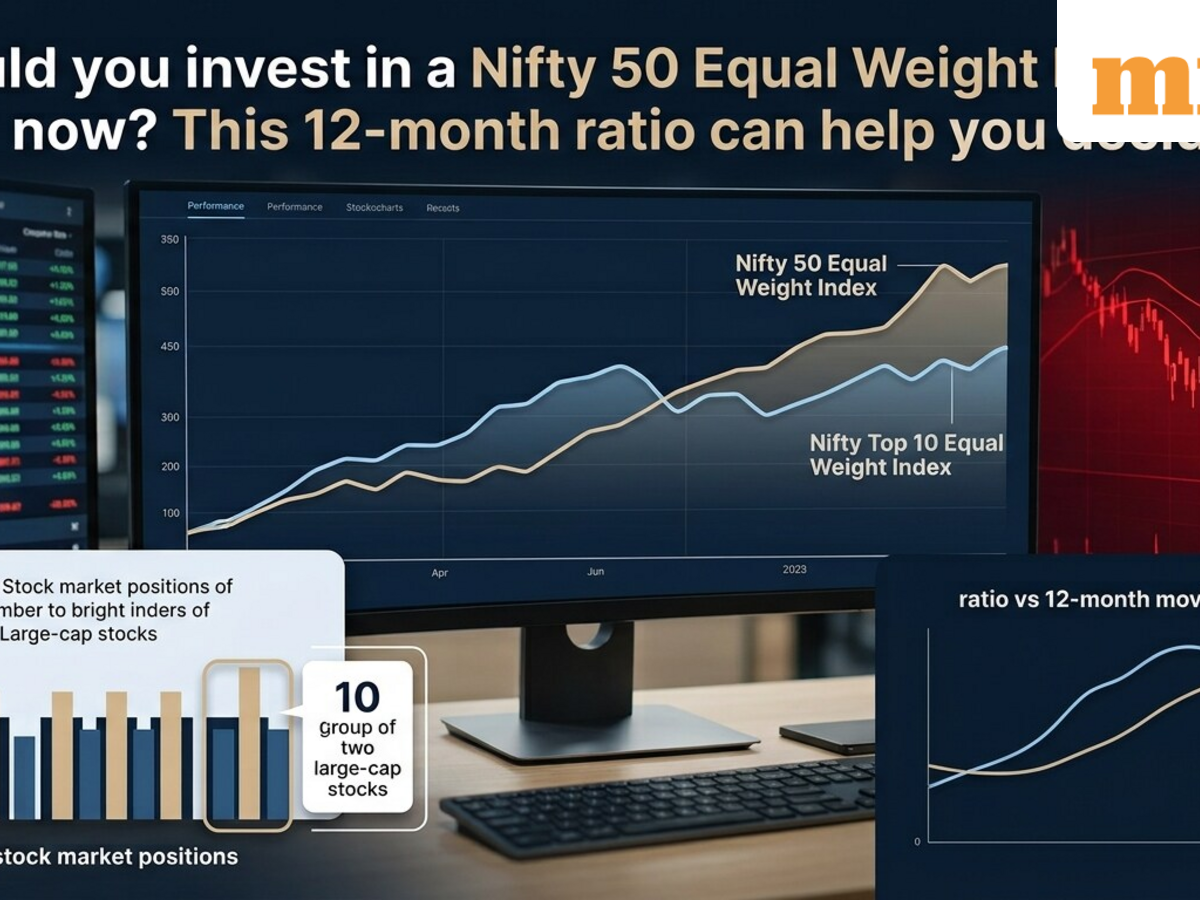
The fund house said investors can track the ratio of the Nifty Top 10 Equal Weight Index to the Nifty 50 Equal Weight Index.
Divide the current level of the Nifty Top 10 Equal Weight Index by the current level of the Nifty 50 Equal Weight Index. The ratio is then compared with its average level over the past 12 months.
When this ratio is above its 12-month moving average, it indicates that the Nifty Top 10 Equal Weight Index has started outperforming, signalling polarization. For mutual fund investors, this means considering a Nifty Top 10 Equal Weight Index Fund and avoiding the Nifty 50 Equal Weight Index Fund.
When the ratio is below its 12-month moving average, DSP suggested investing in the Nifty 50 Equal Weight Index Fund to participate in the depolarization phase.
Where should you currently invest?
DSP said its model has remained invested in the Nifty 50 Equal Weight Index since November 2025.
“The indicator remains below its 12-month moving average, signaling that the depolarization phase is still intact,” DSP highlighted. This means the broader 40 stocks are currently outperforming the top 10 stocks in the index.
For mutual fund investors, this suggests that a Nifty 50 Equal Weight Index Fund may be suitable for the current phase, instead of making a decision based solely on its recent one-year performance.
Disclaimer: This is purely for educational/informational purposes and should not be taken as any sort of investment advice. Always consult a SEBI-registered advisor before making any investment decisions.