Last updated: October 4, 2026 (Reflects information published by the Ministry of Finance up to the September 2026 offering)
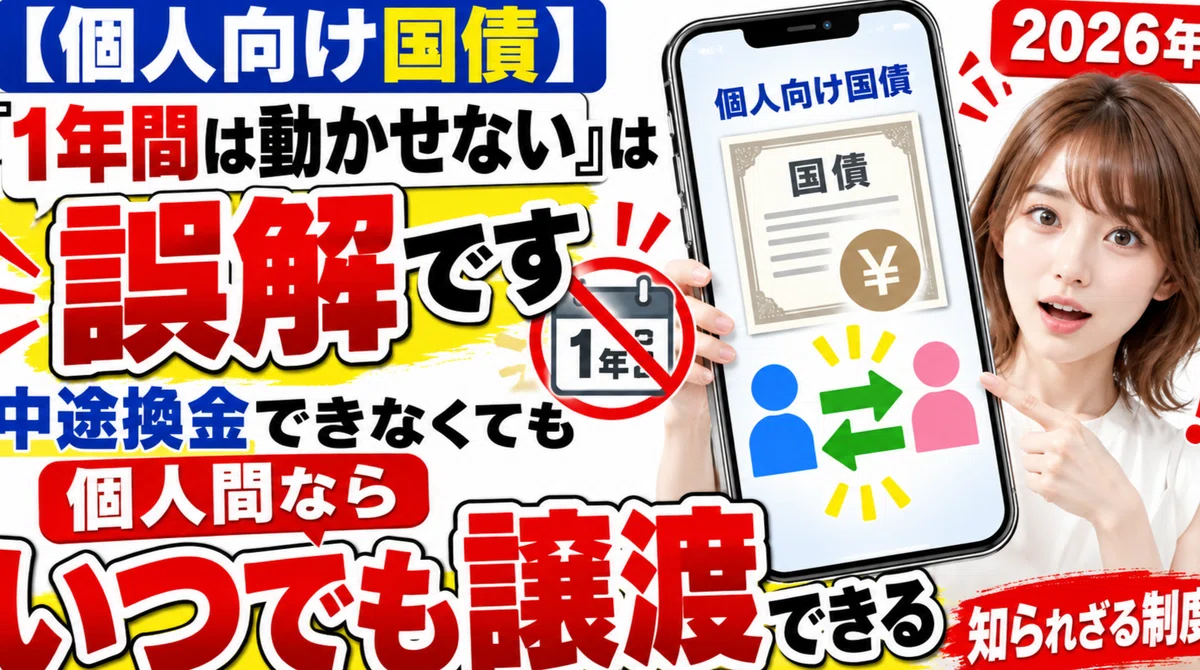
“I bought these only six months ago. I suddenly need a lump sum of money, but the counter told me, ‘You cannot redeem them for one year.'”
This is the moment that makes holders of individual government bonds turn pale.
However, if you give up here thinking, “I can’t move them anymore,” you might suffer a loss you don’t need to take. There is a little-known sentence in the official Ministry of Finance Q&A.
Ministry of Finance “Frequently Asked Questions about Individual Government Bonds”: You can transfer them at any time if it is between individuals.
In other words, “You cannot move them for one year” is only half true and half a misunderstanding. This article will break down the following three points in order.
-
The precise line between “what you cannot do” and “what you can do”
-
Realistic options when you need money within one year
-
Pitfalls that lead to gift tax, seizure, or fraud victimization if you do it the wrong way
By the time you finish reading, you should have a clear map of “how you can move your government bonds in an emergency.” Note that this article is based on information published by the Ministry of Finance as of October 2026.
Conclusion: The only thing you cannot do is “redeem to the government.” “Transfer to an individual” can be done at any time.
First, let’s summarize the overall picture in a table. Reading just this part will reveal the nature of the misunderstanding.
Note taxes and procedures. Inheritance is possible. Transfer to the heir’s account is also possible.

The point is that “redemption” and “transfer” are completely different systems.
Early redemption means having the government buy them back at face value. Transfer means changing the owner of the government bond property to another individual. The former has a one-year lock, while the latter does not.
However, please be calm about one thing here. Even if you transfer them, money does not come out from the government.You only get cash if the person receiving the transfer pays you for it. If you misunderstand this one point, you will end up at the entrance to the taxes and troubles explained in the second half.
30-second review: The 3 types of individual government bonds
Before we get into the topic of transfers, let’s confirm the foundation. If you already know this, feel free to skip it.
All three types are issued monthly starting from a minimum of 10,000 yen in 10,000-yen increments, with interest paid twice a year. The interest rate has a floor of 0.05% per annum, and even during early redemption, they are bought back at 100 yen per 100 yen of face value. This peace of mind that the principal will not be lost is paired with the rule that early redemption is prohibited for one year after issuance.
Why do people assume they cannot move them for one year?
The reason is simple. What is written in large print in pamphlets and explanatory documents is only the “early redemption prohibition period.” Regarding transfers, it is only quietly listed in the “Other” section of the Q&A.
Moreover, if you ask at the counter, “Can I redeem this?”, the answer you get is only about redemption. You will not be told what you did not ask.
The starting point of the “one year” is the issue date, not the purchase date
Another oversight is the starting point. You can perform early redemption “on or after the second interest payment date (one year after issuance).” It is not the date you applied. Individual government bonds are issued on the 15th of the month following the application month (or the next business day if it is a holiday). For example, the issue date for the October 2026 offering (October 8th to 30th) is November 16th. Counting from the application date, there is a gap of half a month to over a month. Be sure to check the issue date for each series you hold.
Even if you transfer them, the “one-year lock” follows the government bonds
Whether or not early redemption is possible is determined by the issue date of the bond itself, not the owner. Therefore, the person who receives them cannot perform early redemption until one year has passed since issuance. Please keep in mind that this is not a loophole for “transferring to a family member and redeeming immediately.”
Four options when you need money within one year
So, when you are actually in trouble, in what order should you think? I will list them in order of smallest loss.
1. Check if you qualify for special exceptions
If the holder passes away or suffers damage from a large-scale natural disaster to which the Disaster Relief Act is applied, early redemption is possible even within one year. If you think you qualify, first check the required documents with your financial institution. You will need documents proving that you are an heir or that you were affected by the disaster, and the calculation method for the adjustment amount to be deducted is different from standard early redemption.
2. Perform early redemption only for series that have passed the one-year mark
For those who have purchased in multiple installments, you can redeem from the oldest series in 10,000-yen increments. The cost is “the amount equivalent to the interest for the two most recent periods (before tax) × 0.79685”.
For example, with a fixed-rate bond of 1 million yen face value at 1.0% per year, the interest for six months is 5,000 yen. With two periods totaling 10,000 yen multiplied by 0.79685, approximately 7,968 yen will be deducted. Since this is essentially returning the net interest received, the principal remains intact.
3. Transferring to a family member or others for “consideration”
This is an option when you only have government bonds held for less than a year. For example, a husband transfers 1 million yen worth of bonds in his name to his wife, and the wife pays 1 million yen. The husband receives cash, and the wife receives the government bonds and subsequent interest.
-
Inform the handling financial institution that you “wish to transfer between individuals” and confirm whether it is possible, as well as the necessary documents and fees
-
Prepare a book-entry account for government bonds for the recipient
-
Submit the prescribed transfer request form and other documents
-
Pay the consideration via bank transfer rather than cash in hand, and keep a record
-
Create two copies of a simple memorandum stating the date, amount, and issue number, and have both parties keep one
The Ministry of Finance also notes that procedures may vary depending on the financial institution. A single phone call in advance will prevent extra work later.
4. Bridging temporarily with other funds
Consider whether you can bridge the remaining few months with funds other than government bonds, such as by canceling a time deposit. Before jumping into high-interest borrowing, be sure to compare the total costs.
Mastering transfers: Situations where it pays off and common traits of those who fail
After one year has passed, which is more profitable: transfer or early redemption?
Although it is surprisingly little known, there are situations where a “transfer” is more advantageous for the household budget as a whole, even for government bonds held for more than a year.
-
Early redemption: The other party is not needed and the procedure is simple. However, an early redemption adjustment amount is deducted, and you will no longer receive subsequent interest
-
Transfer: No adjustment amount is charged, and the government bonds and interest remain within the family. However, it requires a party who can provide consideration and the effort to keep records
If one spouse has surplus savings, changing the owner within the household is better than redeeming the bonds and letting them go, as it avoids losing the “interest for the household.”
3 common traits of people who fail at transfers
-
Verbal agreements with no records: A few years later, no one will be able to explain whether it was a gift or a sale.
-
Handing over the consideration in cash: No proof of payment remains, and it is easily viewed as a “gift” for tax purposes.
-
Not verifying the other party’s account: The recipient does not have a government bond account, and the procedure stalls even when you need it to be urgent.
Conversely, if you just avoid these three things, the transfer is not such a difficult procedure.
By Case: Which Pattern Are You?
I will apply the content so far to three common scenarios (all are examples for explanation).
Case 1: 8 months after purchase, 500,000 yen is needed for hospitalization expenses
Since it has been less than a year, early redemption is not possible. If your spouse has spare savings, you transfer the 500,000 yen worth at face value and receive the consideration via bank transfer. The government bonds remain within the household, and the spouse will receive the interest thereafter.
Case 2: I want to switch a 3-year fixed bond bought a year ago to the current interest rate
A 3-year fixed bond issued in October 2025 (0.93% per annum) will reach exactly one year since issuance in October 2026. If the face value is 1 million yen, the early redemption adjustment amount is two installments of 4,650 yen in interest for half a year × 0.79685, totaling approximately 7,410 yen.
Suppose you can rebuy at the same 1.96% per annum as the 3-year fixed bond offered in September 2026. Since the after-tax interest increases by about 8,200 yen per year, the benchmark for recovering the adjustment amount is about 11 months. Please judge based on this “recovery period” rather than intuition. Note that the newly purchased government bonds will have a later maturity date, and you cannot redeem them early for another year from that point. Also, keep in mind that no interest is earned during the period between redeeming and the issuance of the new government bonds.
Case 3: A lump-sum demand arrived from a credit card company. The government bonds were issued 5 months ago
This is the scenario that requires the most caution. I will explain it in detail in the next chapter.
3 Things You Should Know If You Received a “Lump-Sum Demand”
When loan or credit repayments are delayed, you may lose the right to pay in installments (benefit of time), and the remaining balance may be demanded all at once. This is a lump-sum demand.
“I have government bonds, but it hasn’t been a year yet.” This combination is the scenario where it is easiest to make the wrong judgment.
1. If left unattended, it could lead to seizure. Government bonds are no exception.
The Ministry of Finance explicitly states in its Q&A for Individual Government Bonds Plus that they can be subject to seizure in civil execution or national tax delinquency proceedings. There is no such thing as being ‘protected because it is a government bond’.
2. A transfer for consideration can be a means of creating repayment funds.
A family member pays an amount equivalent to the face value to acquire it, and that cash is used for repayment. This is a legitimate transaction. However, if you hide the cash received or dispose of it in a way that cannot be explained, even a transfer for fair consideration can be subject to cancellation (Article 424-2 of the Civil Code). Please ensure you keep records showing where the money from the sale went.
3. ‘Asset hiding’ by transferring to a family member’s name for free or at a bargain price is counterproductive.
If you transfer only the title for free or at an extremely low price after receiving a demand, the creditor may seek to cancel the transaction (Right to Cancel Fraudulent Acts, Article 424 of the Civil Code). If judged to be malicious, you may also be subject to criminal penalties (Article 96-2 of the Penal Code) for hiding assets with the intent to obstruct compulsory execution.
Supplement: Is that lump-sum demand real?
Postcards or SMS messages regarding a ‘lump-sum demand’ that you do not recognize are typical of fictitious billing fraud. Do not contact the phone number listed; instead, consult the Consumer Hotline at 188.
Conversely, if you receive documents such as a ‘payment demand’ from a court via special delivery, ignoring them is the worst possible choice. If you do not file an objection to the payment demand within two weeks of receiving it, the other party will be able to apply for a provisional execution declaration, opening the path to seizure (compulsory execution).‘Ignore suspicious contacts, do not ignore court documents’. Please remember this distinction.
If you receive a lump-sum demand, contact the creditor before considering a transfer. Also, consult early with Houterasu (Japan Legal Support Center), the Consumer Affairs Center (Consumer Hotline 188), or a lawyer or judicial scrivener.For every day you delay acting, the options available to you will decrease.
Potential risks often overlooked: Taxes and names.
‘We’re family, so I’ll just transfer it quietly.’ Those who think this way are the ones who end up in trouble a few years later.
Transferring for free becomes a ‘gift’.
A transfer without consideration is a gift. The basic deduction for calendar-year taxation is 1.1 million yen per year per recipient. Gift tax is applied to the portion that exceeds this amount when combined with other gifts received in the same year.
Furthermore, what is often overlooked is the ‘addition of gifts made during one’s lifetime’ to the estate. Gifts to a person who inherits property are added back to the inherited estate for a certain period before death, even if they are 1.1 million yen or less. This period has been gradually extended starting with gifts made from 2024 onwards, reaching up to 7 years. It is not the case that ‘nothing happened because it was 1.1 million yen or less’.
An excessively low price can also be considered a gift.
In a transaction such as transferring 1 million yen worth of government bonds for 100,000 yen, the difference may be considered a gift. It is safer to determine the consideration based on the face value. If you transfer government bonds purchased at face value for an amount equal to the face value, no capital gain will arise for the transferor.
‘I only changed the name’ will not hold up.
The name on the account is the child’s, but the parent retains control and receives the interest. Such a situation may be judged as ‘substantially the parent’s assets’ at the time of inheritance. If you are going to transfer them, ensure that both management and interest payments are shifted to the other party.
Interest is paid to the ‘account holder on the interest payment date’
Interest is paid to the owner at that time on the semi-annual interest payment date. If you transfer them just before the interest payment date, the recipient will also receive the interest for the period leading up to that date. Deciding in advance whether to add this amount to the consideration and documenting it in a memorandum will prevent disputes later.
The final tax judgment depends on individual circumstances. If the amount is large, please consult with a tax office or a tax accountant before taking action.
Preparing for upcoming changes
Transitioning to ‘Individual Government Bonds Plus’ starting from the January 2027 issuance
The Ministry of Finance plans to change the product name to ‘Individual Government Bonds Plus’ starting with the December 2026 offering (January 2027 issuance) and allow some corporations to purchase them. The final offering under the current name will be the November 2026 offering (December issuance). The following three points are important for individuals.
-
The basic product features remain unchanged (no principal loss, and the one-year prohibition on early redemption remains the same)
-
Transfers from individual to individual remain possible. Transfers from individuals to corporations, etc., are not permitted
-
The treatment of individual government bonds issued on or before December 2026 will not change
The ‘switching loss’ during periods of rising interest rates
The interest rates for the September 2026 offering were 1.95% per annum for the initial 10-year floating rate, 2.24% for the 5-year fixed rate, and 1.96% for the 3-year fixed rate (the October offering began on October 8). Since the September 2025 offering a year ago had a 10-year floating rate of 1.06% and a 3-year fixed rate of 0.93%, the rates have nearly doubled in just one year. While those who bought fixed-rate bonds during the low-interest period may be tempted to switch, make your decision only after calculating the early redemption adjustment amount and the new one-year lock-in period that will apply to the newly purchased bonds.
Procedures stall due to dementia or inheritance
Once the owner’s intent can no longer be confirmed, it becomes difficult to proceed with transfers or redemptions. While you are healthy, create a list of ‘which financial institution holds which series and how much’ and share it with your family. This alone will significantly reduce the burden on your surviving family members.
Two paths when inheritance occurs
If the holder passes away, the heirs have two options. One is to redeem them early under a special provision allowed even within the first year. The other is to transfer them to the heir’s account and continue holding them. If the bonds were purchased during a period of high interest rates, it may be more advantageous to inherit them rather than rushing to redeem them. In inheritance tax calculations, the basic valuation is the amount that would be received upon early redemption (face value + accrued interest equivalent – early redemption adjustment amount).
Suspect fraud if someone says ‘I will buy your government bonds at a high price’
Individual government bonds are products that are redeemed or purchased at 100 yen per 100 yen of face value. There is no reason to buy them at a high price. Furthermore, in principle, only individuals can be the transferees. If a stranger or a business asks you to ‘transfer them’ or ‘lend your name,’ refuse immediately and consult your family or the police consultation hotline (#9110).
5 Checklists to Complete Today
-
List the series, issue date, and face value of the government bonds you hold.
-
Write down the ‘date when early redemption becomes possible’ for each series.
-
Confirm with your financial institution whether transfer procedures are possible, what documents are required, and what the fees are.
-
Ensure you have several months’ worth of living expenses in savings, separate from your government bonds.
-
Next time you purchase, stagger the timing so that a portion is always ‘past the one-year mark’.
Even if you do all five, it will only take about 30 minutes.
Frequently Asked Questions
Q1. Can individual government bonds be canceled (early redeemed) within one year?
In principle, no. Exceptions are made if the holder passes away or if they have suffered damage from a large-scale natural disaster to which the Disaster Relief Act applies. However, transfers between individuals can be made in 10,000-yen increments at any time after issuance.
Q2. Are there fees for transfers between individuals?
Handling varies by financial institution. Please confirm with your financial institution in advance regarding whether procedures are possible, required documents, and the presence of fees.
Q3. Is gift tax incurred if I transfer them to a family member?
A transfer without receiving consideration constitutes a gift. Under calendar-year taxation, if the total of gifts received in that year exceeds the basic deduction of 1.1 million yen, it is subject to gift tax. If you receive consideration equivalent to the face value, it does not constitute a gift, but if you are unsure, please check with the tax office or a tax accountant.
Q4. Can transferred government bonds be early redeemed immediately?
No, they cannot. Whether early redemption is possible is based on the issue date, so the person who receives the bonds cannot, in principle, early redeem them until one year has passed since the issue date.
Q5. If I receive a demand for full payment, can I transfer the government bonds to a family member’s name?
Transferring them for consideration equivalent to the face value to use for repayment is a legitimate transaction. On the other hand, transferring only the title for free or at a significantly low price may lead to a request for cancellation by creditors. Please consult a lawyer or Houterasu (Japan Legal Support Center) as soon as possible.
Q6. What will happen to the government bonds I currently hold when ‘Individual Government Bonds Plus’ begins?
The handling of transfers and early redemptions for individual government bonds issued before December 2026 will not change. Transfers from individual to individual will remain possible as before.
Summary: The assumption that you ‘cannot move them’ is the biggest loss
-
The only thing you cannot do within one year is ‘early redemption to the government’
-
Transfers between individuals can be done at any time after issuance in units of 10,000 yen
-
However, a transfer is not the same as cashing out. Three elements are essential: consideration, taxes, and records
-
Transferring for free after receiving a demand for full payment carries the risk of cancellation and criminal penalties
-
Although it will change to ‘Individual Government Bonds Plus’ starting with the January 2027 issuance, the rules for individual-to-individual transfers remain the same
The system only helps those who know about it. Start by opening your passbook or transaction reports and checking the ‘series number’ and ‘issue date’ of the government bonds you hold. That is the first step to not panicking when the time comes.
*This article is a general explanation based on information published as of October 2026 and does not provide individual tax or legal advice. Please confirm procedures with your financial institution, tax matters with the tax office or a tax accountant, and debt issues with a lawyer, etc. Reference: Ministry of Finance ‘
Frequently Asked Questions about Individual Government Bonds
‘ / Ministry of Finance ‘
Frequently Asked Questions about Early Redemption of Individual Government Bonds
‘ / Ministry of Finance ‘
Q&A regarding ‘Expansion of Sales of Individual Government Bonds to Corporations, etc.’
‘ (Updated September 11, 2026) / Ministry of Finance Press Release ‘
Issuance conditions for individual government bonds
” (September 2, 2026) / National Tax Agency Tax Answer “No. 4402 Cases Where Gift Tax Applies” / Courts “
”