

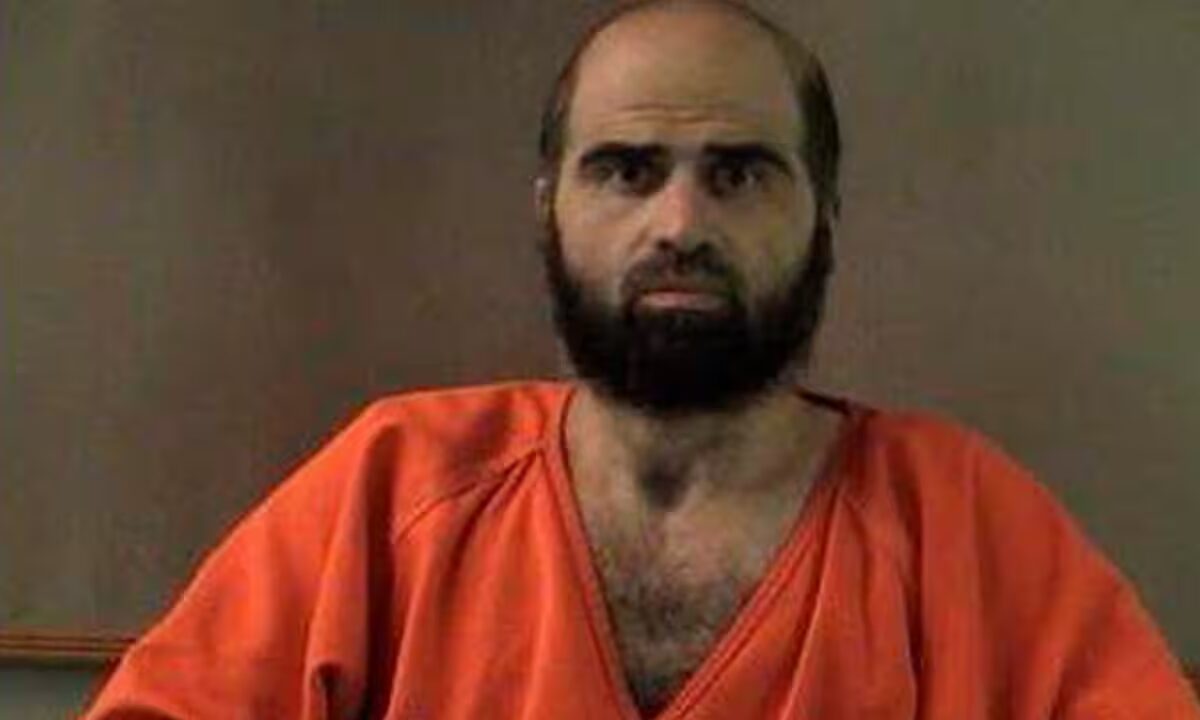
A plan to livestream the firing squad execution of Nidal Hasan, the former US Army psychiatrist convicted of killing 13 people at Fort Hood in 2009, has triggered an unusual bipartisan backlash in the United States.
US Defence Secretary Pete Hegseth said this week that Hasan’s execution, scheduled for December 3 at Fort Hood in Texas, would be made available for the public to watch. If it goes ahead as described, it would be an extraordinary departure from modern US practice, where access to executions is generally restricted to witnesses such as journalists, lawyers and family members.
But there are already signs that the administration may reconsider the plan. US Vice President JD Vance said on Friday that he did not know whether a livestream would actually happen and added that he would not watch it. US President Donald Trump later said his administration would make a determination on the broadcast, CNN reported.
Hasan is due to be executed by firing squad
Hasan was sentenced to death for the 2009 mass shooting at Fort Hood, where he killed 13 people.
Trump approved Hegseth’s recommendation earlier this week that the execution be carried out by firing squad. Under military rules, both the death penalty and the method used to carry it out require presidential approval.
Hegseth said US soldiers armed with rifles would carry out the execution, although the Pentagon has not yet explained who would be selected, how the soldiers would be chosen or who would manage the proposed livestream.
Firing squads remain extremely rare in the United States. There have been only six firing squad executions since 1977, according to the Death Penalty Information Center. Three occurred in South Carolina in 2025.
Hasan’s execution would be even more unusual in the military. According to CNN, it would be the US Army’s first execution of a soldier by firing squad since World War II and the first execution of any US service member in 65 years.
Public executions have largely disappeared in the US
What has caused much of the controversy is not simply the decision to use a firing squad, but Hegseth’s proposal to let the public watch it.
The last execution generally regarded as public in the United States was the 1936 hanging of Rainey Bethea in Kentucky.
There is a more recent precedent for allowing people outside an execution chamber to watch. Oklahoma City bomber Timothy McVeigh asked for his execution to be televised nationally, but a federal court rejected an attempt to livestream it. His 2001 execution was instead shown by closed-circuit television to a limited group that included bombing survivors and victims’ families.
Public executions still take place in a small number of countries. Amnesty International reported six in Afghanistan and 11 in Iran in 2025.
Republicans and Democrats criticise the livestream plan
The proposed broadcast has drawn opposition from politicians across party lines, including several Republicans who support the death penalty.
Republican Senator Thom Tillis compared public executions with practices in Iran and Afghanistan and said they should not happen in America. Republican Representative Austin Scott said that while he supported capital punishment, livestreaming an execution went too far.
Republican Senator John Curtis argued that justice for Hasan’s victims should be administered with solemnity rather than turned into a spectacle, while Democratic Senator Chris Murphy described the proposal as “disgusting” and “medieval.”
Archbishop Paul Coakley, president of the US Conference of Catholic Bishops, also condemned the plan, calling it a “barbaric promotion of a culture of death.”
There are national security concerns as well. Joe Kent, a former senior US intelligence official, warned that footage of Hasan’s execution could become propaganda for terrorist organisations.
CNN national security analyst Peter Bergen made a similar point, arguing that extremist groups could exploit the footage. Hasan views himself as a religious warrior, Bergen said, meaning a public video of his death could reinforce the narrative he has constructed around himself.
For now, Hasan’s firing squad execution remains scheduled for December 3. Whether Americans will actually be able to watch it live is much less certain.