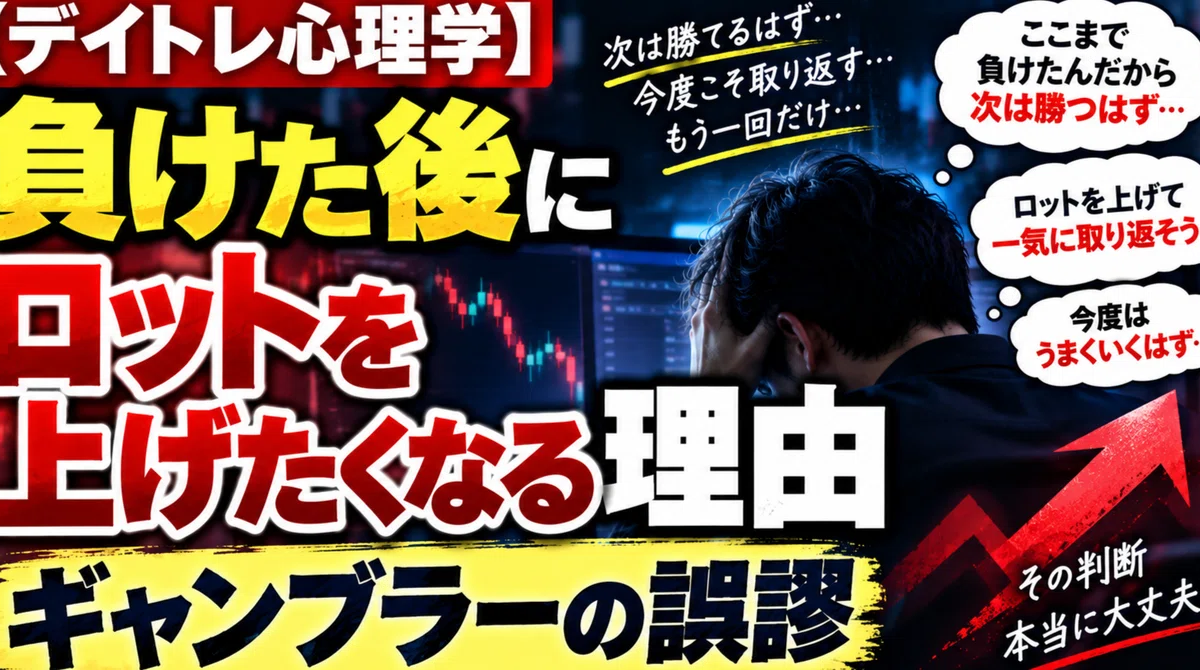
Immediately after losing in day trading,
“I’ll win the next one.”
“Since I’ve lost this much, I should win soon.”
“I want to increase my lot size next time and win it all back at once.”
Have you ever felt this way?
After losing 10,000 yen, you enter with double your usual lot size, trying to win back 20,000 yen.
If you lose again, you enter with an even larger lot size.
If you repeat this, what started as a small loss can turn into a large loss in a short period of time.
Hidden here is sometimes the psychology that “because I’ve had a losing streak, the probability of winning next is high.”
This is related to the “Gambler’s Fallacy.”
In this article, I will explain why you want to increase your lot size after a loss, and why this psychology is dangerous in day trading.
What is the Gambler’s Fallacy?
The Gambler’s Fallacy is a cognitive error where one believes that past results influence future outcomes in independent events.
An easy-to-understand example is coin tossing.
Suppose you toss a coin and get,
Heads, Heads, Heads, Heads, Heads
five times in a row.
Then,
“Since it’s been heads this many times, it feels like tails is likely to come up next.”
Some people might feel that way.
However, if you are using a fair coin and each trial is independent, the probability of getting tails on the next flip does not increase based on how many times heads has appeared in the past.
You might find yourself thinking in a similar way when day trading.
“I’ve lost three times in a row, so I’ll surely win the next one.”
“I’m already down 50,000 yen today, so the tide should turn soon.”
Thinking this way leads you to increase your lot size.
However, the number of times you have lost and whether the stock you buy next will rise are two separate issues.
“I’m sure to win next time” leads to larger lot sizes
For example, let’s say you usually trade with 100 shares.
You lost 5,000 yen on your first trade.
You lost another 5,000 yen on the next one.
That is a total loss of 10,000 yen.
At this point,
“If I make 10,000 yen on the next one, I can get back to break-even.”
You think this and enter with 200 shares.
However, you lose there as well.
Then,
“I’ve lost this much, so surely I’ll win the next one.”
“I want to win it all back in one go.”
These feelings intensify, and you want to increase your lot size even further.
However, just because the number of losses has increased does not mean the win rate of your next trade will automatically rise.
Rather, the problem is that only the lot size is increasing.
Trying to win it back changes your decision-making criteria
The danger of increasing your lot size after a loss is not just that the potential loss amount becomes larger.
It also makes it easier for your entry criteria to become lax.
Normally, you might think,
‘I don’t know the direction of the Nikkei 225, so I’ll pass’
but in a situation where you think,
‘I want to win back another 10,000 yen’
you might end up entering the trade anyway.
Normally, you would exit when the price breaks below the VWAP, but instead,
‘If I cut my losses here, today’s loss will increase even more’
you think, and continue to hold the position.
Normally, you would only enter with 100 shares, but because of the reason,
‘I want to win it back on the next one’
you enter with 300 shares.
When this happens, the purpose of your trade has changed.
Originally, you should have been trading to ‘aim for profits where conditions are good.’
Now, you are in a state of trading to ‘win back today’s losses.’
You need to be careful about this change.
The market does not know your profit or loss
This is extremely important.
The market does not know how much you have lost today.
It does not know that you have lost three times in a row.
It also does not know the circumstances of you thinking, “I can recover today’s losses with 20,000 yen more.”
If the Nikkei Stock Average is falling, it may continue to fall regardless of how many times you have lost.
If the selling pressure on an individual stock is strong, it may drop further even if you think, “It should bounce back soon.”
In other words,
“Because I am losing, the next trade is more likely to be a win”
is a relationship that does not exist.
You need to think about your profit and loss separately from the market in front of you.
Judge the fourth trade after three consecutive losses in the same way
For example, suppose you have executed three trades that fit your rules, and all of them resulted in stop-losses.
Then, a fourth opportunity arrives.
At this time, what is important is not
“I lost three times, so I will win next time”
nor
“I lost three times, so I will lose next time”
either.
You judge the fourth trade based solely on the conditions at that moment.
What is the Nikkei Stock Average doing?
What is the daily chart doing?
Is it above or below the VWAP?
Is there volume coming in?
Is the 5-minute chart forming the pattern I am looking for?
Is the market environment favorable for my strategy?
I make my decisions by looking at these factors.
It is important not to directly link the results of the past three trades to the stock price prediction for the fourth.
Do not change your lot size, especially after a loss
What I find particularly dangerous is
the mindset of
“increasing lot size because I lost.”
Increasing your lot size itself is not inherently bad.
My capital has increased.
My trading has become stable.
I have verified my performance over a certain period.
From a risk management perspective, there is no problem with increasing the lot size.
If you are changing your lot size systematically for reasons like these, that is a different story.
However,
“Because I lost 20,000 yen today”
“Because I lost three times in a row”
“Because I want to win it back in one more trade”
Increasing your lot size for this reason is a change driven by your emotions, not by market analysis.
Especially right after a loss, it is possible that making calm decisions has become difficult.
Increasing your risk further in that state is dangerous.
Doubling your lot size also increases the psychological burden
When you increase your lot size, the movement of your profit and loss also increases.
A price movement that would have been a 10,000 yen unrealized loss with 100 shares becomes 20,000 yen with 200 shares.
Then,
“I don’t want to lose any more”
the feeling of this also becomes stronger.
As a result, you might get scared and cut your losses when you should still be holding, or conversely, you might become unable to cut your losses because you don’t want to realize the loss.
In other words, by changing your lot size, your very judgment can change as well.
Lot size is not just a number.
It is an important factor that affects your mental state.
Discarding the mindset of “winning it back”
One of the phrases that easily leads to large losses in day trading is,
“winning it back”
I think.
I lost 30,000 yen today.
So I will win back 30,000 yen by the end of the day.
The moment you set this goal, you start looking at your profit and loss instead of the market.
However, there is no reason why you must win it back within today.
Even if you lose 30,000 yen today, a market that suits your strengths might come tomorrow.
Conversely, if today’s market does not fit your strategy, continuing to trade forcefully could lead to increased losses.
“I will win back today’s loss today”
Instead of that,
“Is today a market where my strategy works?”
It is more important to look at that.
If the Nikkei Stock Average lacks direction, be even more careful after a loss
In my case, I place importance on trades linked to indices.
Therefore, I am especially careful on days when the Nikkei Stock Average lacks direction.
It goes down just when you think it has gone up.
It bounces back just when you think it has gone down.
It crosses the VWAP up and down repeatedly.
In such a market, my strategy may become difficult to function.
You lose on the first trade.
You lose on the next one too.
Then,
“I’ve lost twice, so I’ll surely win the third time”
and you increase your lot size.
However, if the market conditions are such that your strategy is unlikely to work in the first place, there is a possibility that you will be pushed around in the same way on the third attempt.
What is needed is not to increase your lot size, but
“Perhaps it would be better not to trade today”
to think about that.
Exiting at breakeven also suppresses the “psychology of trying to win it back”
I also make it a rule to exit at breakeven.
I entered a position, but it didn’t move as expected.
It is not moving in the direction I anticipated.
It once had an unrealized gain, but the momentum has faded.
In such situations, I sometimes exit near the breakeven point instead of trying to force a profit.
“I want to make a profit since I went to the trouble of entering.”
“I lost earlier, so I absolutely want to win on this trade.”
Once you start thinking like this, it becomes easier to hold onto a position even when you should be exiting.
You do not need to make a profit on every single trade.
If the conditions have changed, it is also important to exit once and wait for the next opportunity.
Base your decisions on rules, not wins and losses
The most important thing to check after a loss is not
“Can I win the next one?”
but rather
“Does the next entry align with my rules?”
is.
Even if I have lost three times in a row, I do not enter if the conditions are poor.
Conversely, even immediately after a loss, if the conditions are met, I make decisions based on my normal rules.
However,
“Increasing the lot size because I lost”
is a change I do not make.
If you change your rules based on wins or losses, your trading loses its reproducibility.
Things to check immediately after a loss
When I want to enter a trade again after a loss, I believe it is important to check the following points.
“Would I enter this trade even if I hadn’t just lost?”
“Is the reason I want to increase the lot size because the edge is high, or because I want to win it back?”
“Does the Nikkei Stock Average have a sense of direction?”
“Do the daily and 5-minute charts match my rules?”
“Is there a basis for the trade even when looking at VWAP and volume?”
“Is my strategy itself working today?”
If,
“Because I want to win it back”
is part of the reason, I think it is better to be cautious.
Not “I will win next time,” but “I will follow the same rules next time”
In day trading, you may experience consecutive losses.
Even if you trade according to your own rules, there are times when you will experience two or three consecutive stop-losses.
However, that does not mean
“I’m bound to win next time”
is a reason to increase your lot size.
Conversely,
“I will never win again”
is not something you need to think either.
The next trade is just the next trade.
What you should look at is not how many consecutive losses you have had, but whether there is an edge for you in the current market.
If you lose, you try to win it back.
If you lose more, you increase your lot size even further.
Once you enter this cycle, a single large loss could wipe out all the profits you have built up until then.
The market does not know your profit or loss.
Yesterday’s losses and today’s losing streak are irrelevant.
That is precisely why
“I lost, so I will win next time”
is not the mindset, but rather
“I will make the next decision based on the same rules.”
And if the market is one where your strategy does not work, you should also make the choice to “not trade today.”
To avoid being swayed by the gambler’s fallacy, it is more important to stick to your rules than to try to win back your losses.
For those who want to learn more about day trading
On YouTube, I hold a day trading LIVE stream every morning starting at 8:30.
While watching the actual market, I provide real-time commentary on indices like the Nikkei 225, as well as decisions on entries, profit-taking, and exits.
▶ Click here for YouTube
[YouTube Link]
For those who want to learn in more detail
In my YouTube membership, I release exclusive videos covering content that cannot be fully conveyed in regular videos or LIVE streams.
Past videos and LIVE streams are also moved to members-only access after a certain period has passed since their release.
▶ Click here for membership details
[Membership Link]
For those who want to practice day trading with a game
I believe that day trading is not just about memorizing knowledge, but also about repeating decisions such as “buy, sell, wait, and exit” while watching the market.
Therefore, I have released a day trading game where you can practice the concepts I prioritize in my actual trading, such as indices, market conditions, and supply and demand, in a game format.
▶ Click here for the day trading game
[Game Sales Note Link]
I also update day trading articles on note
I write articles about day trading methods, ways of thinking, trading psychology, and points I am conscious of in the actual market.
If you find my articles helpful, please follow me on note.
*This article is provided for informational purposes to help you learn about investment knowledge and concepts, and it does not recommend the buying or selling of any specific stocks or financial products. Investing carries the risk of loss, including the loss of principal. Please make actual investment decisions based on your own judgment and responsibility.