
Summary
The ROBOPRO fund’s net asset value (NAV) adjusted in September against a backdrop of rising crude oil prices, higher long-term interest rates, and the strengthening of the yen. Since then, it has shown a recovery trend, supported by a rebound in equity markets, led by US stocks, and changes in foreign exchange rates.
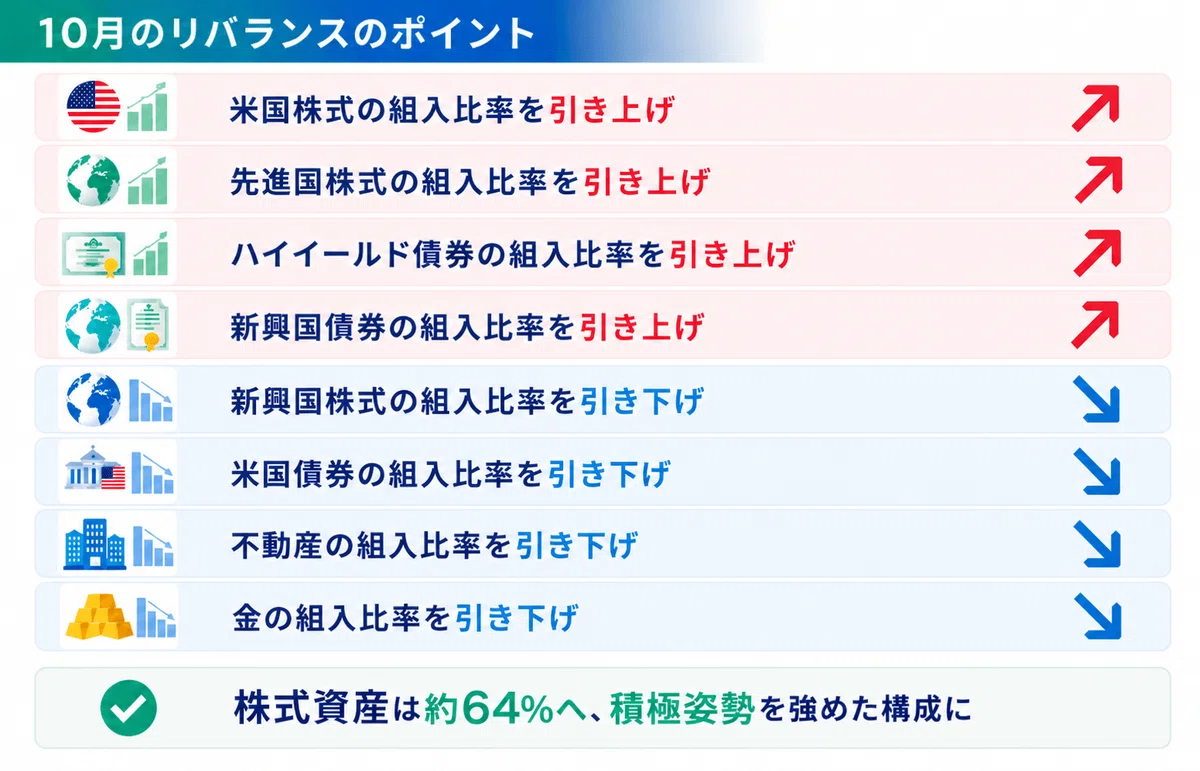
In the regular rebalance for October 2026, the allocation ratios for assets such as US equities and developed market equities were increased, while the ratios for US bonds and gold were decreased.
As a result, the total allocation to equity assets reached approximately 64%, the highest level since October 2025, representing a more aggressive asset allocation compared to the previous month.
In this AI forecast, the outlook for US equities and real estate remained relatively high, while the outlook for gold and US bonds was relatively low.
* “ROBOPRO” is a registered trademark of FOLIO Co., Ltd.
How has the recent net asset value performed?
The ROBOPRO fund’s NAV adjusted in September due to rising inflation concerns fueled by factors such as the increase in crude oil prices.
The decline in investment assets such as equities, bonds, and real estate, as well as the appreciation of the yen against the dollar in the foreign exchange market, also acted as downward pressure on the NAV.
In the bond market, concerns over reignited inflation and additional interest rate hikes intensified in major countries, leading to a rise in long-term interest rates. Although interest rate hikes were decided at the September monetary policy meetings in Japan and the US, the upward trend in long-term interest rates continued due to speculation about further hikes.
On the other hand, from mid-September, global equity markets, led by US stocks, rebounded, and the dollar-yen exchange rate moved toward a stronger dollar and weaker yen, causing the NAV to recover slightly toward the end of the month.
Entering October, US equities have maintained their strength, and the NAV has shown a firm trend. (As of October 9, 2026)
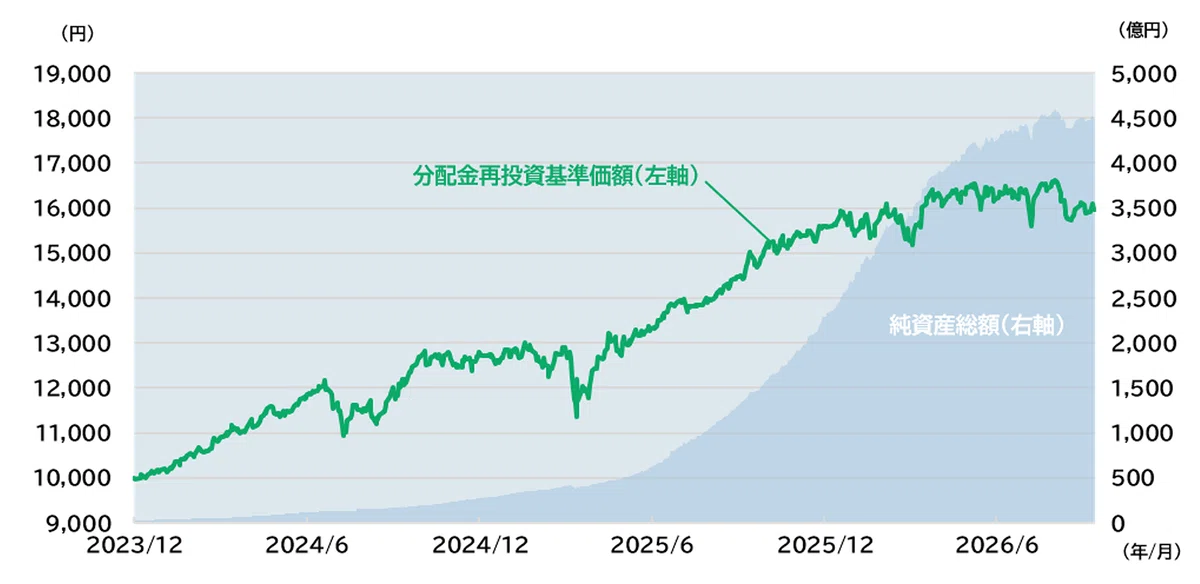
In the September rebalance, the allocation to US equities and real estate was increased. Subsequently, while the rise in US equities contributed positively to the NAV, the adjustment in real estate was a negative factor.
For more details, please see the previous article.
Related article: [September 2026 Rebalance] Increased US Equities and Real Estate, Equity and Real Estate Now Approximately 65%
Increased allocation ratios for US equities, developed market equities, etc.
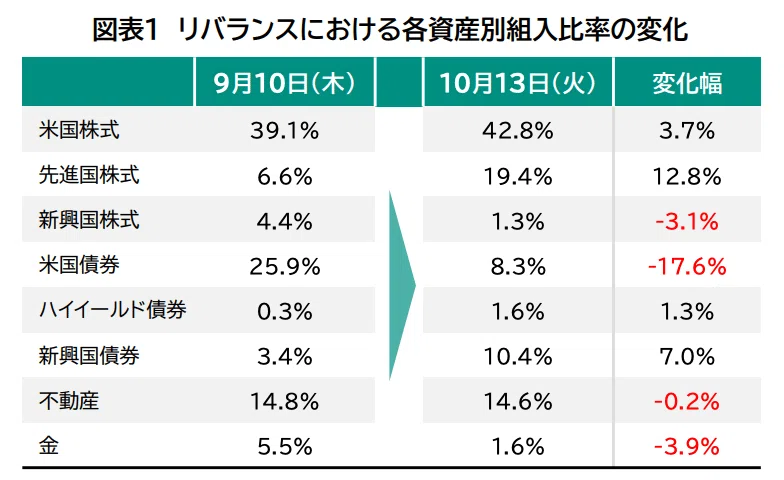
In the regular rebalance on October 13, 2026, the allocation ratios for assets such as US equities and developed market equities were increased, while the ratios for US bonds and gold were decreased.
In particular, developed market equities increased significantly from 6.6% to 19.4%, and US equities were also increased from 39.1% to 42.8%.
The changes to the asset allocation this time are as follows.
Equity assets increase to approximately 64%, a composition that strengthens an aggressive stance
In this rebalancing, the total of equity assets increased to approximately 64%. This is the highest level since October 2025.
Meanwhile, the total of bond assets and gold became approximately 22%, the lowest level since September 2025.
Last month, the total of equity assets and real estate was approximately 65%, but this time, equity assets alone account for approximately 64% of the composition.
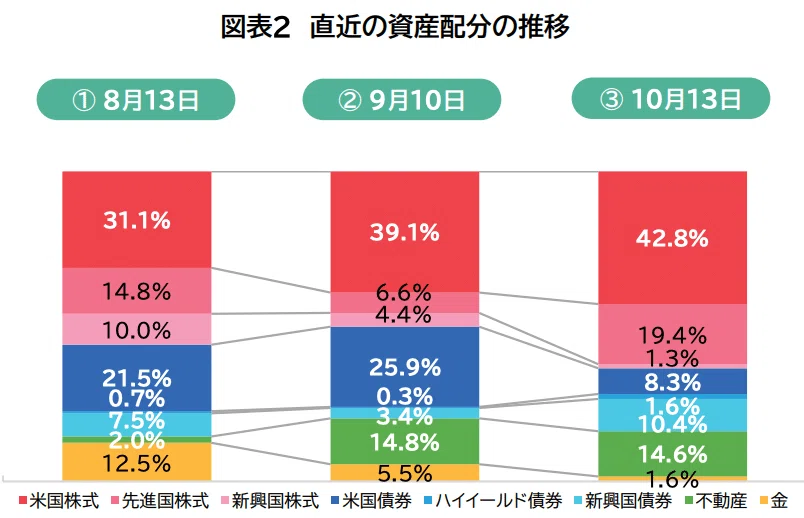
In particular, the total of U.S. stocks and developed market stocks has reached 62.2%, which is characterized by a heavier allocation to these two assets within the equity assets.
With the increase in allocation to relatively high-risk assets, the portfolio as a whole has strengthened its aggressive stance compared to the previous month.
However, we continue to allocate to U.S. bonds, emerging market bonds, real estate, gold, etc., and maintain a composition that diversifies investments across multiple assets.
AI forecasts show relatively high outlooks for U.S. stocks and real estate
In this AI forecast, the outlook for U.S. stocks and real estate was relatively high.
On the other hand, the outlook for gold and U.S. bonds is relatively low.
Compared to the previous time, the outlook for gold and U.S. bonds has retreated, while the outlook for developed market stocks and others has improved.
What is particularly noteworthy is that the outlook for developed market stocks has improved significantly.
While AI-based return forecasts are an important factor in determining asset allocation, the actual allocation ratio is determined by also taking into account the expected return and risk of each asset.
Therefore, rather than simply including a large amount of assets with high AI outlooks, the asset allocation also takes into account the balance of the entire portfolio.
U.S. stocks continue to have the highest outlook among the 8 assets
The inclusion ratio of U.S. stocks was increased from 39.1% last month to 42.8%.
In the AI forecast, U.S. stocks maintain the highest outlook among the 8 assets.
The background for this includes the continued expansion of long-term volatility in energy prices, which is having a positive impact on the outlook for U.S. equities.
U.S. equities continue to have a relatively high outlook following the previous month, and they have become the asset with the highest allocation in this rebalancing as well.
Developed market equities see a significant improvement in outlook, and their allocation has also increased.
This time, developed market equities saw the largest increase in allocation.
The allocation for developed market equities was raised by 12.8 percentage points, from 6.6% in the previous month to 19.4%.
The background for this includes adjustments in European equities and expectations for growth based on long-term price trends.
The AI forecast also shows a significant improvement in the outlook for developed market equities compared to the previous month, which is believed to have led to this change in allocation.
Within the same equity asset class, the allocation for emerging market equities has been reduced from 4.4% to 1.3%.
In this way, a feature of this rebalancing is that it not only increases the overall allocation to equity assets but also adjusts allocations based on changes in the outlook for each region.
Real estate maintains a high outlook.
The allocation for real estate decreased slightly from 14.8% in the previous month to 14.6%, but it maintains a relatively high outlook in the AI forecast.
Real estate has been undergoing price adjustments against the backdrop of rising interest rates, and with the increased possibility of a rebound, it appears that a relatively high outlook has been maintained in the AI forecast.
On the other hand, the allocation for U.S. bonds decreased significantly from 25.9% to 8.3%.
In the AI forecast, the outlook for U.S. bonds has retreated from the previous month, negatively impacted by adjustments in a wide range of risk assets.
Regarding gold as well, the allocation has been reduced from 5.5% to 1.6% against the backdrop of a retreating outlook.
What can be read from this rebalancing.
What can be read from this rebalancing is that as the market environment changes, allocations are being significantly revised even within the same asset category.
For example, in equity assets, while allocations to U.S. equities and developed market equities were increased, the allocation to emerging market equities was reduced.
Also, regarding bond assets, while the allocation to U.S. bonds was significantly reduced, the allocation to emerging market bonds was increased.
This indicates that asset allocations are being flexibly revised based on the outlook and risks for each asset, rather than just by broad classifications such as equities or bonds.
Although the stock market is beginning to regain its composure, there are upcoming events that could impact financial markets, such as monetary policies in Japan, the US, and Europe, as well as the US midterm elections.
In such an uncertain environment, it is an important perspective in asset management not only to look at the price movements of specific assets but also to review allocations according to changes in the outlook for each asset.
Summary
In the regular rebalancing for October 2026, we increased the allocation ratios for assets such as US equities and developed market equities, while decreasing the ratios for US bonds and gold.
As a result, the total for equity assets reached approximately 64%, the highest level since October 2025, resulting in a portfolio with a more aggressive stance compared to the previous month.
According to AI forecasts, the outlook for US equities and real estate remained relatively high, and the outlook for developed market equities improved significantly.
Because the market environment is constantly changing, the ROBOPRO fund uses AI to analyze over 40 types of market data to forecast the returns of each asset for approximately one month ahead. Based on those forecasts, we diversify investments across multiple assets and flexibly review asset allocations.

The principal of investors is not guaranteed, and losses may be incurred due to a decline in the net asset value, which may result in the principal being breached. Investment trusts are different from deposits and savings. All profits and losses generated from investment trust assets belong to the investors.
The fund invests in securities with price fluctuations, such as domestic and foreign stocks, domestic and foreign bonds, domestic and foreign real estate investment trust securities, and commodities. Therefore, the net asset value may decline and losses may be incurred due to the impact of price declines in the incorporated securities. In addition, since the fund invests in foreign currency-denominated assets, losses may be incurred due to fluctuations in exchange rates.
The investment performance posted in this document is based on the past and does not guarantee future investment results. Furthermore, taxes, fees, etc., are not taken into account.
When applying for a purchase, please read the ‘Investment Trust Explanatory Document (Prospectus)’ and the ‘Document Delivered Before Conclusion of Contract’ or ‘Prospectus Supplementary Document’ thoroughly, and please make investment decisions on your own.
Disclosures related to the Financial Instruments and Exchange Act, etc.
SBI Okasan Asset Management Co., Ltd.
Trade Name, etc.: SBI Okasan Asset Management Co., Ltd.
Registration Number: Financial Instruments Business Operator, Director of Kanto Local Finance Bureau (Kinsho) No. 370
Member Association: The Investment Trusts Association, Japan