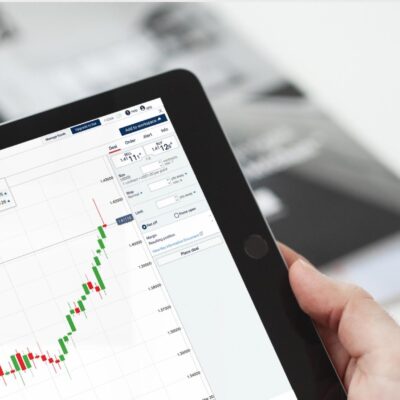
When researching day trading for stocks, you often come across the term “scalping.” Both involve finishing trades within a single day, so the difference can be hard to understand. Beginners are likely wondering, “Which one is better for me to try first?” In conclusion, for most beginners, it is easier to start with day trading. However, if you choose without knowing the reasons, you might find later that it doesn’t suit you. In this article, we will organize the differences between the two and consider which one a beginner should choose.
What is the difference between the two types of trading?
Day trading refers to a trade where you hold a stock you bought for anywhere from a few minutes to a few hours and sell it within the same day. You ride the flow of price movements and aim to capture a certain range.
Scalping involves an even shorter holding time. You finish trades in a few seconds to a few minutes, accumulating small price differences repeatedly. The profit per trade is small, but the number of trades is high.
In other words, the core difference lies in the holding time and the price range targeted in a single trade. Day trading aims for a larger price range with fewer trades. Scalping aims for a smaller price range with many trades. Even though both are “short-term trading,” the required movements are quite different.
Why scalping is difficult for beginners
Scalping is difficult because the time available for making decisions is extremely short.
To decide on a trade in a few seconds, you need to react instantly while watching changes in the order book and the time and sales data. There is almost no time to look at a chart and think. Experienced people can process this intuitively, but it is a heavy burden for beginners.
Also, the impact of trading costs cannot be ignored. Since the profit per trade is small, commissions, spreads, and slippage significantly eat into your profits. The more trades you make, the more those costs accumulate. Even a slight miscalculation can easily tilt your balance into the negative.
Furthermore, there is the issue of concentration. Repeating decisions at short intervals is more tiring than you might think. If you continue in a tired state, mistakes increase, and small losses tend to occur in succession.
Why day trading is easier to start
In day trading, the time available for making decisions is relatively long.
If you hold for a few minutes to a few hours, you can look at the chart to organize the situation and calmly decide on your stop-loss position. It is also easier to put the reasons for your trades into words and look back on them later. Being able to review your trades is directly linked to how quickly you improve.
Also, because the price range targeted in a single trade is larger, the impact of costs is relatively smaller. Since you don’t need to trade as often, you can focus on each individual trade. It is easier to practice the stop-loss and profit-taking decisions that beginners should learn first.
Suitability also depends on personality and lifestyle
That said, which one is suitable depends on the person.
People who are good at instantaneous judgment and can focus on the screen might be suited for scalping. On the other hand, people who want to carefully observe the situation before moving might find it more natural to continue with day trading.
Lifestyle also has an impact. For those who trade in between work, scalping, which requires being glued to the screen, is not realistic. If you are making a few trades in a short time in the morning, day trading is likely a better fit. Choosing a style you can sustain is just as important as the superiority of the method itself.
How to protect your capital also changes with the time horizon
The way you think about capital management is also slightly different between the two types of trading.
Scalping is based on the premise of keeping individual losses extremely small. In exchange, if you hesitate even once to cut your losses, dozens of small gains can be wiped out by a single large loss. The speed of your stop-loss execution directly determines your performance.
Day trading allows for a certain degree of flexibility in the width of your stop-loss. However, because the range is wider, the amount of loss per trade tends to be larger. You need to adjust the number of shares and decide in advance the amount you are willing to lose in a single trade. Regardless of which you choose, the need to be conscious of limiting losses remains the same.
At the beginner stage, day trading, where you can calmly calculate the loss amount, is easier to protect your capital with than scalping, which requires speed.
Actually, there is no clear-cut distinction
I have explained these two separately so far, but the actual boundary is ambiguous.
Even within day trading, there are trades that end in a few minutes, and some people trade with a brevity close to scalping. What is important is not distinguishing them by name, but knowing the time frame in which you can make decisions.
Start by holding trades a little longer as a day trader. Once you get used to it, shorten your holding time to verify your aptitude. Following this order allows you to expand your range without strain. It is easier to understand the causes of failure this way than by jumping into a short time frame immediately.
The quality of practice changes with the time frame
There is also a difference in the speed of improvement.
In day trading, because the number of trades per day is small, you can carefully verify each decision.
Scalping allows you to gain experience quickly due to the high number of trades. However, it is difficult to keep up with reviewing each trade, and you may not notice if you are repeating the same mistakes.
A realistic way to start
So, how should you start?
At first, trade with a small number of shares to keep losses small. The goal is not to make a profit, but to get used to the flow of trading and learn your own habits. You also want to develop the habit of entering a trade only after deciding on your stop-loss position at this stage.
After a trade, review why you entered and why you exited. Rather than focusing on whether the result was good or bad, check whether the reasoning behind your decision was sound. This accumulation will become the foundation for whatever style you choose later.
Summary
The difference between day trading and scalping lies in the holding time and the price range targeted per trade. Scalping is a heavy burden for beginners because it requires quick judgment and is significantly affected by costs. Day trading makes it easier to take time to think and is suitable for practicing stop-losses and profit-taking.
However, suitability varies from person to person, and the boundary is ambiguous. First, master the basics through day trading, and then gradually explore the time frame that suits you.
Note: This article is intended for general information and sharing perspectives on the market; it does not recommend buying or selling any specific stocks. Please make investment decisions at your own responsibility.