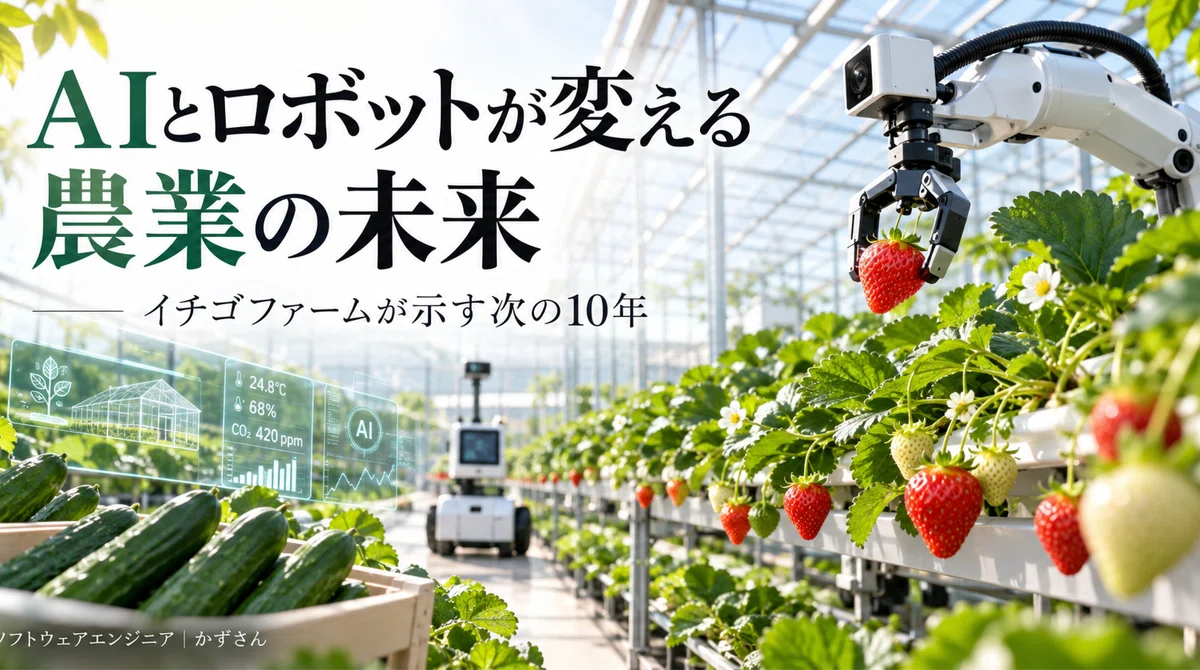
—Thinking about the future of Japanese agriculture through cucumber harvesting robots and strawberry plant factories.
When you go to the supermarket, vegetables are lined up just as they always are.
Cucumbers, tomatoes, strawberries.
We look at the prices and freshness, and think about what to buy.
But what if, in a few decades, the places where those vegetables are grown and the people working there were completely different from today?
Not in a field, but inside a building.
Not just by human hands, but by AI and robots.
Unaffected by the weather, with harvest times and required quantities predictable to a certain extent.
Such agriculture is already beginning to become a reality.
I have recently been paying attention to two pieces of news.
One is the cucumber harvesting robot being developed by JA Zen-Noh and Yaskawa Electric.
The other is Oishii Farm, which operates large-scale strawberry plant factories in the United States.
Looking at these two, I thought about something.
Isn’t the future of agriculture not just about automating farm work, but about the very system of producing food changing?
Five years for a single cucumber
JA Zen-Noh and Yaskawa Electric have been developing a cucumber harvesting robot for about five years.
It uses AI to recognize the harvest target and a robotic arm to pick the fruit.
Newspaper articles reported that the harvesting accuracy has reached about 80 percent.
Even tasks that humans perform naturally are not easy for robots.
Finding fruit hidden in the shade of leaves.
Judging what is ready for harvest.
Picking fruit without damaging other fruit or stems.
Agriculture involves many judgments that have been acquired through years of experience.
I believe it is a major step forward that some of these can now be left to AI.
However, I am not focusing solely on harvesting accuracy.
What is more important is how the way farmers work will change when this technology becomes widespread.
Daily harvesting tasks will be reduced.
Cultivation can be continued even with fewer people.
Physical strain will be reduced.
If such effects become a reality, robots will not just be machines, but entities that connect agriculture to the next generation.
An era where the place to grow strawberries does not have to be a field
Another thing I am interested in is Oishii Farm.
The company is developing large-scale strawberry plant factories in the United States that combine AI, robots, and environmental control technology.
In traditional agriculture, crops have been grown in accordance with the natural environment, such as temperature, sunlight, and rainfall.
However, in plant factories, the way of thinking changes.
Humans create the environment suitable for the crops.
Temperature, humidity, light, water, and nutrients.
These conditions are controlled to cultivate crops while minimizing the influence of seasons and weather.
Furthermore, they are also advancing the automation of harvesting using robots.
They have also announced a policy to begin the production and sale of strawberries in Japan in 2026.
I find this movement extremely interesting.
This is because what is happening here is not merely the mechanization of agriculture.
From agriculture that adapts production to the natural environment, to agriculture that designs production environments suitable for crops.
The very concept of agriculture is expanding.
Agriculture: From ‘Experience and Intuition’ to ‘Experience and Data’
Until now, what has supported agriculture has been the experience and observational skills of producers.
Observing the state of the soil.
Checking the color of the leaves.
Reading the weather and judging the time for harvest.
Such knowledge is not acquired overnight.
I do not think that AI can easily replace that.
Rather, I believe that what will become important from now on is combining human experience with AI data.
For example, sensors record temperature and humidity.
AI analyzes growth conditions.
It predicts harvest yields and harvest times.
Based on that information, producers improve their cultivation methods.
Knowledge that has been accumulated as experience until now is reinforced by data, making it easier to utilize in other locations as well.
Beyond that lies a new possibility for agriculture.
Even people with little experience might be able to engage in cultivation while receiving a certain level of support.
It might become possible for a small number of people to manage farms located in remote areas.
It may become easier to deploy cultivation techniques acquired in one region to another.
I feel the potential for agriculture to change from an industry dependent on a limited number of skilled experts to one in which a wide variety of people can participate.
Will farmers disappear in the future?
As the automation of agriculture progresses, there is a question that inevitably arises.
Won’t human jobs disappear?
I imagine a future where the role of farmers changes, rather than a future where farmers disappear.
Until now, humans have been responsible for many tasks, such as growing, harvesting, and transporting.
From now on, machines will come to support some of those tasks.
On the other hand, new jobs for humans may be created.
Designing cultivation environments.
Analyzing data to improve production methods.
Managing quality and safety.
Developing varieties that consumers want.
Thinking of mechanisms to maintain regional agriculture.
In other words, won’t agriculture expand further into a job that utilizes technology, management, and creativity, while still being a job that uses the body?
And I hope that these changes will also increase opportunities for the younger generation to take an interest in agriculture.
The path to being involved in agriculture will no longer be limited to inheriting a family business or owning farmland.
There is great potential in such a future.
However, it does not mean that everything should be turned into a plant factory.
I want to think about this carefully.
Plant factories face challenges such as capital investment, power consumption, and operating costs.
Not all crops are suitable for indoor cultivation.
The appropriate production methods differ between rice and wheat, which are grown on large tracts of land, and high-value-added strawberries.
Introducing AI and robots does not necessarily guarantee increased profits.
What is technically feasible and what is sustainable as a business are separate issues.
Therefore, I do not believe that the future of agriculture will take a single form.
Agriculture that continues with open-field cultivation.
Agriculture that advances environmental control in greenhouses and polytunnels.
Regional agriculture that shares the use of robots.
Plant factories that produce near urban areas.
Each will develop according to the conditions of the crops and the region.
I believe that what is needed for the future of agriculture is not a single correct answer, but an increase in sustainable options.
To continue being a country that can produce food
When thinking about Japanese agriculture, I believe there is another important issue.
That is whether we can continue to produce food stably.
The number of people involved in agriculture is decreasing.
The climate is changing.
Extreme heat and heavy rainfall are increasing.
The prices of materials and energy are also fluctuating.
In such an environment, it may become difficult to continue relying solely on the same methods as before.
That is precisely why there is meaning in cultivating AI, robotics, and plant factory technologies.
However, I do not want to think of food security simply as a matter of domestic production volume alone.
Being able to produce when necessary.
Being able to continue operations sustainably.
Protecting local farmland and water resources.
Ensuring consumers can buy food at affordable prices.
All of these are interconnected.
No matter how advanced a plant factory may be, if it can only produce crops that only a limited wealthy class can afford, it cannot support the food supply for all of Japan on its own.
On the other hand, there is also a path to cultivate technology starting from high-value-added crops and expand into broader production in the future.
The true value of new agricultural technology lies not in how high-end the crops it can produce are, but in how much it can support the food and livelihoods of many people.
That is what I believe.
How will the vegetable section of supermarkets change in ten years?
I do not know how much agriculture will change over the next ten years.
Even so, I have some expectations.
Farms where robots help with the harvest.
Greenhouses where AI monitors the condition of crops.
Plant factories that grow vegetables and fruits near cities.
And people who continue to farm while utilizing the experience and skills that have been cultivated until now.
It is a future where such various forms coexist.
What is important is not to drive humans out of agriculture.
Supporting work that could only be continued through human overexertion with technology.
Making it easier for those who want to start farming to take the first step.
And ensuring that we can continue to obtain food with peace of mind.
I believe that both the robot that harvests a single cucumber and the massive strawberry plant factory are individual challenges moving toward that future.
I want agriculture to become an industry that the next generation will want to challenge themselves with, rather than an ‘industry we continue out of necessity because there is a labor shortage.’
What is needed for that is not just the performance of robots.
Systems that allow technology to be used in the field.
A business environment where farmers can invest without undue burden.
Human resources and education that enable people to take on new challenges.
And the awareness that we support agriculture as a whole society.
Ten years from now, the single cucumber we pick up at the supermarket might look exactly the same as it does today.
But the system for growing, harvesting, and delivering that single cucumber might have changed significantly.
The future of agriculture is not about machines growing vegetables in place of humans. I believe it is about building a society where humans can continue to eat with peace of mind, together with technology.
And whether that future has truly been realized should be judged not by the number of robots, but by whether more people are able to continue farming and whether our dining tables have become more enriched.
PR We support the job change site Green!!