After a strong rally in 2025, gold managed to continue its rally only briefly in 2026, and topped on Jan. 28, 2026 at US$5417,21 (XAU gold spot price). It fell to $3,976.50 on July 16, 2026 for a decline of 27 per cent and is now trading slightly above $4,000.
It has been a frustrating decline for investors that have long believed in the merits of gold. One of the stated reasons for the strong rally in gold is that governments were spending too much money and racking up huge deficits and debts driving up interest rates and that central banks were going to have to step in to save them by printing money. This central tenet for gold moving higher has not changed, and yet, gold has dropped significantly. So, why has gold been declining in value?
Although the long-term thesis that central banks will have to “print” money to save the economy is a long-term driver of the price of gold, there are a number of variables that can affect the price of gold in the short term. Two of the largest drivers are the direction of interest rates and the U.S. dollar.
In the short-term, the price of gold can be greatly affected by rising interest rates. When interest rates are rising, the opportunity cost of holding gold increases. Since gold does not pay a dividend, it becomes less attractive.
Another major factor in driving the price of gold is the U.S. dollar. Generally speaking, when the value of the U.S. dollar increases, the price of gold declines, as gold is priced in that currency.
In addition, when the U.S. dollar is rising, it becomes a strain on countries outside of the U.S., in particular emerging market countries. It becomes more difficult for other countries to pay their U.S dollar debts and on the margin, some countries are forced to sell gold to protect their currencies. We saw this earlier in March of 2026 when Turkey had to sell or swap 60 tonnes of gold (over US$8 billion) to protect their currency in an environment of a rising U.S. dollar.
Gold doesn’t always decline when interest rates or the U.S. dollar are rising, but the headwinds make it more difficult for gold. In particular gold tends to struggle when both interest rates and the U.S. dollar are rising together. There are times when gold can perform well in this environment, but it is difficult.
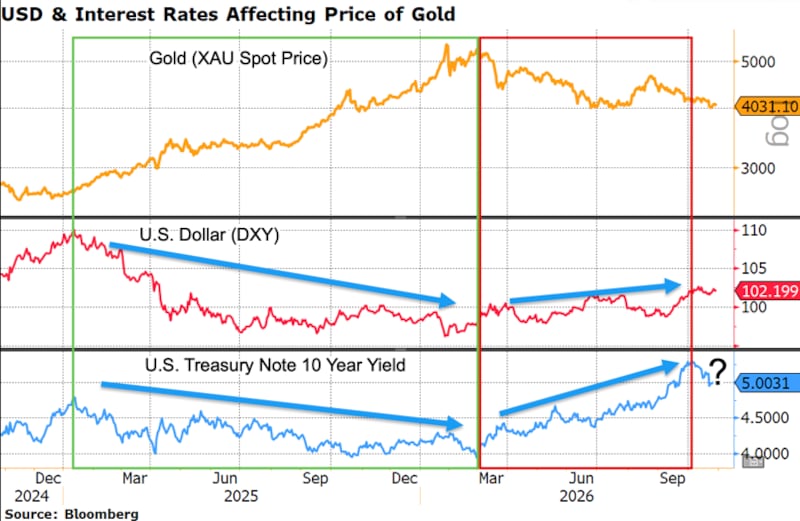
The above graph illustrates the relationship between the price of gold (gold line), the U.S. dollar (red line) and the yield on the U.S. Treasury Note 10 Year (blue line). The period from January 2025 to February 2026 (green box) is generally a period of a falling U.S. dollar and a declining yield on the U.S. Treasury Note 10 Year. There are some zigs and zags along the way, but the overall trend was lower for the U.S. dollar and interest rates. In this period, gold performed extremely well and rose to over $5,000.
In comparison, the period from March 2026 to September (red box) is characterized by a rising U.S. dollar and a rising yield on the U.S. Treasury Note 10 Year. In this period, interest rates rose very fast. It is not only direction that matters, but also the rate of change. Rising interest rates did a lot of damage to the price of gold and it performed poorly in this environment.
The good news is that the yield on the U.S. Treasury 10 Year Note has recently been trending lower. It is difficult to tell at this point if it is a sustainable trend, or just another zag.
At the same time that interest rates have moved lower, the U.S. dollar has slowed its ascent. This combination of trends is a welcome environment for gold to perform well compared to the earlier 2026 environment.
So far, gold has not managed to rally in the developing favourable environment. Sometimes there is a lag and investors should be patient. The market is becoming more favourable for gold, it has just not shown up in the price.
The views and opinions expressed herein are solely those of the author(s) and may not necessarily reflect the views of Global X Investments Canada Inc. All comments, opinions and views expressed are generally based on information available as of the date of publication and should not be considered advice to purchase or sell any securities mentioned. Before making any investment decision, please consult your investment advisor or advisors.