When I open social media, posts saying “I made ○ yen this month from day trading” often appear. If I keep watching charts and practicing every day, will I eventually be able to do that too?
There is a study that attempted to answer this question using trading records collected by the government. It is a study that followed approximately 20,000 people who started day trading for several years from the day they began.
This article introduces a paper by other researchers. It is not a verification of data I collected myself.
What kind of study is it?
It is a paper published in 2019 by three researchers at a Brazilian university (Fernando Chague, Rodrigo De-Losso, and Bruno Giovannetti). The title is “Day trading for a living?”. In Japanese, it translates to “Can you make a living from day trading?”.
Day trading refers to buying and selling within the same day and not carrying positions over to the next day.
-
Data: Daily trading records of individuals and institutions provided by the government agency that oversees securities trading in Brazil (CVM)
-
What was traded: Futures of Brazil’s representative stock index (Ibovespa)
-
Subjects: All individuals (19,646 people) who first day-traded these futures between 2013 and 2015
-
Period: 2012–2017
Futures are trades where you deposit margin and can enter from either buying or selling. These futures are the most frequently traded by individuals in Brazil for day trading.
Profit and loss are calculated after deducting commissions paid to the exchange and brokerage firms. The paper notes that since taxes and costs for accounts or trading tools are not deducted, actual performance should be even worse.
Finding 1: 97 out of 100 people who continued for more than 300 days were losing money
Out of about 20,000 people, 1,551 people traded for more than 300 days (about 8 out of 100). 300 days is a duration that takes over a year even if you day trade every day the exchange is open.
Of these 1,551 people, 47 had profits remaining after deducting commissions. This means 97 out of 100 people were losing money.
When the 1,551 people were ranked by profit and loss, the loss for the person in the middle was about 23 dollars per day. Calculating at 150 yen to the dollar, that is about 3,500 yen per day. Simply multiplying by 300 days, it comes to about 1.04 million yen (the yen calculation is my own).
Even looking only at trading profit and loss before deducting commissions, only about 11 out of 100 people were profitable. This means that commissions were not the only cause of the losses.
Finding 2: The longer people continued, the smaller the percentage of people who remained profitable
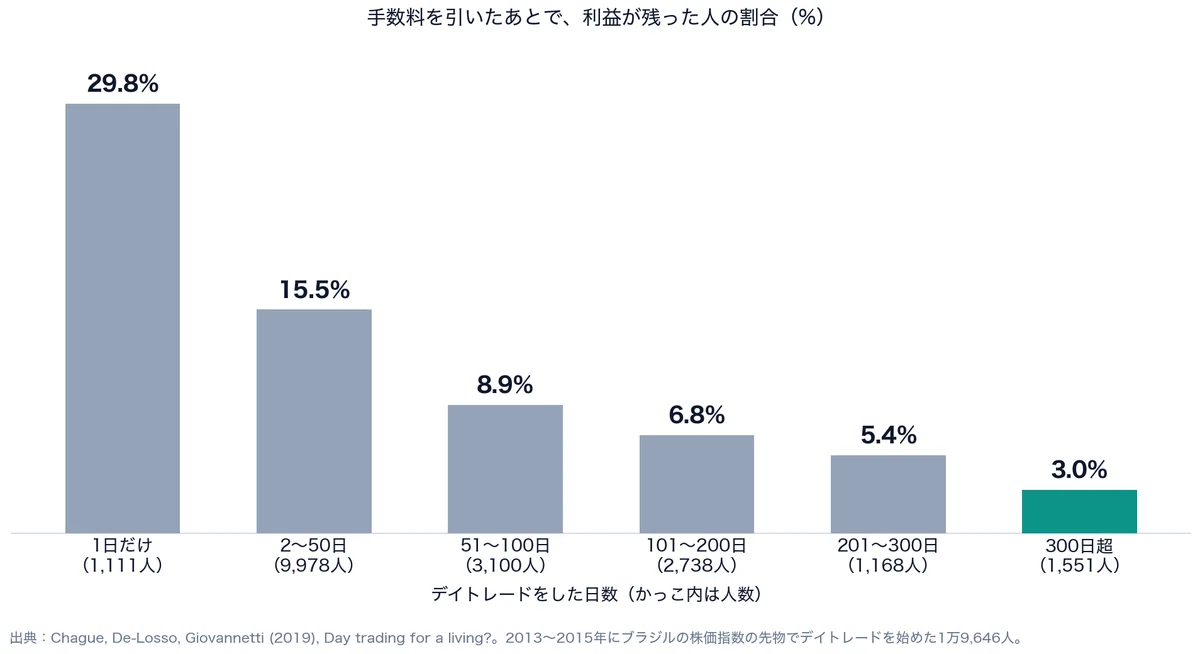
How to read the chart: The horizontal axis divides people into 6 groups based on the number of days they day-traded (numbers in parentheses are the number of people). The further to the right, the longer they continued. The vertical axis is the percentage of people who remained profitable after deducting commissions; the higher the bar, the more people in that group remained profitable.
Among those who day-traded for only one day, about 30 out of 100 remained profitable. However, the percentage decreased the longer the group continued, and for those who exceeded 300 days, it was 3 out of 100.
Personally, I found this trend more surprising than the figure of 97 people. I had assumed that if people kept at it, the number of successful traders would gradually increase.
The paper notes that if more skilled people were the ones continuing for longer, this pattern would be unlikely to occur.
The researchers also examined whether the profit and loss improved over time for the 1,551 people who continued for more than 300 days. The average daily profit after fees was a loss of about $47 for the first 250 days, and a loss of about $52 thereafter. The conclusion of the paper is that no evidence was found that they improved by continuing.
During this period, the trading volume of firms using computers to trade more than once per second increased from 17% (in 2013) to 42% (in 2017). The higher that percentage was on any given day, the greater the losses for individuals. However, even when calculating while excluding that influence, no evidence of improvement through continued practice was found.
Finding 3: Even among the 47 who remained profitable, many did not reach the minimum wage
How much were the 47 profitable traders earning? The paper compares this to the Brazilian minimum wage and the starting salary of a bank teller.
-
17 people exceeded the Brazilian minimum wage (approx. $16 or 2,400 yen per day)
-
8 people exceeded the starting salary of a bank teller (approx. $54 or 8,100 yen per day)
-
Even the highest earner averaged $310 (approx. 46,500 yen) per day
Of the 1,551 people who continued for more than 300 days, only 8 exceeded the starting salary of a bank teller. Even the person who earned the most saw their daily profit and loss fluctuate by an average of about $2,560 (approx. 380,000 yen), repeating days of large wins and large losses.
What this means for FX traders
This study concerns stock index futures in Brazil, not FX. Even so, I believe the point that “if you keep doing it every day, you will eventually get better” does not necessarily apply to FX either.
One way to verify this is to look at your own trading history. Compare your profit or loss per trade, including spreads and fees, between your first month and your most recent month. If you haven’t improved despite repeated attempts, it might be time to review your approach before continuing.
It is also worth remembering that the posts you see on social media claiming “I made X amount this month” may only be the results of a very small fraction of those who are still trading.
Points to note
-
This is data on stock index futures in Brazil from 2013 to 2017. It does not necessarily apply directly to current FX trading in Japan.
-
This is a working paper published by researchers, not a peer-reviewed academic journal article.
-
Profit and loss figures do not include taxes or the costs of accounts and tools.
-
The yen amounts were calculated by me at a rate of 150 yen to the dollar.
Summary
-
Among 1,551 people who continued day trading for over 300 days, 97 out of 100 lost money after deducting commissions.
-
The longer the group continued, the smaller the percentage of people who remained profitable, and no evidence was found that they improved with experience.
-
Of the 47 people who remained profitable, only 8 earned more than the starting salary of a bank teller.
Source
-
Fernando Chague, Rodrigo De-Losso, Bruno Giovannetti (2019). Day trading for a living? Working Paper Series Nº 2019-47, Department of Economics, FEA-USP (University of São Paulo, School of Economics). https://ssrn.com/abstract=3423101
-
Abstract (RePEc): https://ideas.repec.org/p/spa/wpaper/2019wpecon47.html
Regarding consultations for verification and automated trading
I accept requests on Coconala for strategy verification, creation of indicators and strategies using TradingView’s Pine Script, and development of EAs (automated trading programs) for MT5 (MetaTrader 5).
https://coconala.com/users/6166029
Disclaimer
This article introduces the content of publicly available research and is not investment advice. It does not recommend the buying or selling of specific financial products, nor does it guarantee future performance. Please make trading decisions at your own risk.
#FX #FXBeginner #DayTrading #FullTimeTrader #InvestmentBeginner #InvestmentPsychology #AcademicPaper #Research #FuturesTrading #Trade