

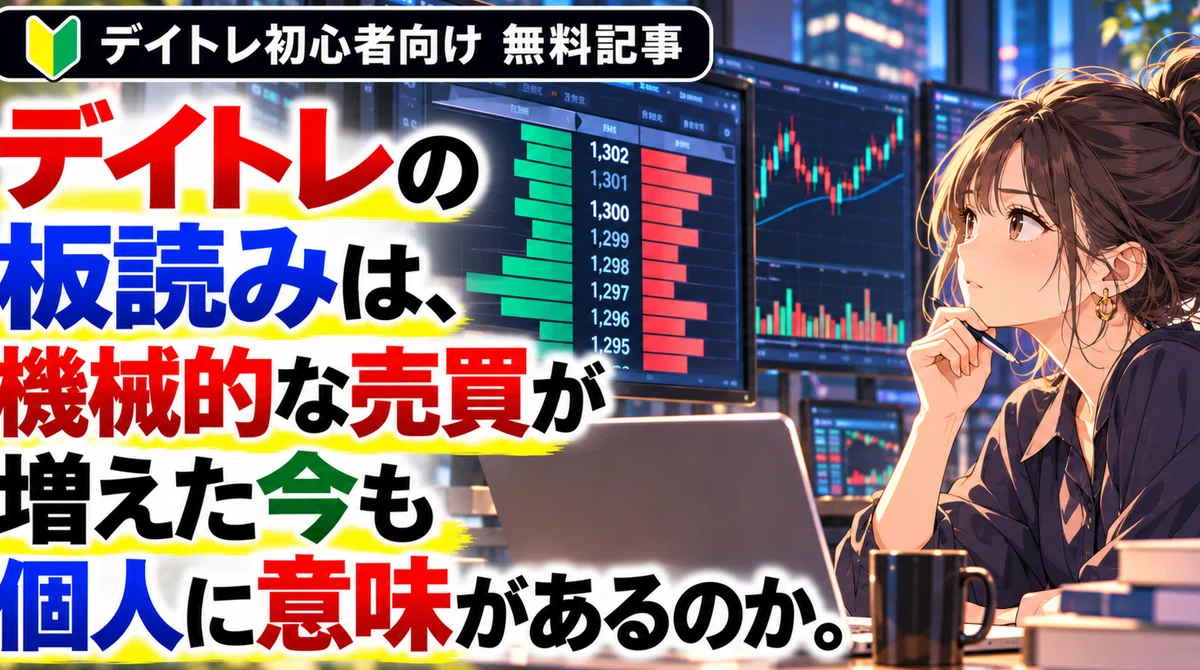
When you start learning day trading, there is a question that almost always comes up: “I hear that the current market has a lot of mechanical trading. Is there any point in an individual reading the order book?” When you look at the order book, it is just a stream of rapidly changing numbers, and you lose track of what to believe. This article organizes how beginners should think about this question.
Some order book movements can look like mechanical trading
It is said that in the current stock market, automated trading by programs accounts for a large proportion of transactions. When you actually watch the order book, you can see orders entering and exiting at regular intervals, or order figures changing significantly in a short period of time. Such movements are sometimes suspected to be caused by mechanical trading.
However, an individual cannot definitively judge whether a movement in the order book is mechanical or human. All you can see are the order figures, and you do not know who placed them. Therefore, it is not accurate to conclude that “it is unreadable because the opponent is a machine,” nor is it accurate to think that “you can see through the movements of a machine.”
The order book is a “copy of the situation,” not a “prophecy”
If your expectations for reading the order book are too high, your disappointment will also be great. The order book is not a prophecy that tells you what the stock price will do next. It is a copy of the situation, reflecting the lineup of orders from people who want to buy and sell at a certain moment.
What you can understand from this copy includes, for example, the following: which price ranges have orders concentrated in them; whether the sell side or the buy side is thicker; and how orders decrease when the stock price moves. None of these are certain conclusions, but merely materials for judgment. As long as you use them as materials, there are situations where they are useful even in an environment with a lot of mechanical trading.
Strengths that individuals have that machines do not
Individuals also have strengths that institutional investors and large-scale traders do not. Because the amount traded is small, it is difficult to move the price even if you enter or exit the order book. You also have the freedom to pass, and you do not have to do anything all day on days when conditions are poor. Furthermore, you can choose only those stocks whose movements are easy to read from among the many available.
There is no need to compete on speed on the same playing field as mechanical trading. You can compensate for the parts where you cannot win on speed by choosing and waiting. Reading the order book acts as a tool to improve the accuracy of that selection.
Look at actual trades in addition to the numbers in the order book
The numbers lined up in the order book are merely “orders that have been placed” and are not trades that have actually been executed. Therefore, if you only look at the numbers in the order book, you may make the wrong judgment. However, knowing that “the numbers in the order book can change” is itself part of the value of reading the order book.
When the stock price approaches an order that looks thick, does it actually get executed and decrease, or does it change in some other way? You can understand this difference to some extent by looking at the order book and the time and sales data together. If you switch to a perspective of confirming whether actual trades are accompanying the numbers instead of taking them at face value, there will still be uses for even a highly active order book.
The true meaning of an individual reading the order book
The point of an individual reading the order book is not to beat mechanical trading. Rather, it is to know the congestion or danger of the situation you are about to enter.
For example, if you jump in when sell orders are lined up thickly and buy orders are thin, there is a high possibility that it will not rise as you expected. Conversely, if buy orders are coming in continuously and the sell side is light, the conditions are not bad. Just knowing this sense of temperature can reduce reckless entries.
It is realistic for a beginner to think of reading the order book as a tool to avoid dangerous situations before it is a weapon for winning.
Where beginners should look first
There is no need to track all orders at once. At first, it is enough to just look at the thickness of the orders a few ticks above and below the current price and the pace at which executions occur. Once you get used to that, you can gradually expand the range you look at.
Narrowing down the range you look at is not discarding information. It is a way to handle information in a form that can be used for judgment. Rather than being overwhelmed by the amount of information on the screen and becoming unable to judge anything, looking at a few items reliably will result in faster learning. You can add items to look at later as you get used to it.
Thinking through a hypothetical scenario
The following is a hypothetical example to illustrate the way of thinking.
On the order book for a certain stock, large buy orders are lined up. A beginner sees this and feels there is strong support, so they enter with a buy. However, as the stock price drops, those orders do not hold up as expected and disappear all at once.
At this time, if you are basing your decisions solely on the order book, you will feel betrayed. However, if you know that large orders can change, you can treat the decrease as a signal that the premise has collapsed and cut your losses early. Do not trust the order book completely; use it while remaining skeptical. This is a realistic way to use it in a high-activity environment.
Not relying solely on the order book ultimately makes order book reading effective
The order book gains value when combined with other information rather than being used alone. Check actual executions using the time and sales data. Look at the volume to see the number of participants. Grasp prices that many people are aware of, such as VWAP or the previous day’s high. When these multiple pieces of information point in the same direction, the accuracy of your judgment increases.
Even if the order book is moving suspiciously, if other information is calm, do not try to force an interpretation. Being able to choose to pass on situations you cannot read is also part of the skill of using the order book.
Summary
Even now that algorithmic trading has increased, order book reading can be used as a tool to understand the situation rather than as a prophecy. With the understanding that the numbers on the order book can change, check them in conjunction with time and sales data and volume. Using it as material to avoid dangerous situations rather than as a weapon to win is a realistic approach for beginners.
The important thing is not to trust the order book too much, but also not to ignore it. If you use it while knowing the limits of the information you can see, there is still plenty of meaning for individuals to look at the order book.
Furthermore, how to read the order book does not end once you learn it. Because the market environment and participants change, an attitude of continuing to observe and updating your perspective little by little is essential.
Note: This article is intended for general information and sharing market perspectives, and does not recommend buying or selling specific stocks. Please make investment decisions at your own responsibility.


