

When I am debating whether to carry a short position over to the next day, I first check the day of the week on the calendar.
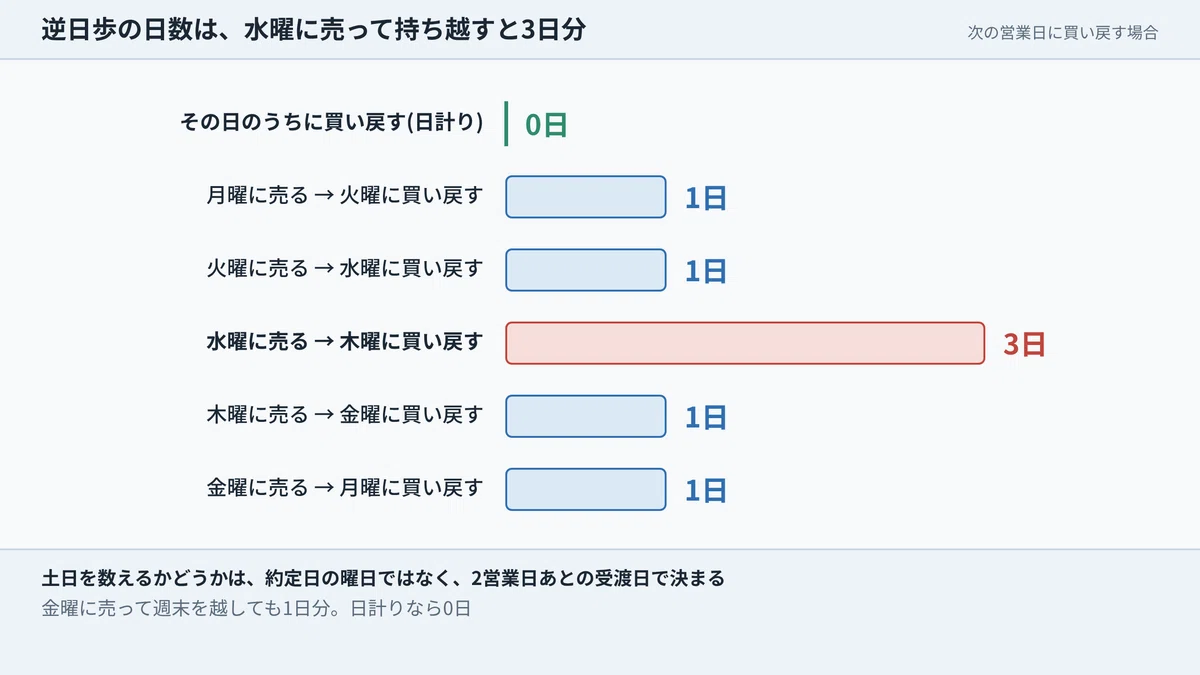
This is because the number of days for which the reverse daily fee (gyakuhibu) is charged changes depending on the day of the week. Selling on Wednesday and buying back on Thursday incurs a 3-day charge, whereas selling on Friday and buying back on the following Monday only incurs a 1-day charge. It was somewhat surprising to count it out and realize that Friday, which spans the weekend, is actually cheaper.
You would think that carrying over on a Friday, which includes Saturday and Sunday, would be the most expensive, right?
That is not the case.
If you are day trading and buying back within the same day, the number of days is zero.
No matter how high the reverse daily fee is on that day, the amount you pay is 0 yen.
The stock borrowing fee paid by short sellers
When you short sell using institutional margin trading, you are essentially borrowing the shares from a securities finance company. When there are more people selling on margin than buying, and there are not enough shares to lend, the securities finance company borrows shares from institutional investors to cover the shortfall. The borrowing fee at that time is the reverse daily fee (gyakuhibu).
According to an explanation on Rakuten Securities’ investment information media, the missing shares are collected through a bidding process, starting from the lowest offer, and the price at the point when the required amount is met becomes that day’s reverse daily fee.
Everyone who holds a short position on that day must pay it.
This includes those who have held the position from before.
Conversely, those who are buying on institutional margin are on the receiving end. The amount is determined as a set price per share; for example, Nikko Securities’ explanation mentions that if a reverse daily fee of 0.5 yen per share is applied for one day, a short seller of 1,000 shares would pay 500 yen.
It is said that the fee is determined between 10:00 AM and noon on the business day following the trade date.
At the time I sell in the evening, I do not know how much I will have to pay. This is what I dislike the most; I end up carrying the position over without knowing the cost. I only find out the next morning when I see the numbers, which is always a bit disappointing.
Note that short selling using general margin trading, where the securities company provides the shares itself, is a different story. Matsui Securities’ guide states that reverse daily fees do not occur with indefinite margin, short-term margin, or 1-day margin trading (other costs like stock lending fees are determined by each securities company).
The number of days is counted by the settlement date
This is the reason why the number of days changes depending on the day of the week.
According to Matsui Securities’ explanation, the reverse daily fee is charged for the number of days from the settlement date of the new position to the day before the settlement date of the repayment. Saturdays, Sundays, and holidays when there is no trading are counted if they fall within that period.
The trade date itself is not counted.
Only the settlement dates are counted.
The settlement date is the third business day counting from the trade date. According to the JPX website, this rule has been in effect since trades on July 16, 2019.
If you sell on Wednesday, the settlement date is Friday. If you buy back on Thursday, that settlement date is the following Monday. Since you count from Friday to Sunday, the day before Monday, it is 3 days: Friday, Saturday, and Sunday.
If you sell on Friday, the settlement date shifts to Tuesday. If you buy back on Monday, the settlement date is Wednesday, so you only count Tuesday, which is 1 day.
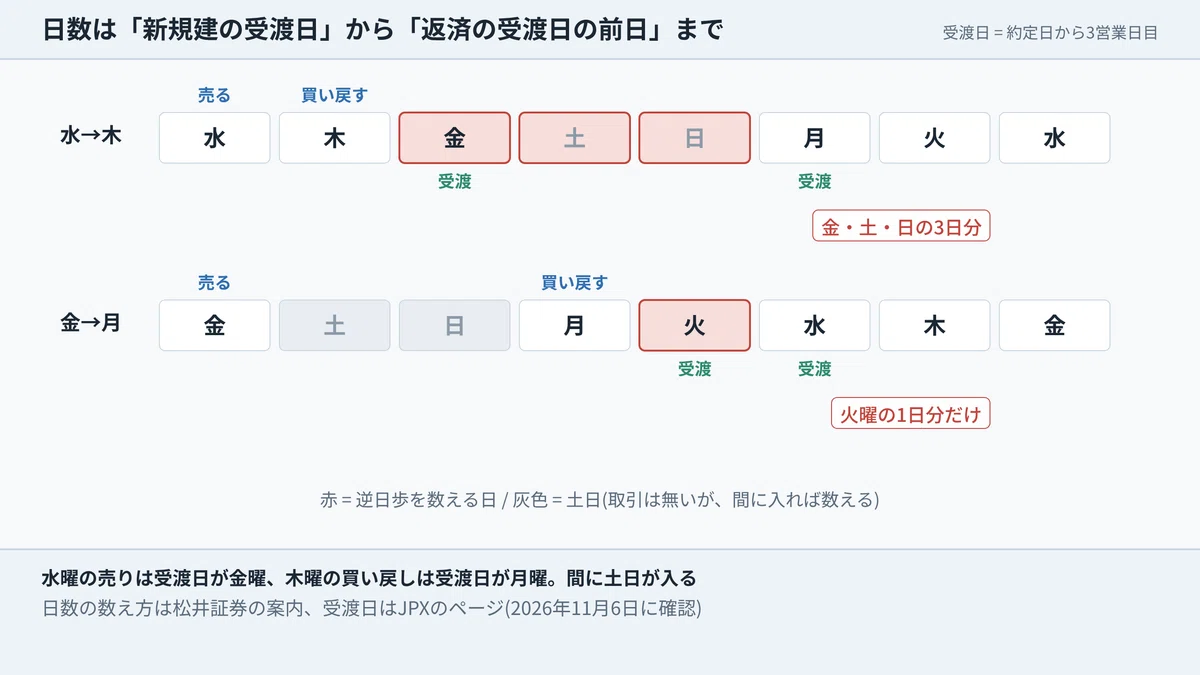
This means that where the two days of the weekend fall is determined not by the day of the week you sold or bought back, but by the day of the week of the settlement date two business days later. The explanation from Nikko Securities also included an example stating that if the settlement date spans a weekend, the weekend days are included in the count, so if it is 2 yen per share, for 1,000 shares it would be 2,000 yen per day, totaling 6,000 yen for 3 days.
Wednesday nights and before long weekends
Assuming you buy back on the next business day, the number of days for each day of the week is as follows.
-
Sell on Monday or Tuesday: 1 day
-
Sell on Wednesday and buy back on Thursday: 3 days
-
Sell on Thursday and buy back on Friday: 1 day
-
Sell on Friday and buy back on Monday: 1 day
The way of counting is the same even when holding for two or more nights.
If you sell on Thursday and buy back on Monday, spanning the weekend, the settlement dates are Monday and Wednesday, so it is 2 days. If you sell on Wednesday and buy back on Friday, the settlement dates are Friday and the following Tuesday, so it is 4 days. If you sell on Monday and hold until Friday, there are only 4 nights, but it is 6 days.
The number of nights held does not match the number of days paid.
It is hard to remember.
I only remember it as “shift the settlement date by two days and count.” Shift the day you sold and the day you bought back each two business days forward, and count the number of calendar days between them. This way, even if you don’t memorize the table of days of the week, you can recount it yourself during weeks with many holidays.
When a public holiday falls on a Monday, Wednesday night becomes even heavier.
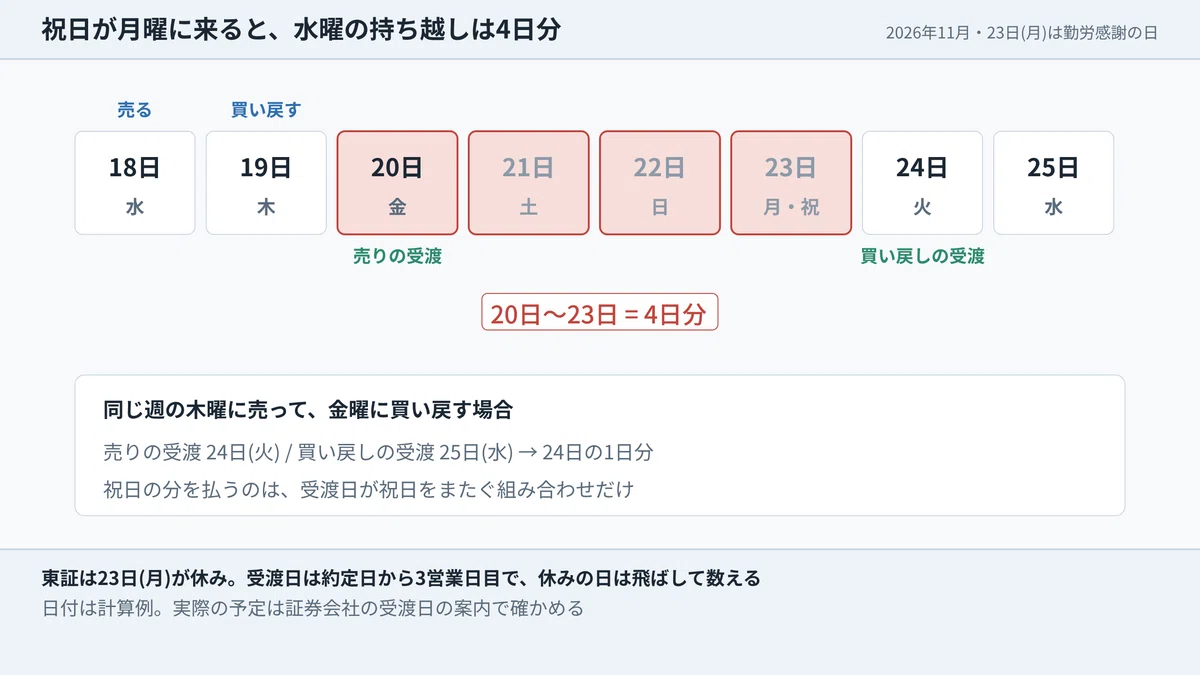
This month, Monday the 23rd is Labor Thanksgiving Day, so the Tokyo Stock Exchange is closed. If you sell on the 18th (Wed) and buy back on the 19th (Thu), the settlement dates are the 20th (Fri) and the 24th (Tue). From the 20th to the 23rd, it is 4 days. Even in the same week, if you sell on the 19th (Thu) and buy back on the 20th (Fri), the settlement dates are the 24th and 25th, which is 1 day.
You can check the number of days without counting them yourself. According to the explanation from Nikko Securities, you can see the stock lending fee rate and the number of stock lending days for each stock in the “Loan Transaction Information” of the Japan Securities Finance Co., Ltd. I read it as the number in that days column being 3 for trades on Wednesday. When you are unsure if your counting method is correct during a holiday week, I think the fastest way is to compare that number with your own count.
It is a tedious task.
Let me convert it into a monetary amount.
Suppose you short 500 shares of a certain stock at 1,200 yen. If the Gyakuhibu (reverse daily fee) is 0.5 yen per share, it would be 250 yen for one day, 750 yen for three days, and 1,000 yen for four days. Converted to a per-share basis, that is 0.5 yen, 1.5 yen, and 2 yen, which is the same as your buyback price increasing by that amount. If a 2-yen-per-share day occurs for three days, that is 6 yen, totaling 3,000 yen.
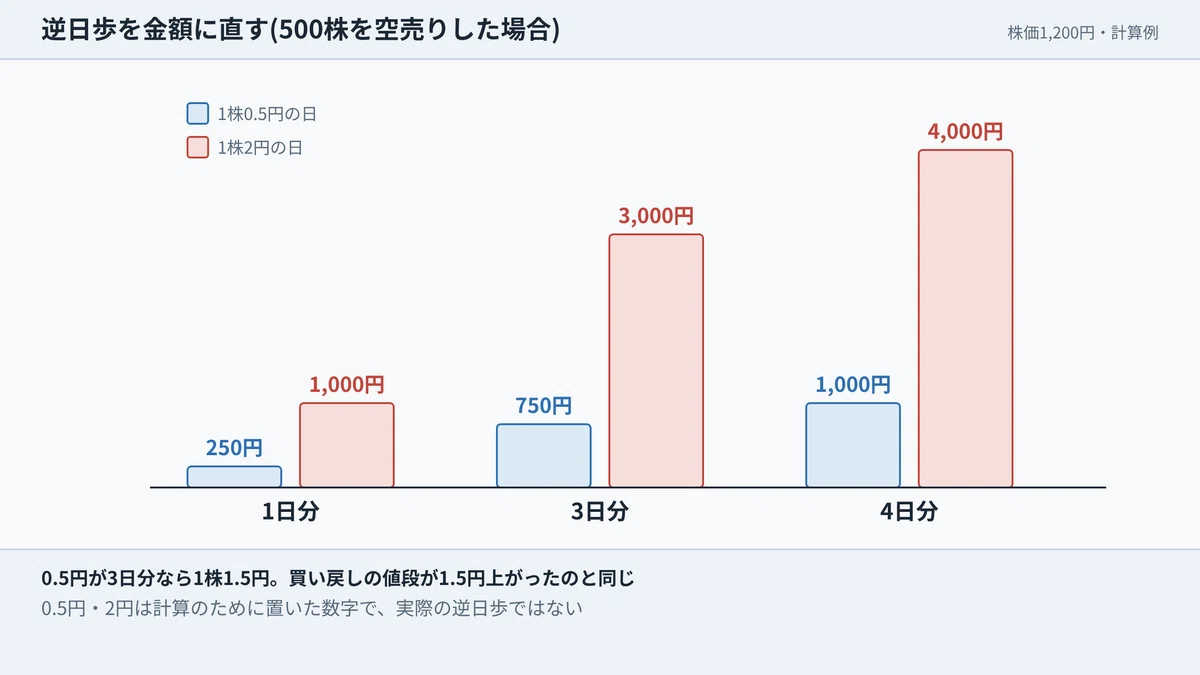
0.5 yen and 2 yen are figures used for calculation purposes. Some stocks rarely have Gyakuhibu, while others have it continuously, so it cannot be summarized in a single word.
It is not limitless.
There is an upper limit. According to SMBC Nikko Securities’ explanation, the limit is the “maximum rate” set by the Japan Securities Finance Co., which is determined by the trading unit and the loan price, and can be checked in a quick-reference table. If the stock shortage persists for several days, that limit can reportedly be raised by 2 to 10 times.
For three days, and on a day when the limit has been raised, the amount becomes no laughing matter.
For day trading, it is 0 days. Even so, it is a point of hesitation.
If the sale and buyback occur on the same day, the settlement date for the new position and the settlement date for the closing position are also the same day.
“From the settlement date to the day before the settlement date” is 0 days.
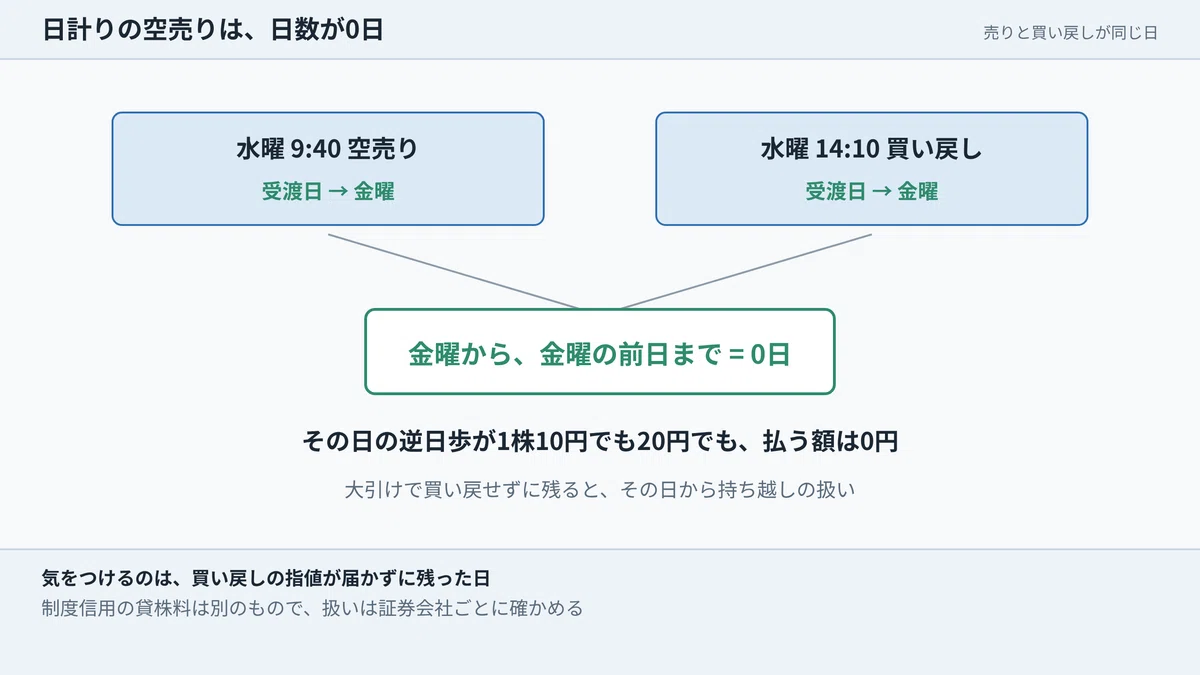
Even if the Gyakuhibu for that day is 10 yen or 20 yen per share, it does not affect day-traded short sales. I think the only time you worry about Gyakuhibu in day trading is when you fail to buy back by the market close.
However, you sometimes cannot choose that “day you failed to buy back.” If the limit order you intended to buy back at by the 3:30 PM market close is not filled and remains, that short sale is carried over. If that happens on a Wednesday, you end up paying for three days unintentionally.
Honestly, what I struggle with is a different situation.
Whether or not to carry over a short sale with unrealized gains past the Wednesday market close. Even if there is a slight prospect of it falling the next day, you end up paying three days’ worth of borrowing fees at a price that has not yet been determined. If it is before a long weekend, that is four days’ worth.
There is one more thing I have not been able to fully verify. The stock lending fee for institutional margin trading is separate from Gyakuhibu, and I have not verified with every securities company whether this includes a one-day charge for day trading.
On Wednesday nights, I usually close out my positions. Well, if the price drops after I close out, that tends to stick in my memory more, so I still do not know if that is the right approach.
I have included an article calculating where to sell and where to buy back for short sales, down to the number of shares, in my paid magazine “[Day Trading Stocks] Practical Edition Set.” If you want to read more, “Cutting Short Sales One Line Above: Position and Share Count for Selling into Rallies” is a similar topic. The practical edition contains 19 articles for 1,980 yen, with each article normally around 580 yen, and you can read future articles added without additional payment.
https://note.com/takway/m/mb368587d6ef5
If you have read this far and found the way to count the days even slightly helpful, I would be happy if you could press the Like (♡) button. I use it as a reference to decide the theme for my next article.
Do you worry about the day of the week when carrying over short sales? Please let me know in the comments, and I will use it as a reference for my next article.
If you follow me, you will receive new articles every night.
This page explains the mechanism of Gyakuhibu (stock lending fees) and how to count the days involved. The figures in the article are calculation examples for explanation and are not actual Gyakuhibu or trading results for specific stocks. The definition of Gyakuhibu and the fact that weekends and holidays are included in the count were confirmed on the Daiwa Securities financial and securities glossary; the method of counting days (from the settlement date of the new position to the day before the settlement date of the closing position) and the fact that Gyakuhibu does not occur in one-day margin trading were confirmed on the Matsui Securities guide; examples of settlement dates spanning weekends and the maximum rate/determination time were confirmed on the SMBC Nikko Securities explanation; the bidding mechanism was confirmed on the Rakuten Securities investment information media; and the fact that the settlement date is the third business day from the trade date was confirmed on the JPX page, all as of November 6, 2026. This does not recommend trading any specific stock, nor does it guarantee future results. Please make investment decisions at your own responsibility.