


Written by: Tsukasa Minbu (Private Asset Management Division)
Even for the same rental building, asset value can fluctuate by around 10% without any change in rent or occupancy rates. Furthermore, depending on the terms of the loan, the ratio of money remaining in hand relative to the money invested can change significantly.
Both are changes that are difficult to notice just by looking at monthly income and expenditure reports.
In my previous article (What is the difference between AM, PM, BM, LM, and CM?) I organized the fact that AM (Asset Management) is a role that considers real estate operation policies.
This time, I will delve into what an AM looks at and what kind of judgments they lead to, from the perspectives of the PL (Profit and Loss Statement) and the BS (Balance Sheet).
AMs view the present and future of real estate as one
As organized in the previous article, while PM (Property Management) is responsible for daily operations, AM grasps current earnings and asset value, and judges operation policies while keeping the future in mind.
What an AM thinks about is not just immediate earnings. They consider increasing value, using money efficiently, and preparing for risks all together.
And the foundation for an AM to grasp the situation of real estate and judge and execute operation policies is the two perspectives of PL and BS. The PL represents earnings and expenses over a certain period, while the BS represents assets at a certain point in time, and the liabilities and net assets that support them.
However, what an AM looks at is not just the numbers on the books. They consider future operation policies based on the current market value of the real estate and the status of borrowings.
Broadly speaking, real estate earnings are easily differentiated by human ingenuity, while asset value is easily influenced by the market. This difference becomes the axis of the story from here on.
PL: NOI is differentiated by ‘people’
The central figure in the PL is NOI (Net Operating Income).
NOI is what remains after subtracting operating expenses such as management fees, routine repair costs, and fixed asset taxes from income such as rent; it is, so to speak, the ‘earning power of the property itself.’ It differs from accounting profit, which subtracts loan interest and depreciation.
To increase this NOI, an AM considers ways to increase income and ways to review operating expenses.
However, it is not always the case that expenses should just be cut. If old equipment is updated, rent and occupancy rates may rise, and NOI may grow. In that case, they check the necessary investment amount and the period required for its recovery.
Furthermore, there is also the option of changing the way the building itself is used to aim for improved earnings.
This is ‘content-type’ investment that creates reasons for users to choose the building, by planning not only renovations and changes in use, but also the services and experiences provided in that building.
What is required of an AM here is not just the ability to manage numbers. It is the creativity to look beyond competitors and the industry to conceive new ways of use.
Although influenced by market conditions, the results for the same property will change depending on who is involved, with what level of precision, and with what kind of ideas. The PL is an area where the ingenuity and execution power of the people involved are easily reflected in the numbers. However, it is necessary to consider separately whether the reason for the improved numbers is due to operational ingenuity or the rise of the market as a whole. It is also the role of an AM to verify where they are now compared to the market and the initial plan.
BS: Value moves with the ‘market’, and how you borrow changes what remains in hand
On the other hand, what is viewed from the perspective of the BS is how much value the real estate has now, and how it is supported by borrowings and equity.
The value referred to here is not the amount recorded on the books, but the value in the current market.
One way to think about the value of income-generating real estate is to calculate it by dividing the stably expected NOI by a yield called the ‘cap rate.’ Simply put, the cap rate is the yield on earnings that an investor seeks from that real estate. It changes depending on interest rates, investor movements, and property characteristics.
For example, suppose there is a property that generates 50 million yen in NOI per year. If the cap rate is 5.0%, the estimated asset value is 1 billion yen. If this is 4.5%, it is about 1.11 billion yen, and if it is 5.5%, it is about 910 million yen. In other words, even for real estate that generates the same earnings, if the required yield changes due to interest rates or investor trends, the asset value also changes.
On the other hand, as seen in the PL chapter, improving NOI through operational ingenuity also leads to an increase in asset value.
If NOI increases by 5 million yen per year, it is expected to continue, and the cap rate remains at 5.0%, the asset value is calculated to increase by about 100 million yen. Each individual action on-site moves the value of the asset itself.
Another important point from the BS perspective is the combination of borrowings and equity.
Even if you change how you borrow, the value of the property does not change, but the ratio of earnings to the invested equity and the risk can change significantly.
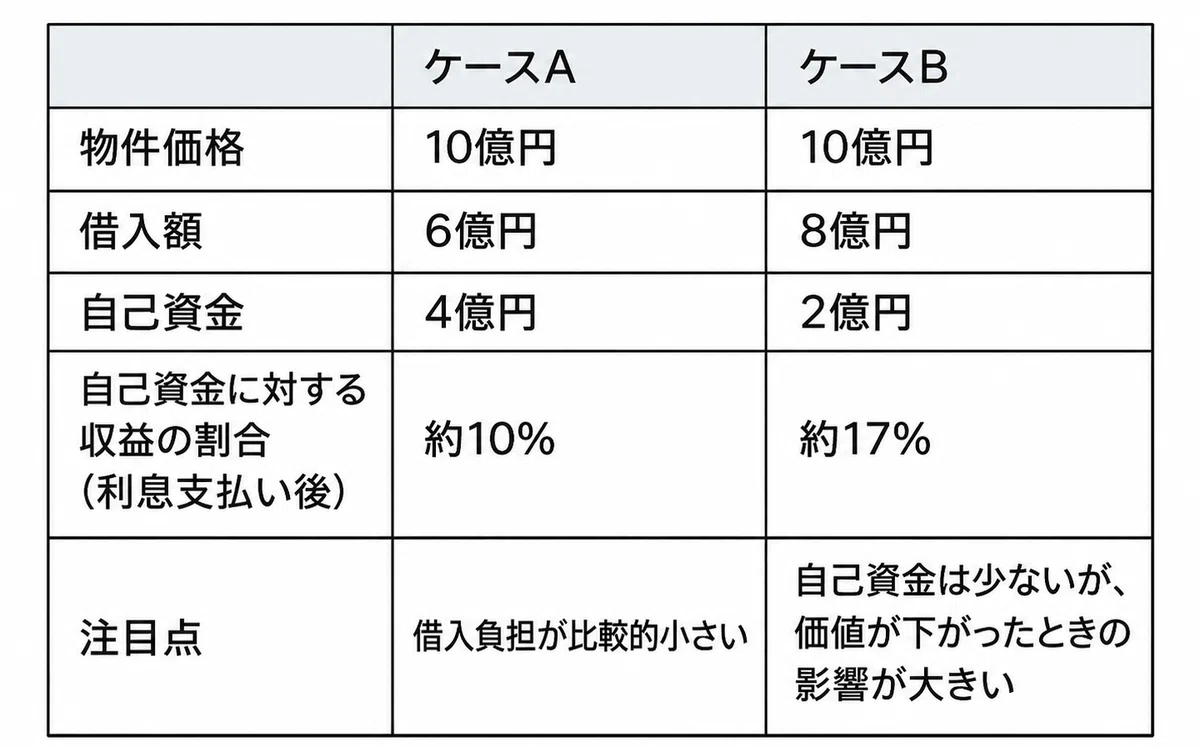
For example, even for the same 1 billion yen property, if the borrowing is 600 million yen, the equity is 400 million yen; if the borrowing is 800 million yen, the equity is 200 million yen. By increasing borrowings, you can own the property with less equity, but the burden of interest and repayment increases. Furthermore, if the value of the property falls, the ratio of borrowings to asset value increases, and options such as refinancing may narrow.
In phases where the property yield exceeds the borrowing interest rate, capital efficiency may increase, but increasing borrowings does not necessarily mean it will be advantageous. Efficiency and risk are two sides of the same coin. That is why an AM continues to review not only earnings but also loan terms while watching the market. Loan terms include the level of interest rates, whether they are fixed or variable, the loan period and repayment method, and promises made with financial institutions.
▽ Different ‘ways of borrowing’ even for the same property
The relationship between PL and BS so far can be summarized as follows.
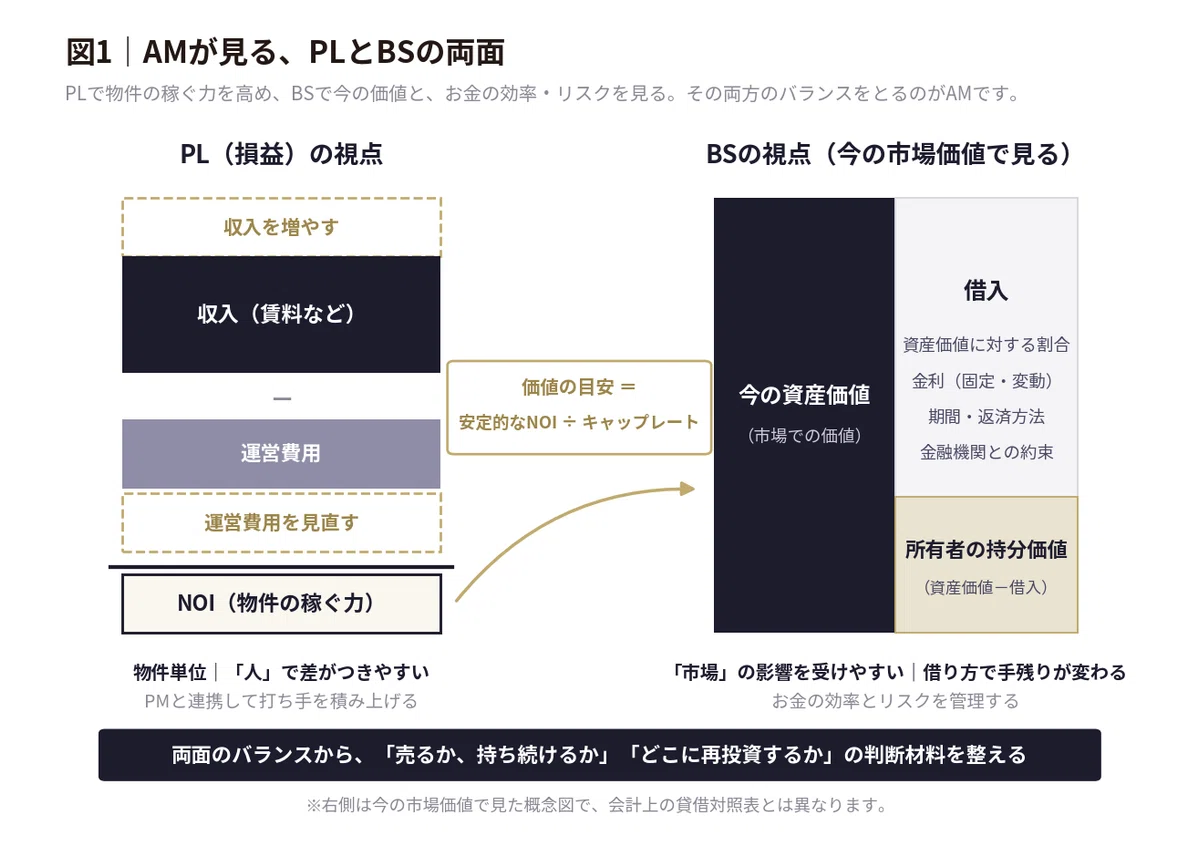
*Cap rate: The yield on earnings that an investor seeks from that real estate
‘How much it was bought for’ is not the starting point for judgment
As we have seen so far, an AM considers operation policies based not only on the earning power of the real estate but also on the current asset value and the status of borrowings.
One of the important judgments is ‘whether to sell or continue holding.’
The starting point for judgment at this time is not the acquisition price, but ‘now.’
For example, suppose real estate that was previously acquired for 200 million yen now has a market value of 400 million yen and generates 10 million yen in NOI per year. If you only look at it as ‘bought cheaply,’ you might not feel any doubt about continuing to hold it.
However, if you use the acquisition price of 200 million yen as a standard, the annual NOI ratio is 5.0%, but if you use the current market value of 400 million yen as a standard, it is 2.5%. Even for the same real estate, if you use the current value as a standard, the way earnings appear changes.
So, if you sell it now, how much will remain in hand after paying taxes, expenses, and loan repayments?
Continuing to hold it also means that you are continuing to leave that money in this real estate. Then, how much will that money increase in the future? We look ahead to the balance after future taxes, interest, and principal repayment, necessary additional investments, and even the proceeds when selling at some point, and compare it with the case of using that money elsewhere, including the period and risk.
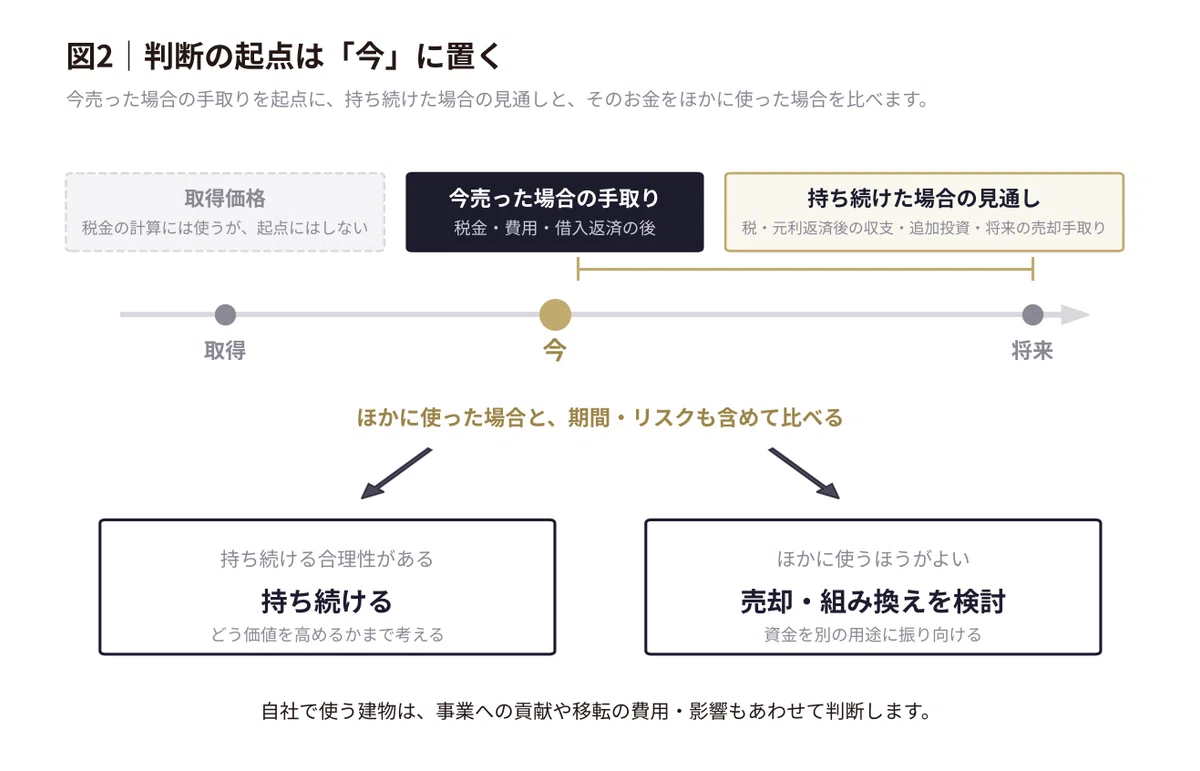
The acquisition price and the plan at the time of acquisition are important comparison materials for looking back on past achievements. On the other hand, when considering whether to continue holding or sell from now on, we use the current value and future prospects as the starting point.
This applies especially to land inherited through succession or buildings that have been held for a long time. Even if you think ‘the original cost has already been recovered,’ it is worth verifying again whether it is generating earnings commensurate with its current value. If it is a building used by your own company, the contribution to the business and the costs and impact if relocated are also important judgment materials.
Last time, we, the Private Asset Management Division (PAM Division), stated that we ‘do not assume selling as an exit.’ That means applying this ‘now’-based yardstick to the judgment of continuing to hold as well.
We organize everything including business succession and the owner’s intentions, and prepare judgment materials so that the owner can decide with a basis. At the root of that is the stance of thinking about the owner’s assets as if they were our own assets.
Judgment materials for real estate that cannot be seen from income and expenditure alone
Looking back, what we saw in the PL was the earning power of the real estate. What we saw in the BS was the current asset value and the money supporting it. And what we saw through cap rates and interest rates were market movements.
An AM grasps these earnings, asset value, loan terms, and market trends together to consider real estate operation policies. Not how much it was acquired for in the past, but judging whether to continue holding or sell based on the current value. That is the AM perspective.
For your company’s real estate, try writing down three things: earning power (NOI for rentals, contribution to business for self-use), current value, and loan terms.
When these three are lined up, real estate changes from something you ‘have’ to something you ‘manage.’
[For those who want to know more about the PAM Division’s initiatives]
We introduce in detail the Profit’s PAM Division, which views real estate from a management perspective and accompanies you from strategy formulation to execution.
▼ View PAM Division introduction materials (PDF)
*Click the image to view the materials

▼ Click here for inquiries

▼ View Profit’s corporate site