

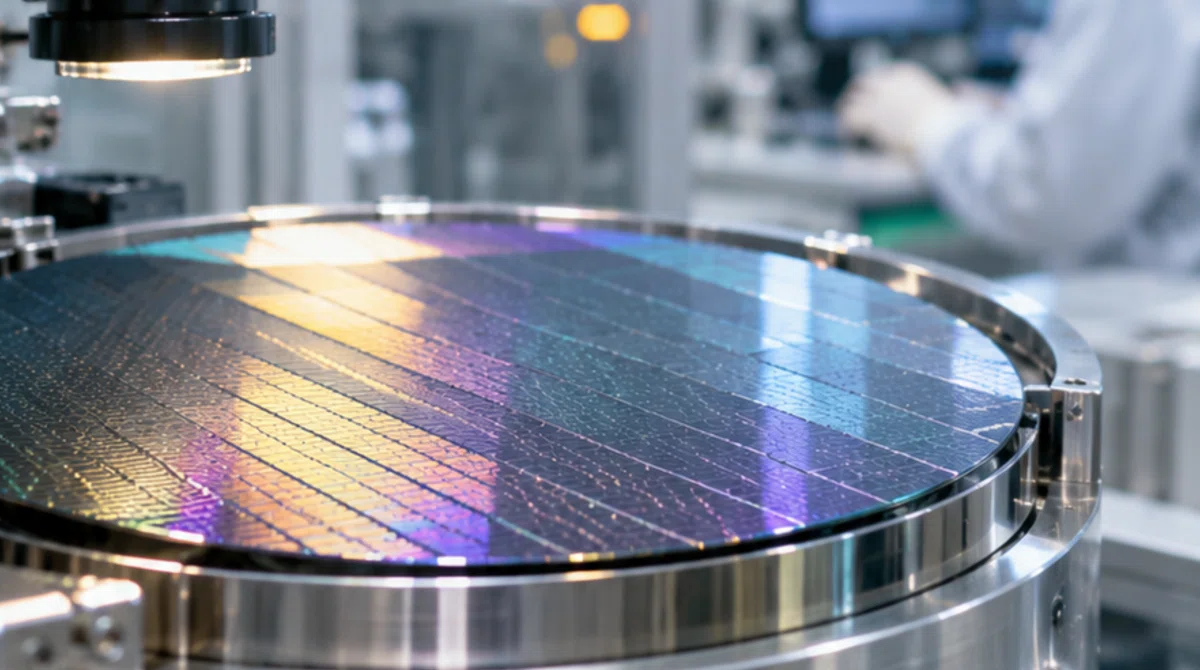
It is not just high-performance semiconductors that support the evolution of generative AI.
To process massive amounts of data at high speeds, communication technology that connects semiconductors is also essential.
In this field, a new partnership between domestic companies has been announced.
On November 9, 2026, JX Metals, a major non-ferrous metal and advanced materials company, and Oxide, an optical crystal manufacturer, announced a capital and business alliance.
JX Metals will underwrite a third-party allocation of shares by Oxide, investing 2.7 billion yen. The shareholding ratio after the investment is expected to be 7.12%.
Why would a major company dealing in metal materials invest in a specialized manufacturer of optical crystals?
The background lies in a technology called ‘photoelectric fusion,’ which is becoming increasingly important due to the spread of generative AI.
The challenge for AI infrastructure is not just computing performance.
With the improvement in generative AI performance, data centers are requiring massive amounts of electricity.
According to a report published by the International Energy Agency (IEA) in April 2025, the global electricity consumption of data centers was approximately 415 TWh as of 2024.
This is equivalent to about 1.5% of total global electricity consumption.
Furthermore, it is estimated that this could increase to approximately 945 TWh by 2030.
AI is considered a major factor in this increase.
In generative AI training, numerous GPUs are linked to perform vast calculations.
Therefore, it is important not only to have the performance of individual semiconductors but also to efficiently send and receive data between semiconductors and servers.
With conventional electrical signal communication, as communication speed and data volume increase, power consumption and heat generation become issues.
This is why technology that replaces some electrical signals with optical signals is attracting attention.
Optical communication is already used between data centers and in other areas.
In the future, it is expected that utilizing light for shorter-distance communication will help reduce the power required for data processing.
However, not all electrical wiring will be replaced by light immediately.
For the technology to be put into practical use, there are issues to be solved, such as the miniaturization of components, mass production, and costs.
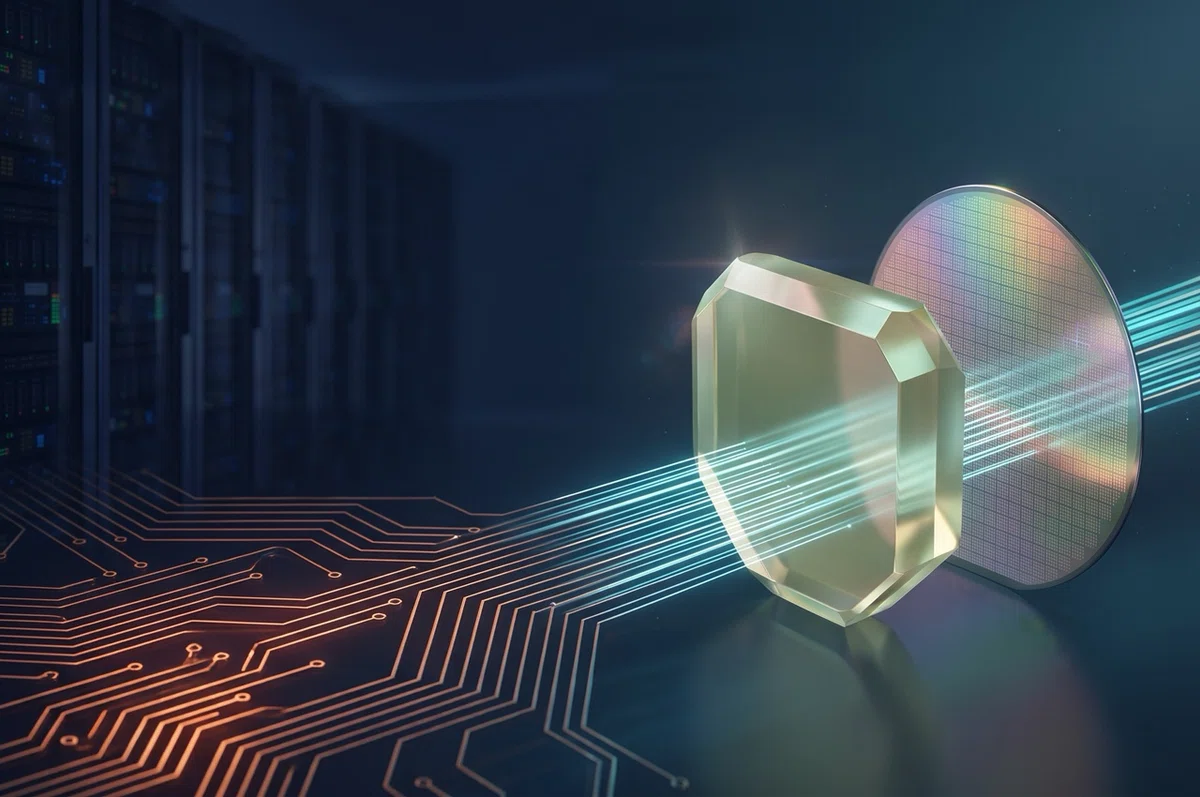
Why did JX Metals and Oxide
form a partnership?
Crucial to understanding this partnership are the material technologies of both companies.
JX Metals has strengths in materials used for semiconductor manufacturing.
One of these is the indium phosphide (InP) substrate.
InP substrates are used in the manufacturing of lasers and light-receiving elements used in optical communication.
In June 2026, JX Metals announced a policy to invest up to 120 billion yen over the next four years to increase its InP substrate production capacity.
Including previously announced investments, the scale of investment reaches approximately 150 billion yen.
The plan is to expand production capacity by 7 to 10 times compared to fiscal year 2025.
The company is trying to cultivate InP substrates as a new pillar of revenue.
On the other hand, Oxide is a company that handles optical single crystals and lasers.
In this partnership, two material technologies held by the company are attracting attention.
One is a material called ‘Bi:RIG.’
This is used in components called optical isolators, which prevent laser operation from becoming unstable due to light reflection.
The other is ‘TFLN.’
TFLN is being researched as a material for optical modulators that convert electrical signals into optical signals.
In other words, JX Metals and Oxide possess different technologies necessary for optical communication.
JX Metals has strengths in materials for elements that generate and receive light, while Oxide has strengths in materials related to light control and modulation.
By cooperating, both companies are expected to broaden the range of technologies related to optical communication components.
Three perspectives that are important in partnerships with large companies
This partnership can also serve as a reference for technology companies when expanding their businesses.
1. Secure contact points with sales destinations, not just technology
Even if you have excellent technology, that alone does not mean you can sell products to customers around the world.
Especially in the fields of semiconductors and optical communication, requirements for quality and stable supply are high, and it is necessary to obtain certification from customers.
JX Metals has built trading relationships with global customers through semiconductor materials and other products.
For Oxide, being able to collaborate with such a customer base could be an opportunity for business expansion.
On the other hand, for JX Metals, combining optical material technology that it does not possess itself could allow it to expand the range of products and technology proposals.
2. Raise funds while maintaining management independence
This time, the amount invested by JX Metals is 2.7 billion yen.
The shareholding ratio after the investment is expected to be 7.12%, and it is not intended to make Oxide a subsidiary.
Oxide will continue its business as an independent listed company while proceeding with cooperation with JX Metals.
For technology companies, large amounts of funds are sometimes required for research and development and manufacturing equipment.
To respond to markets where growth is expected, it is also necessary to make capital investments before demand becomes full-scale.
Raising funds from companies with which you have a business cooperative relationship, as in this case, is one option.
However, it is necessary to be aware that the shareholding ratio of existing shareholders will decrease due to the third-party allocation of shares.
Also, as the relationship with a specific company deepens, it is necessary to be considerate of relationships with other business partners and information management.
3. Link the partner company’s management strategy with your own technology
When considering a partnership with a large company, it is important to understand not only the scale of the partner’s business but also which fields they are concentrating their investments in.
JX Metals had already announced a plan for a significant increase in InP substrate production.
Therefore, materials and technologies related to optical communication are fields deeply related to the company’s growth strategy.
The technology that Oxide possesses is located in the peripheral area of the business that JX Metals is promoting.
In partnerships between companies, it is required not only to show the excellence of the technology but also to explain what value that technology brings to the partner’s business.
There are still challenges to the spread of photoelectric fusion.
Photoelectric fusion is a technology whose importance is increasing due to the spread of generative AI.
However, it has not yet been determined what methods will be widely adopted in the future.
There are multiple types of components necessary for optical communication, such as lasers, optical modulators, and optical isolators.
For each technology, it is necessary to improve performance and establish mass production systems.
Also, it is not certain that AI-related capital investment will continue to expand at the same pace in the future.
There is a possibility that material demand will fluctuate due to changes in the market environment.
Therefore, to what extent this partnership will actually lead to sales and profits needs to be confirmed through future joint development and the progress of mass production.
At this point, the specific revenue effects of the partnership have not been determined.
It is the less visible material technology that supports the growth of generative AI
In discussions about generative AI, the performance of AI models and the processing power of GPUs tend to attract attention.
However, to run large-scale AI systems, many technologies are required, such as power supply, cooling, and communication.
This partnership between JX Metals and Oxide is an initiative related to materials that support communication among them.
In Japan, there are companies with highly specialized technologies such as semiconductor materials and optical crystals.
On the other hand, to spread technology in the global market, manufacturing capacity, quality control, and sales networks are also necessary.
Combining the business foundation of a large company with the technology of a specialized manufacturer is one way to address these challenges.
Summary
JX Metals will invest 2.7 billion yen in optical crystal manufacturer Oxide and proceed with a capital and business alliance.
The background is the increase in data communication volume and power consumption accompanying the spread of generative AI.
Both companies possess different material technologies necessary for optical communication, and they plan to proceed with cooperation on the technical side through this partnership.
However, the spread of photoelectric fusion and specific business results depend on future efforts.
This case serves as an opportunity to think about the importance of material technology that supports the growth of generative AI and the significance of companies with specialized technology cooperating with large companies.
(Reference article = BUSINESS JOURNAL)


