Wildlife and agriculture has always felt like a battle that just goes back and forth with no winner. You hear about wolves living in their natural habitat that attack livestock and about wild horses that compete with ranchers for grazing rights on public lands.
But the relationship between wildlife and agriculture is often a lot more complicated and nuanced than these examples.
Even though it might feel like it at times, it is not farming versus wildlife. Instead, coexistence is the real challenge. Farmers and ranchers are often the ones who help create and maintain habitat that wildlife lives on, but on the other hand, wildlife can damage fences, fields, prey on livestock, and have other downsides. Instead of trying to eliminate wildlife, farmers and ranchers have the challenge of coexisting with livestock in a way that is beneficial to everyone in the long run.

A gray wolf captured on a game camera approaching a bull in June of 2023. (Image by Tina Saitone and Ken Tate, UC Davis)
Farms are often one of the most prevalent habitats for animals. There are shelterbelts, wetlands, strips of grass alongside roads, creeks and waterways, pastures, and more that provide places for animals to live. There are also a lot of areas that are not actively used for agriculture.
The U.S. Department of Agriculture has a variety of conservation programs. The Conservation Reserve Program, for example, has 27 million acres enrolled across the country. The CRP gives landowners and rental payments and cost-share assistance to establish long-term vegetative areas. The overall goal is to reduce soil erosion, improve water quality, and increase wildlife habitat. The USDA’s Natural Resources Conservation Service provides resources to farmers and ranchers about conservation practices, cover crops, prairie restoration, and similar practices, which can help to manage land.
Wildlife and agriculture have a complicated relationship, but there are many examples of wildlife and agriculture benefiting from each other.
“Native wildlife provides valuable biological pest control allowing farmers to reduce their use of pesticides and rodenticides, while also saving money,” said Jamie Nack, an Extension Senior Wildlife Outreach Specialist for the University of Wisconsin-Madison. “Natural predators such as swallows, bluebirds, bats, owls, American kestrels, and snakes help manage insect and small mammal populations. Wildlife, including native insects, birds and bats, are also important pollinators. Many conservation practices, such as rotational grazing, windbreaks, and stream buffer strips benefit agricultural land and wildlife.”
She also noted that agricultural practices can also be important for wildlife, especially when food resources are low, such as in late winter.
“For example, wild turkeys benefit from winter manure-spreading. They are able to feed on the undigested corn and grains when snow covers their natural forage like acorns and seeds in the forests,” she said.
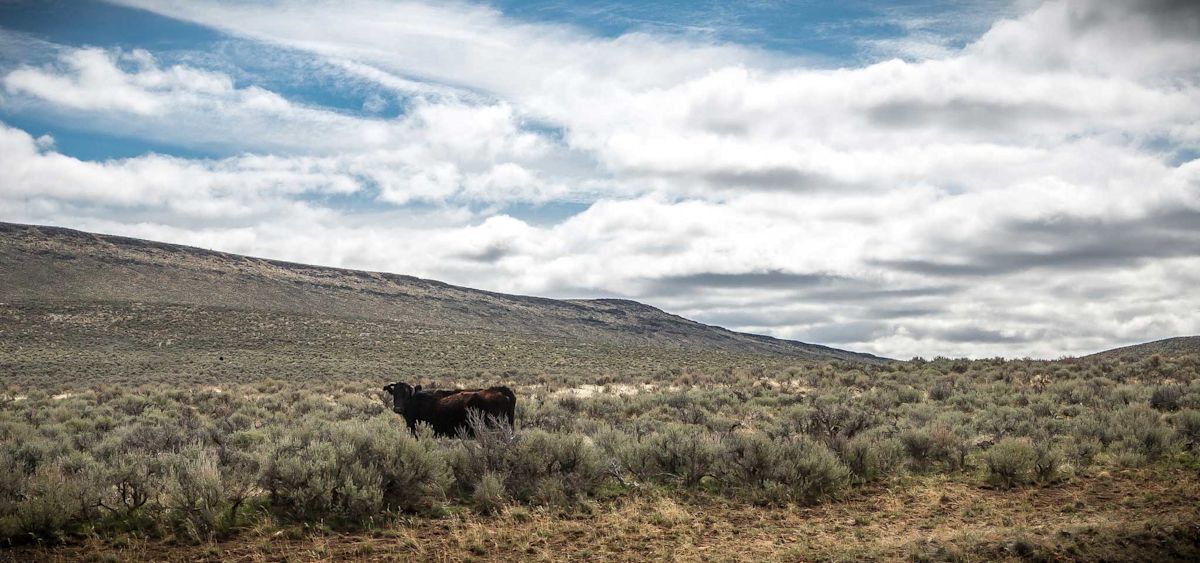
You will often find livestock sharing grasslands with wildlife, especially if animals are on public land or large, open grasslands. These pastures and grasslands can provide habitats and cover for birds and other small animals. Unfortunately, large animals can also mean problems for grazing livestock. Wild horses, elk, and other grass-eaters can end up competing with cattle, sheep, and goats for food. Wolves, mountain lions, coyotes, and other large predators can kill livestock if there aren’t efforts to prevent this.
Agriculture faces challenges from “livestock predators such as coyotes and wolves,” Nack said, while also dealing with “crop depredation from deer, sandhill cranes, black bears, and other animals, and invasive/nuisance species like European starlings that consume livestock feed and can contaminate feed, water, and animal environments.”

Image by Heidi Crnkovic, AGDAILY
On the other side of the fence — perhaps literally and figuratively — she warns that “conventional agricultural practices can create fragmentation via fencing and roads, and reduce available habitat and travel corridors through intensive cultivation and the removal of fencelines.” She also says that agriculture has some tools to help with this like the use of rotational grazing, which can be very beneficial for grassland birds.
There have been increased efforts to reduce conflicts between predatory wildlife and livestock. Specialized fences can be used to keep certain animals in or out of an area. Injured, sick, or animals who are close to or have recently given birth are often kept closer to a barn or in special areas away from potential predators.
One unique way to protect livestock from predators is the use of guardian dogs, donkeys, or llamas. These animals will protect the herd from potential predators and keep predators away in the first place. Bright colored flags called fladry can be placed along a fence to scare away predators from areas inhabited by livestock. All of these nonlethal efforts and more have been used to protect livestock, while allowing wildlife to continue living in their natural habitat.
“The most effective strategies will depend on the specific situation and the wildlife species involved. Generally speaking, the most effective nonlethal strategies include physical exclusion such as fencing, carcass disposal, and attractant modification, changes in husbandry practices, livestock guardian animals, and hazing or sensory deterrents,” Nack explained.
The USDA’s Animal and Plant Health Inspection Service also provides wildlife services, including things like providing damage for damage caused by wildlife, conducting wildlife research, sharing resources, and implementing various programs to support wildlife and agriculture simultaneously. This is very important, especially in an area of agriculture that has been lacking in research.

Snakes can sometimes pose a danger to chickens and their eggs. (Image by P_galasso2289, Shutterstock)
Conflict and issues relating to this are unavoidable, but luckily, research is ongoing — and the conversation is starting to change. The farmers and ranchers of the past were a lot more likely to take matters into their own hands to keep wildlife off of their property, but times are changing. People are recognizing that if we don’t start protecting wildlife and providing habitats, some species and areas of the county will be in trouble. Farming and ranching is actually a big part of the solution. Farmers and ranchers understand caring for animals and the land better than almost anyone, and this includes the wildlife naturally found there.
There are benefits and downsides of sharing agricultural land with wildlife, but it’s almost always a conversation about co-existence, not one versus the other. Obviously we need agriculture to be productive and successful to ensure people are fed and clothed. We also need wildlife to live in their natural habitats, or we run into much bigger problems. The ongoing challenge is how to manage livestock and wildlife populations with the smallest risk of livestock and biodiversity loss. Conservation and protecting both wildlife and livestock is just another example of how farmers and ranchers work with the land, not take it over.
“Wildlife habitat and agricultural land should be thought of and managed as one healthy ecosystem, rather than competing entities. Farmers and wildlife both depend and thrive in healthy ecosystems,” Nack said.
Michelle Miller, the Farm Babe, is a former row crop and livestock farmer, keynote speaker, writer, and online influencer who advocates for agriculture while traveling the world. She is passionate about bridging the gap between farmers and consumers, by giving science a bigger voice. Find more about Michelle on her website.
The post Shared land complicates interactions between wildlife and agriculture appeared first on AGDAILY.