
Few firms get a closer look at how accredited investors actually buy commercial real estate than Custom Capital. The Miami-based private family office spends $60,000 to $80,000 a month reaching these investors and tracks every deal they close. Its new Q3 2026 Accredited Investor Report puts a full year of that data out in the open.
One finding stands out. Most of these investors don’t buy property where they live. Here’s what the data shows, and why so many buyers are comfortable owning a building hundreds of miles from home.
Most investors bought far from home
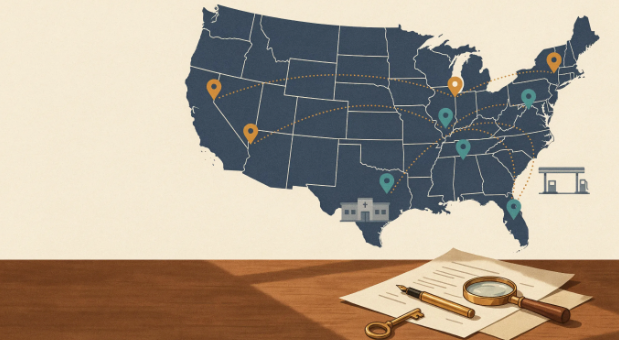
From October 2025 to September 2026, Custom Capital’s investors bought 47 properties. Most of those investors lived in Illinois, California, New York and New Jersey. But the properties they bought were mostly in Texas, Ohio, Missouri and Florida.
Texas is the clearest example. Only two of the investors lived in Texas, but 13 of the deals happened there. Ohio and Missouri came next, and not one investor lived in either state.
It works the other way too. Not a single property was bought in California, New York or New Jersey. Every investor from those three states bought somewhere else.
Why distance matters less than you’d think
“Where an investor lives and where they want to own real estate are often two different places. When there aren’t many favorable assets located near an investor, distance matters a lot less. Investors in Chicago or New Jersey can comfortably own a clinic in Texas,” said Jason Milton, CEO of Custom Capital.
Many of these investors live in large, expensive metro areas. Good income-producing property near home can be hard to find, or priced too high. So they may look elsewhere. Milton points to states like Texas, Arizona, Florida and Tennessee, in part because their populations are growing.
The type of lease helps too. With an absolute NNN lease, the tenant pays the taxes, insurance and the roof, along with other repairs. The owner’s day-to-day role is low, so it’s much easier to own a building in a state you rarely visit. A double net lease is different. It often leaves the roof or structure with the owner, and that’s a harder call to handle from far away.
What out-of-state buyers look at instead
An owner in Chicago can’t drive over to a clinic in Texas to check on it. So out-of-state buyers focus on what they can review from anywhere: who the tenant is, what the lease says, how many years are left on it, and whether the tenant’s finances hold up.
Milton sorts leases as good, better and best. A long lease beats a short one. A corporate guarantee from a national company beats a promise from a single local operator. Custom Capital looks for both, he says, and both can be judged from any state.
Either way, the owner still depends on the tenant to pay rent. A tenant that stops paying is a problem in any ZIP code. That’s why the lease and the tenant’s finances get read closely before a purchase closes.
Why medical tenants are the top pick
Most of these buyers chose medical and dental properties. They made up 27 of the 47 deals, more than every other type combined.
“Investors ask a simple question about every tenant: Will people still need this in twenty years?” said Milton.
Medical tenants also tend to stay put, Milton says. Once a practice installs expensive equipment and patients know where to find it, moving is costly. That makes the tenant less likely to leave, no matter where the owner lives.
Someone still has to do the legwork
Buying in another state doesn’t mean skipping the homework. It means someone else does it on the ground.
Milton says a typical client is a busy professional, like a doctor, practice owner or entrepreneur. They have money to invest and little time to look for deals. Before a deal reaches an investor, he says, the firm puts hundreds of hours into checking it. That includes reviewing the lease, environmental checks, land surveys and what he calls “boots on the ground” inspections.
The firm also hosts a monthly live webinar. A couple hundred investors typically join to learn about the market and see current deals.
What this means if you market to accredited investors
Don’t assume investors only want property near home. The data shows the opposite. Many will buy across the country if the tenant is strong and the lease is clear. Lead with the tenant, the lease terms and the work done to check the deal. For these buyers, that matters more than the map.
You can read the full Q3 2026 Accredited Investor Report on Custom Capital’s website.
About the data: Figures cover Oct. 1, 2025, to Sept. 30, 2026, and are unaudited. They do not include refinances. Tenant and buyer names are withheld.
This article is for general informational and educational purposes only and should not be construed as tax, legal, investment, or financial advice. Custom Capital does not act as a fiduciary, broker-dealer, or investment adviser. Commercial real estate investments involve risk, including possible loss of principal, and any outcomes or figures mentioned are illustrative only and not guaranteed. Readers should consult their own financial, tax, and legal advisors before making any investment decision.
DISCLAIMER – “Views Expressed Disclaimer – The information provided in this content is intended for general informational purposes only and should not be considered financial, investment, legal, tax, or health advice, nor relied upon as a substitute for professional guidance tailored to your personal circumstances. The opinions expressed are solely those of the author and do not necessarily represent the views of any other individual, organization, agency, employer, or company, including NEO CYMED PUBLISHING LIMITED (operating under the name Cyprus-Mail).