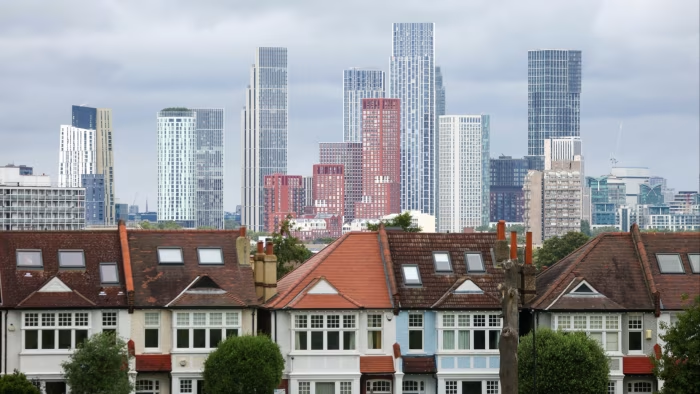
House prices in London have fallen to their lowest in almost two years on the back of affordability pressures, bucking growth in the rest of the UK, as Rachel Reeves prepares to increase property taxes in the Budget next week.
Average house prices in the capital fell by an annual rate of 1.8 per cent in the year to September, with drops of 15 per cent in the City of London and 11.3 per cent in Kensington and Chelsea, the Office for National Statistics said.
The 1.8 per cent decline was the biggest since early 2024 and left the average price at £549,942, the lowest figure since December 2023.
Although London prices remain about double the national average, the drop compared with a 2.6 per cent increase across the country in the 12 months to September.

Experts said Wednesday’s ONS data showed high property prices in the capital, relative to earnings and steeper mortgage costs, were weighing on the property market, which is braced for higher taxes in Reeves’ fiscal statement.
Ahead of the Budget on November 26, the chancellor is planning a tax raid on the owners of expensive homes, with new, higher bands of council tax seen as the best way to raise several billion pounds.
The idea of creating new council tax bands for the most expensive homes in England has been on the table in the Treasury since it was considered by Conservative chancellor George Osborne in 2012.
Having dropped plans last week to increase income tax rates, Reeves is expected to rely on a “smorgasbord” approach of increasing a range of narrowly drawn taxes.
Richard Donnell, executive director at property consultancy Houseful, said affordability was “a major constraint on buying in London and southern England”, where prices rose at an annual rate of 0.9 per cent.
“Mortgage rates remain higher than many expected at the start of the year, and it’s also got more expensive since stamp duty reliefs ended in April,” he added, noting that nearly all homeowners were paying more stamp duty in London than elsewhere.
Rates on a two-year fixed mortgage with a 60 per cent loan-to-value ratio stood at 4 per cent in October, down from a peak of 6.22 per cent in the summer of 2023, but well above the 2020-21 average of 1.3 per cent, according to the Bank of England.
Mortgage rates are affected by interest rates, and financial markets widely expect the BoE to cut rates from 4 per cent to 3.75 per cent next month, after separate ONS data on Wednesday showed inflation fell in October.
Simon Gerrard, chair of Martyn Gerrard Estate Agents, blamed the government for the drop in London house prices and warned that a Budget tax on high-value properties would “overwhelmingly hit families” living there.
“It’s nigh on impossible to start a family in the capital and this will ensure that remains the case for many years to come,” he added.

Excluding London, all regions in England registered an annual increase in house prices in the year to September. In Scotland they rose by 5.3 per cent, while prices in Wales grew by 2.7 per cent, according to the ONS.
The annual fall in the capital’s house prices was driven by detached houses, which suffered a 3.4 per cent drop, followed by a 2.9 per cent annual decline in prices for flats and a 0.6 per cent fall for terraced houses.
Jason Tebb, president of OnTheMarket, a property portal, said property prices in London had been hit by a combination of “increased supply” and “lower buyer demand”, with prospective purchasers “constrained by higher mortgage rates than in the past, as well as higher living costs”.
London remains the UK region with the highest average monthly rent, at £2,265, but growth in rental costs has slowed more sharply in the capital than elsewhere.
London rental prices increased by an annual rate of 4.3 per cent in October, while UK prices rose 5 per cent, itself the weakest pace since August 2022.