
This conversation has been edited for length and clarity.
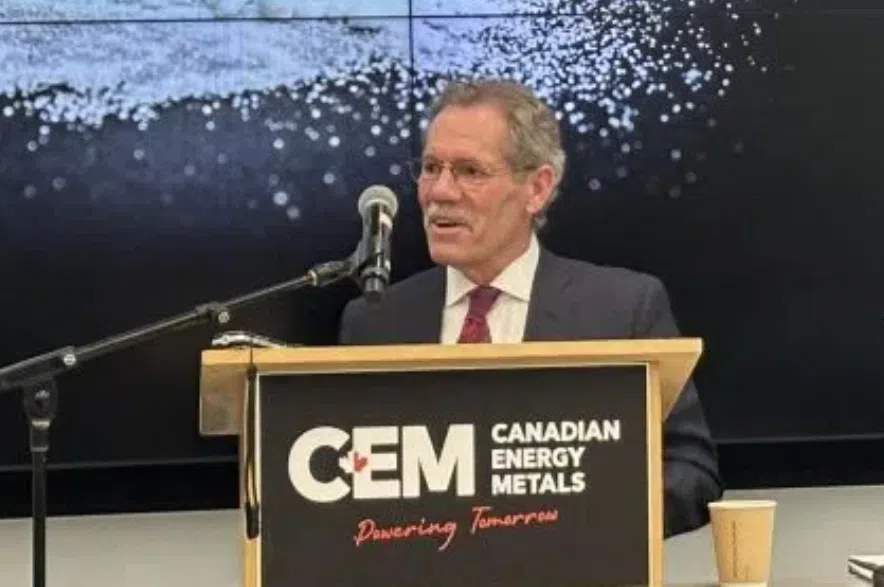
Evan Bray: This feels like a 10 out of 10 when we’re talking about the importance of this announcement. How big is this for the province?
Christopher Hopkins: It’s big. As a resource, it’s huge in terms of the financial impacts. We’ll be assessing those in a more formal report, but it certainly has the potential to rival potash or other minerals in the province.
Bray: I don’t think I’ve said the word ‘alumina’ in my life prior to this, so help us understand what is this resource that we’ve found.
Hopkins: We’re talking about aluminum the metal ultimately. However, the form that we’re looking at extracting is alumina, which chemically is an oxide.
It basically is a white powder rather than a silver metal and from it is made the silver metal if it’s refined as metal.
Alternatively, alumina is a product itself and it’s used in high technology applications as high-purity alumina.
One example it would be used in is the screens of your phones. It’s alloyed with glass to make it strong, but it’s also used in advanced electrical applications and a wide variety of uses associated with electric vehicles.
Then there’s chemical-grade deodorant. Everybody says there’s aluminum content in deodorant. Well, that’s alumina. That’s a trite sort of use, but it goes well beyond that. There’s thousands of uses for alumina.
Bray: How did we find this? What had to happen to find this alumina here?
Hopkins: It resulted from some work that was done by the Saskatchewan government in 2016.
A partner of mine in a previous business identified from that work that there was a possible economic potential in the rocks in the area of Melfort, Tisdale, Hudson Bay and that region.
He initiated some work on that and then contacted me with the advent of COVID-19. I came on board to develop the company and examine what metals would be of commercial potential.
Bray: Was it mining, was it earth probing? How was it that we brought this to the surface and how deep do you have to go to find this stuff?
Hopkins: We’re talking about sediments that are close to surface. They range from 20 metres to 50 metres in the area that we’ve drilled to determine the resources that we’re talking about in our news release.
They dip to the west and to the south, so they go deeper as you go further west and further south. So they’re really only at the surface in that corridor I described, sedimentary layers that are close to surface and accessible by surface mining.
Bray: What could this mean for jobs and opportunities that this project could create for people in Saskatchewan?
Hopkins: Our economic assessment that we announced shows the potential cash flows are very large.
We identified a net present value of the conceptual project could be $70 billion over a 25-year period. So we’re talking very serious numbers, and we’re hoping to expand on that with additional metals.
We’ve got additional metals as well as the additional alumina products, so we think it can get bigger than that.
Read more: