High-tech opportunities in agriculture brings a new crop of professionals
Agriculture is one of humanity’s oldest professions. In the U.S., it accounted for 10% of total jobs in 2024 according to USDA data. But technology is rapidly reshaping agricultural employment.
“Farming used to be all about horsepower. Now it’s just as much about computing power,” says Justin Rose, president of John Deere’s worldwide agriculture and turf division, small agriculture and turf care.
And that means hiring people who understand both soil and software.
“A lot of people still picture farming as purely mechanical — big machines, dusty fields, long days,” Rose says. “But today, we’re building artificial intelligence (AI) systems that can literally see what’s growing in the field and make split-second decisions about what needs attention.”
Daniel Burrus, technology futurist and head of Burrus Research, is also bullish on the sector.
“We’re no longer guessing about the future,” he says. “The data is there, and when we combine it with human ingenuity, we can pre-solve problems before they happen. The next generation is using technology as a tool for stewardship of the land, the water and the communities that depend on agriculture.”And that’s attracting talent.
“The narrative that agricultural careers are limited to field work is outdated,” says Elaine Millar, associate vice president of research at Gray Decision Intelligence. She says that new enrollments in high-tech agriculture programs are growing faster than other programs. And that’s a plus since the sector is facing a labor shortage as older farmers retire.
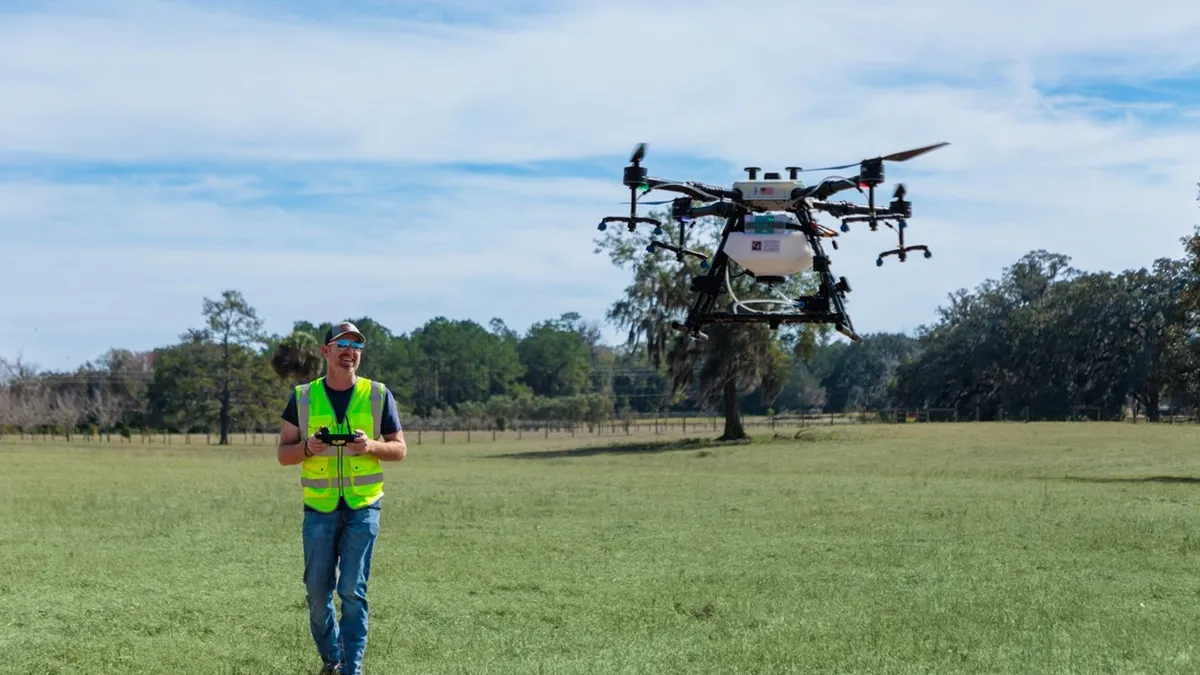
Beginning in fall 2026, the College of Central Florida (CF) in Ocala, will offer the state’s first Associate in Science degree in precision agriculture. CF currently offers an associate degree in agribusiness management that focuses on agricultural operations and management. The new degree will prepare graduates for roles such as precision agriculture specialists, agronomic consultants, farm data analysts, drone operators and equipment technicians — important in a state where agriculture ranks second to tourism. The curriculum was developed by associate professor Tavis Douglass, who is program manager of the program.
Smart farming’s emphasis on efficiency over labor is also attracting a more diverse labor force. “Sixty-four percent of all agriculture graduates in 2023 were women,” Millar says.
High-tech equals high pay
Gray’s data shows that high-tech roles are not just in demand, but well-compensated.
“With an average salary of $83,842 for data analysts and flavor technologists commanding almost $70,000 annually, these positions offer a financially rewarding path for analytically minded graduates eager to shape the future of global food systems,” Millar says.
Sarah Budde Rodriguez is an agronomy solutions manager at Tidal Grow AgriScience. She’s been setting up trial protocols to test a recently launched intelligent leaf delivery technology created to simplify nitrogen management.
“Testing new technologies in real-life scenarios is critical to bringing innovation to market,” Budde Rodriguez says. “Without in-field results, retailers and growers are less likely to try or adopt solutions that haven’t been validated.”
Budde Rodriguez’s academic training includes an undergraduate degree in microbiology and graduate studies in plant pathology. “This foundation allowed me to develop strong analytical and critical-thinking skills. I see this career as a continually evolving discipline that will be increasingly engaging and impactful,” she says.
Twenty-three-year-old Salvador Ayala, who lives and works in Tieton, Washington, is a paid intern with Innov8.ag, an agricultural data services that turns data into actionable solutions, using AI, machine learning and data analytics, while he finishes post-baccalaureate fellowships.
“My roots are in agriculture,” Ayala says. “Before college, I spent my summers working in orchards picking apples, cherries and pears to save money for school. I completed eight internships in different industries, including roles with the Amazon, Department of Energy and the University of Washington collaborating with NASA. In my senior year, I returned to agriculture because it matched my background and I was excited to apply technology to farming.”
Ayala says he spends 70 to 75% of his time in front of the computer and the rest in the orchards or meeting with farmers.
“It’s incredibly satisfying when growers see different options and gain efficiency without sacrificing their health, time or money,” he says.
Rose echoes that sentiment.
“When I visit a farm and see a twenty-something using drones to analyze crop health or relying on perception technology to scout fields, it’s inspiring,” he says. “Agriculture today is as dynamic as any field in Silicon Valley.”