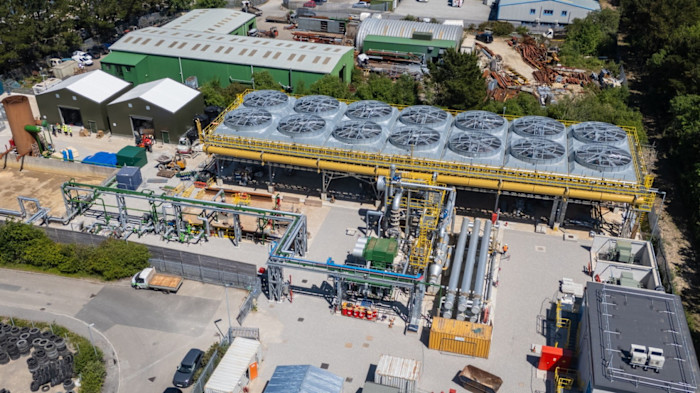
The UK’s first commercial-scale lithium plant has started operations as part of the country’s efforts to secure its own supplies of the critical mineral.
Geothermal Engineering Ltd’s facility in Redruth, Cornwall will begin by producing 100 tonnes of lithium a year — enough for about 2,000 electric vehicles. It will then aim to increase to 1,500 annual tonnes within a few years and to more than 18,000 annual tonnes over the next decade in a scale-up that will require about £640mn.
GEL, which plans to extract the battery metal from mineral-rich liquids underground, also turned on the UK’s first geothermal power plant on Thursday to supply the lithium operation. Any excess power will be sold to Octopus Energy.
The company is among a clutch of UK lithium hopefuls racing to bring projects online as western countries look to secure domestic supplies of critical minerals.

A fresh urgency was injected into that effort by China’s moves last year to weaponise its control over rare earths by limiting exports.
Beijing dominates the processing of lithium, controlling about 60 per cent of global production in 2025, according to consultancy Project Blue. It also controls much of the global supply chain that turns the metal into batteries, which are used in EVs and for energy storage.
The UK government has set a target to produce 50,000 tonnes of lithium domestically by 2035.
Although a raft of western lithium mining projects won support from carmakers around 2021, a crash in the price of the metal led to many being delayed, cancelled or renegotiated.

Ryan Law, the founder of GEL, said the plant would produce lithium “cheaply and competitively”, noting that without the geothermal generation power would have been a significant cost. “We can easily compete with what’s coming from China.”
Rival miner Cornish Lithium’s demonstration plant has been producing samples of lithium hydroxide — battery-grade material — in small volumes for potential customers to test since October, and hopes to open its commercial plant by 2029.
Cornish Lithium plans this year to raise an undisclosed sum for the commercial plant, financing that sales agreements with customers would be “key” to unlocking, said corporate development manager Neil Elliot.
The company cut its 2030 production target from 25,000 tonnes a year to 20,000 tonnes, which Elliot said was more realistic operationally.
British refiner Green Lithium has pushed back the opening of its commercial plant in Teesside from 2024 to around 2029 but hopes a demonstration plant will be operational next year. The change was part of a “more phased development strategy” that investors preferred, said co-founder Guy Hatcher.

Analysts said it remained to be seen whether UK and European lithium projects would be cost-competitive compared with China, adding that carmakers had not demonstrated a willingness to pay more for material sourced closer to home.
Luc Braun at Benchmark Mineral Intelligence said carmakers could probably absorb the higher cost of mining lithium in the UK since the raw material was a small part of the overall cost of an EV. However, he warned that operating the whole supply chain in the west would result in cost increases “at each step”.
US-based producer Albemarle said this month it would close its Kemerton processing plant in Australia, noting that the recent price rise was “not enough to offset the challenges”.

French group Imerys said last week it would suspend work on its project in Cornwall. A restart would depend on finding investors to back the project, it said.
Analysts also pointed out that the lack of European cathode active material manufacturing — which converts materials including lithium into something battery manufacturers can use — was a hurdle. Much of that capacity is in China.
“Without [CAM] investments, European lithium producers will remain intrinsically tied to Asian supply chains,” said Jon Mulcahy, a battery supply chain expert at SC Insights.
GEL’s lithium carbonate will go to LevertonHELM in Basingstoke for processing — the step before CAM manufacturing — into battery-grade material, with the processor in talks with carmakers about possible deals.