
At the onset of the shutdown, a contingency fund available for WIC was set to run out. The administration did support WIC benefits throughout the shutdown, but not before it created uncertainty around those and other payments. That left anti-hunger groups to combat a lot of misinformation about the program’s operations.
“This shutdown really highlighted the vulnerability of WIC and demonstrated how any lapse in funding can create real instability,” said Kate Scully, deputy director of WIC at the Food Research and Action Center.
Conservation Programs Now Face a Backlog
During the shutdown, the Natural Resources Conservation Service (NRCS) continued some operations funded through mandatory farm bill dollars. But farmer-facing operations, like the processing of contracts, ceased.
Since nearly all NRCS staff were furloughed during this period, no one was available to visit farms to confirm that farmers were fulfilling their federal conservation contracts. That meant that farmers then didn’t receive the federal dollars owed through those contracts.
“You’re hitting the pause button on conservation during the shutdown,” Mike Lavender, director of policy at the National Sustainable Agriculture Coalition, told Civil Eats.
NRCS is funded through a mix of mandatory and discretionary spending, which makes it challenging during a shutdown to parse out which operations can continue, said Robert Bonnie, a former Agriculture undersecretary for conservation under the Biden administration. Even the staff for NRCS programs are supported by a mix of funds.
During the 2013 shutdown, when Bonnie was working at the agency, he said NRCS and other farm programs closed. But over time, they were able to adapt the shutdown plan and reopen certain essential programs when possible.
That’s all a challenging process, however, and requires legal scrutiny to ensure the government doesn’t break the Antideficiency Act, which prohibits agencies from spending money without appropriations.
“People tend to be fairly conservative about it,” Bonnie said.
When farmers experienced these delays in conservation funding, they were left to front the federal portion themselves or find alternative ways to pay for expenses. Like taking on other loans or putting the costs on their credit card.
Now that the shutdown is over, federal workers will have to tackle a backlog of contracts to be verified and processed. But the NRCS has lost at least 2,400 employees under the Trump administration, which could make it challenging to catch up, Lavender said.
When farmers experienced these delays in conservation funding, they were left to front the federal portion themselves or find alternative ways to pay for expenses.
The October shutdown came at an inopportune time, because that month is when the NRCS starts determining how to deploy farm-bill resources, Bonnie said. October is also when many farmers are out of the fields and interact with NRCS staff to plan their next year. These processes lost a precious 43 days under the shutdown, which will create “enormous challenges” in the creation of agreements and the processing of payments, Bonnie said.
“This isn’t just about sustainability, it’s also about markets and farmers being asked by their customers to produce commodities in a certain way with less environmental footprint,” Bonnie said. “NRCS provides resources that de-risks that for farmers so they can make a transition.”
Cuts to NRCS staffing, particularly technical assistance, had already undermined this effort, he said. And the USDA had already paused or terminated conservation contracts earlier in the year.
Under the deal to end the shutdown, meanwhile, Congress passed annual appropriations for the USDA and a farm bill extension. But these both include cuts to conservation, including a $75-million reduction to NRCS technical assistance.
“I think there’s all of those things that are setbacks to conservation,” Lavender said.
Commodity Payments Overshadowed Other Farmer Priorities
While NRCS offices remained closed during the shutdown, the USDA reopened Farm Service Agency (FSA) offices to distribute payments to commodity and dairy farmers and process some farm loans. That was an important decision, said Mike Stranz, the vice president of advocacy at the National Farmers Union (NFU), especially because the shutdown happened right when most commodity subsidies are distributed.
“We would have preferred not to have had a government shutdown and a three-week delay in a lot of those programs, but that was the reality of the situation,” he said. “USDA did take some steps to help out farmers, given the circumstances we’re in.”

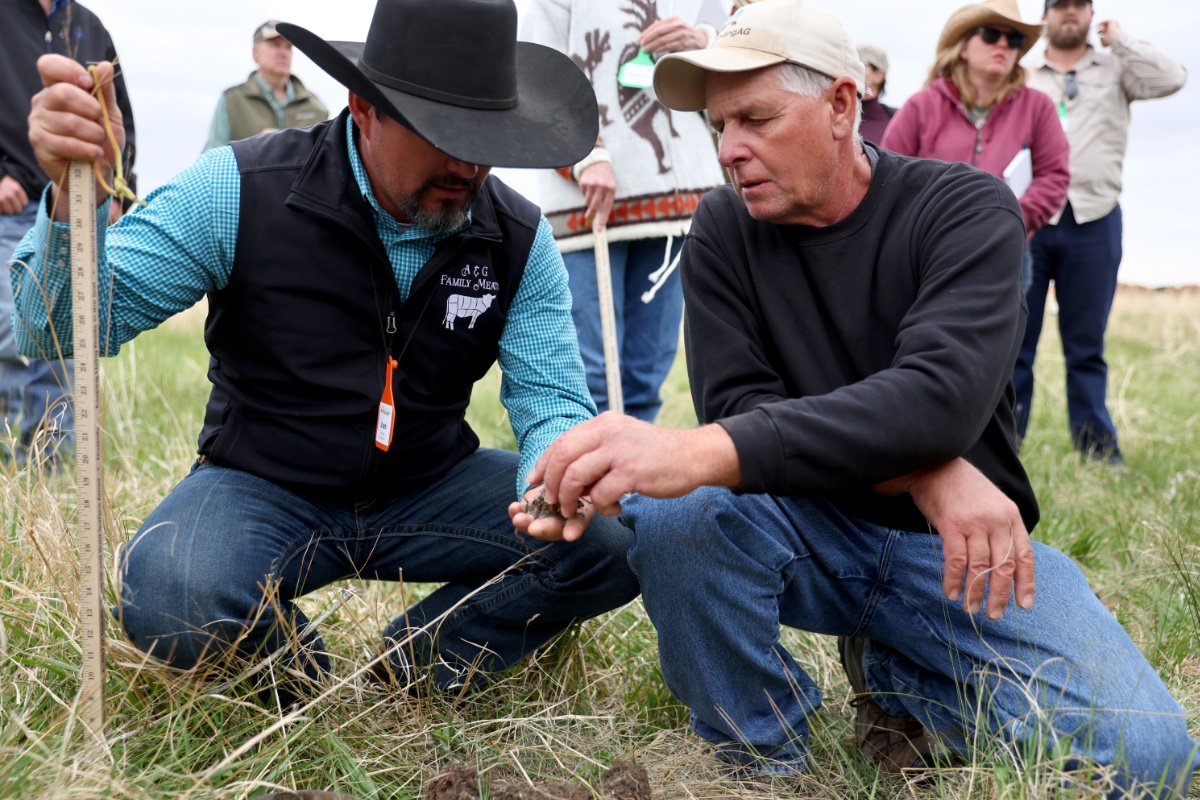
Educator Shane New (right) displays healthy soil at CS Ranch during the Soil Health Academy, which teaches regenerative agriculture techniques. The shutdown meant few federal resources went toward agricultural research and conservation. (Photo credit: Mario Tama/Getty Images)
In terms of long-term impacts, Stranz said he’s most worried about the time lost on important agricultural research projects. According to a recent analysis from the National Sustainable Agriculture Coalition (NSAC), the USDA’s four primary research agencies have lost nearly a quarter of their staff since January.
As far as the bill that ended the shutdown, Stranz said the union was relieved to see that agriculture funding passed without a rider, proposed earlier, that would have gutted the USDA’s ability to protect farmers from meatpacker abuses.
The farm bill extension was necessary too, he said, to ensure farm programs keep running. However, the NFU is still pushing for a full farm bill as soon as possible, and he worried that the extension could take some political pressure off lawmakers.
“Hopefully it sets the stage for the early 2026 Farm Bill 2.0 process that has been hinted at by leaders of the ag committees,” he said.
“What was painful was the politicization [of healthcare access] and the disregard for a lot of things that farmers care about as part of the negotiations.”
At the National Young Farmers Coalition, Director of Government Relations Vanessa Garcia Polanco and Co-Executive Director Michelle Hughes said that the battle over the Affordable Care Act (ACA) credits that led to the shutdown was more revealing than how the USDA handled the pause.