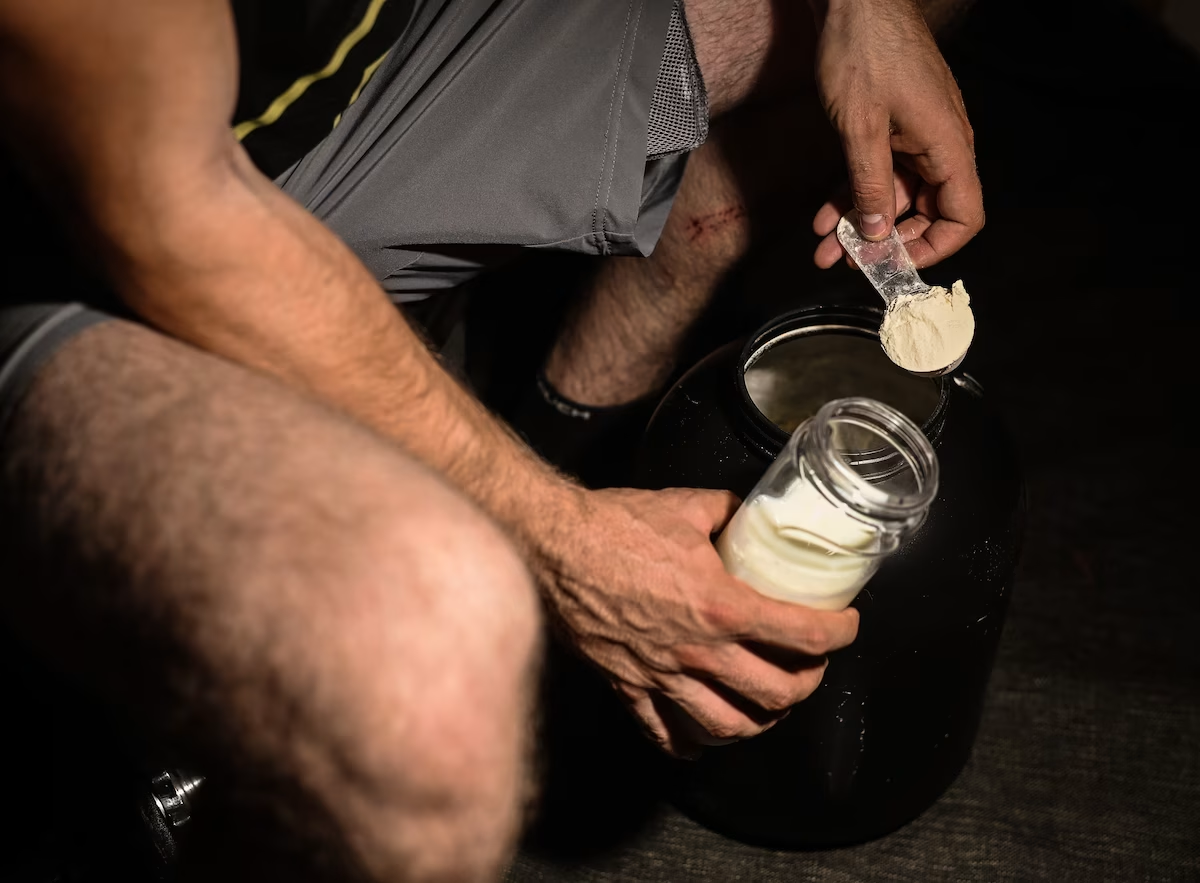
Researchers are sounding the alarm on several protein powders after discovering that many of them contain high levels of lead.
A study conducted by Consumer Reports released Oct. 14 involved the testing of 23 protein powders, including products marketed as vegan-friendly. Researchers found that while having toxic metals in protein powders is not new, it has become more common.
“For more than two-thirds of the products we analyzed, a single serving contained more lead than [Consumer Reports’] food safety experts say is safe to consume in a day — some by more than 10 times,” the report states.
Consumer Reports Food Safety Researcher Tunde Akinleye said these findings were “concerning” and “even worse than the last time we tested. This time, in addition to the average level of lead being higher than what we found 15 years ago, there were also fewer products with undetectable amounts of it. The outliers also packed a heavier punch.”
The product with the highest lead levels was “Naked Nutrition’s Vegan Mass Gainer” powder, which had nearly twice as much lead per serving as the worst product researchers analyzed in 2010, according to Akinleye.
In fact, nearly all the plant-based products Consumer Reports tested had elevated lead levels and were, on average, nine times the amount found in those made with dairy proteins such as whey, and twice as great as beef-based ones.
But while dairy-based protein powders and shakes generally had the lowest amounts of lead, half of the products tested still have high enough levels of contamination to make experts concerned and advise customers against daily use.
Occasionally taking the supplements can be fine because even protein powders with the highest lead levels are far below the concentration needed to cause immediate harm, Consumer Reports said.
With that being said, most Americans already receive the necessary amount of protein and therefore may not actually need protein supplements, nutrition experts state in the report.
“Consumers often assume supplements deliver health benefits without risks,” Associate Professor of Medicine at Harvard Medical School Pieter Cohen explains in the report.
An issue for these experts is that unlike prescription and over-the-counter drugs, the Food and Drug Administration (FDA) doesn’t review, approve or test protein powders before they’re sold because there’s no federal limit for the amount of heavy metals these products can contain.
While no amount of lead is technically safe, it’s dangerous to repeatedly or continuously expose oneself to lead, especially in high doses, Rose Goldman, an associate professor of medicine and a physician at Cambridge Health Alliance in Medford, said in the report.
Children and pregnant people are more vulnerable to lead because the toxin can damage the developing brain and nervous system, which can cause neurological issues, learning delays and behavioral problems, Consumer Reports said.
Chronic lead exposure has also been linked to immune suppression, reproductive problems, kidney damage and high blood pressure in adults.
“The FDA can take action if it finds unsafe lead levels, but the lack of enforceable standards mean it doesn’t happen nearly enough,” Consumer Report’s Director of Food Policy Brian Ronholm said in the report. ““The FDA’s lack of funding and staff makes the problem worse. Establishing enforceable limits in foods and supplements would go a long way in protecting consumers.”
List of products to avoid or limit
Consumer Reports has listed the protein powder and shake products they urge consumers to avoid or limit themselves to based on the researcher’s level of concern for lead which is 0.5 micrograms per day.
Here’s the full list:
- Avoid “Naked Nutrition Vegan Mass Gainer.” Over 15 times the lead amount Consumer Reports deems safe for a full day.
- Avoid “Huel Black Edition.” Nearly 13 times the lead amount Consumer Reports deems safe for a full day.
- Limit “Garden of Life Sport Organic Plant-Based Protein” to once a week. Over 5.5 times the lead amount Consumer Reports deems safe for a full day.
- Limit “Momentous 100% Plant Protein” to once a week. Nearly 5 times the lead amount Consumer Reports deems safe for a full day.
- “MuscleMeds Carnivor Mass” is OK to eat occasionally. Nearly 2.5 times the lead amount Consumer Reports deems safe for a full day.
- “Optimum Nutrition Serious Mass” is OK to eat occasionally. About 2 times the lead amount Consumer Reports deems safe for a full day.
- “Jocko Fuel Mölk Protein Shake” is OK to drink occasionally. Nearly 2 times the lead amount Consumer Reports deems safe for a full day.
- “Vega Premium Sport Plant-Based Protein” is OK to eat occasionally. Almost 2 times the lead amount Consumer Reports deems safe for a full day.
- “Quest Protein Shake” is OK to drink occasionally. Over 1.5 times the lead amount Consumer Reports deems safe for a full day.
- “Orgain Organic Plant-Based Protein Powder” is OK to consume occasionally. Nearly 1.5 times the lead amount Consumer Reports deems safe for a full day.
- “Optimum Nutrition Gold Standard Protein Shake” is OK to consume occasionally. 1.5 times the lead amount Consumer Reports deems safe for a full day.
- “Equip Foods Prime Protein” is OK to consume occasionally. 1.4 times the lead amount Consumer Reports deems safe for a full day.
- “PlantFusion Complete Protein” is OK to consume occasionally. 1.4 times the lead amount Consumer Reports deems safe for a full day.
- “Ensure Plant-Based Protein Nutrition Shake” is OK to consume occasionally. Over 1.3 times the lead amount Consumer Reports deems safe for a full day.
- “Muscle Milk” is OK to consume occasionally. Nearly 1.3 times the lead amount Consumer Reports deems safe for a full day.
- “KOS Organic Superfood Plant Protein” is OK to consume occasionally. Over 1.1 times the lead amount Consumer Reports deems safe for a full day.
Better protein powder and shake options
During their research, Consumer Reports found that the following protein powders and shakes are OK to consume daily:
- “Owyn Pro Elite High Protein Shake” with a one serving per day limit and is nearly 0.9 times the lead amount Consumer Reports deems safe for a full day.
- “Transparent Labs Mass Gainer” with one serving per day limit and is nearly 0.9 times the lead amount Consumer Reports deems safe for a full day.
- “Optimum Nutrition Gold Standard 100% Whey” with a 143 servings limit per day and is about 0.5 times the lead amount Consumer Reports deems safe for a full day.
- “BSN Syntha-6 Protein Powder” with two servings per day limit and is nearly 0.5 times the lead amount Consumer Reports deems safe for a full day.
- “Momentous Whey Protein Isolate” with a 331 serving limit per day and is 0.3 times the lead amount Consumer Reports deems safe for a full day.
- “Dymatize Super Mass Gainer” with four servings per day limit and is 0.25 times the lead amount Consumer Reports deems safe for a full day.
- “Muscle Tech 100% Mass Gainer” with no limit for how many daily servings (lead not detected).
If you purchase a product or register for an account through a link on our site, we may receive compensation. By using this site, you consent to our User Agreement and agree that your clicks, interactions, and personal information may be collected, recorded, and/or stored by us and social media and other third-party partners in accordance with our Privacy Policy.