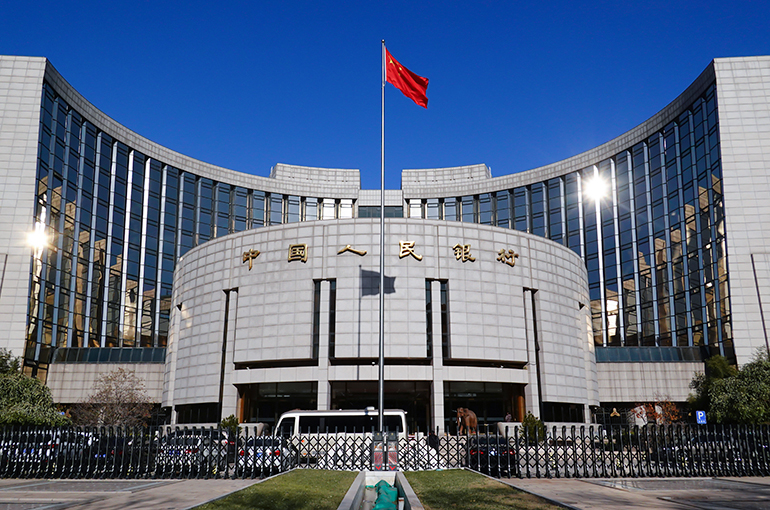
(Yicai) March 2 — China has stopped setting a 20 percent reserve requirement on forward foreign exchange sales. Analysts believe one of the main reasons behind this move is to control the rapid appreciation of the Chinese yuan.
Scrapping the forward forex risk reserve ratio sends a clear policy signal that regulators intend to prevent an excessive, rapid appreciation of the yuan, helping stabilize market expectations, according to analysts.
Other reasons include supporting the real economy in managing exchange rate risks, sending a counter-cyclical adjustment signal, keeping the Chinese yuan exchange rate basically stable at an adaptive and equilibrium level, and lowering costs for companies to purchase forward forex contracts, analysts believe.
The People’s Bank of China announced on Feb. 27 that it will cut the risk reserve requirement ratio for forward forex sales to zero from 20 percent, effective today. The last adjustment was made in September 2022, when the PBOC raised the ratio to 20 percent from zero after the yuan faced persistent downward pressure against the US dollar.
The reserve ratio for forward forex sales is a counter-cyclical macro-prudential tool created by the PBOC to manage banks’ forward forex business. It indicated the percentage of contracted volumes financial institutions need to place as non-interest-bearing reserves, affecting forward pricing and regulating market behavior.
The offshore yuan has strengthened by around 2 percent against the US dollar this year, maintaining a robust tone after breaking above 7 at the end of 2025. But after the central bank’s announcement on Feb. 27, the exchange rate briefly plunged more than 1 percent to below 6.85.
The main goal of the PBOC’s move is to reduce corporate forward forex purchase costs, boost demand for the US dollar in the forex market, and moderate the yuan’s fast appreciation to stabilize exchange rate expectations, said Wen Bin, chief economist at China Minsheng Bank. With no persistent depreciation pressure on the yuan, the tool is being phased out to return policy to neutrality and reduce direct market intervention.
Cutting the forward forex risk reserve ratio directly reduced lenders’ forward forex sales costs, thus lowering corporate costs for hedging future forex needs, said Wang Qing, chief macroeconomic analyst at Golden Credit Rating International. This encourages companies to use forward forex instruments and effectively eases their exchange rate risk management burdens, he explained.
The complex and volatile international landscape and rising geopolitical tensions could exacerbate volatility in the global forex market and bring uncertainties to the Chinese yuan’s trajectory.
The yuan is expected to continue two-way fluctuations, with mild appreciations in the future, said Pang Ming, senior researcher at the National Institution for Finance and Development, warning that a trend-driven strong appreciation should be assessed cautiously.
Editor: Futura Costaglione