Who is going to end the year as Spotify’s top artist: Bad Bunny or Taylor Swift? There’s a $13mn predictions market that overwhelmingly favours the Puerto Rican rapper over the Life of A Showgirl star, for any Swiftie who cares to take a punt on their gal.
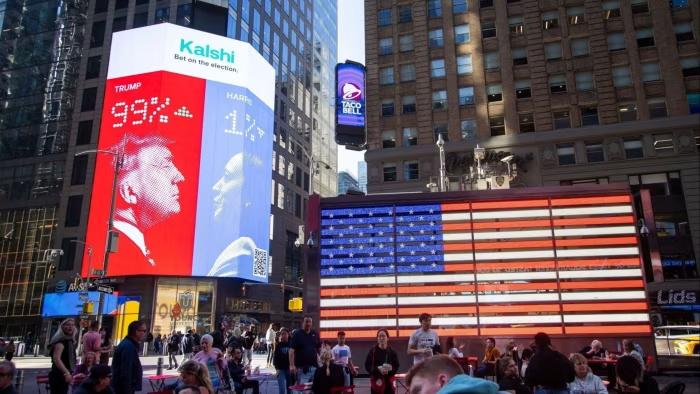
Prediction markets, or “event contracts” — binary, yes-or-no options — gained notoriety in last year’s US elections as users forecast a big win for Donald Trump. Recently, sports-related contracts have surged: almost $10bn is likely to be wagered this month, up 15 per cent on October, Piper Sandler estimates.
This rapid growth rests on a legal grey area. While individual US states regulate games of chance — and several have chosen to ban sports betting — prediction market operators argue they are providing financial contracts that are overseen by the Commodity Futures Trading Commission, a national markets watchdog.
So far, the big winners from the new market have been the largest dedicated exchanges. In less than six months, the valuations of Kalshi and Polymarket have each risen roughly fivefold through private funding rounds.

Since the start of the US football season, shares in gaming giants Flutter and DraftKings have fallen by a third, however, as investors fret about the threat to their businesses. Both are now seeking a slice of the predictions action. In October, DraftKings acquired a small exchange while Flutter’s FanDuel will next month launch a joint venture with giant exchange group CME. Both are targeting states that don’t permit their other products.

Brokers could offer another way to play this trend. Robinhood offers events contracts and has just invested in an exchange, but its shares recently have more closely tracked the fall in risky assets such as bitcoin.
Existing exchanges are a safer bet, although their size makes it unlikely that predictions will move the needle any time soon. In addition to CME, fellow Chicagoan Cboe Global Markets is planning its own prediction products, while New York-based Intercontinental Exchange has a stake in Polymarket. All have been seeking to court small-scale punters in the hope of introducing them to their other financial products.
While the bets look simple, the legal wrangling over prediction markets is anything but. Several states are arguing that the contracts are, in fact, gambling, while other lawsuits have invoked colonial-era laws that make gambling losses legally unenforceable. Washington has, for now, declined to get involved.
Unless the music stops, it’s fair to assume that fans of a flutter will continue to pile in, adding to the competition faced by traditional sports books and potentially diverting some retail cash from stocks. As newcomers such as Kalshi fight for territory and the old guard defends its turf, it is not just the punters who could end up out of pocket.