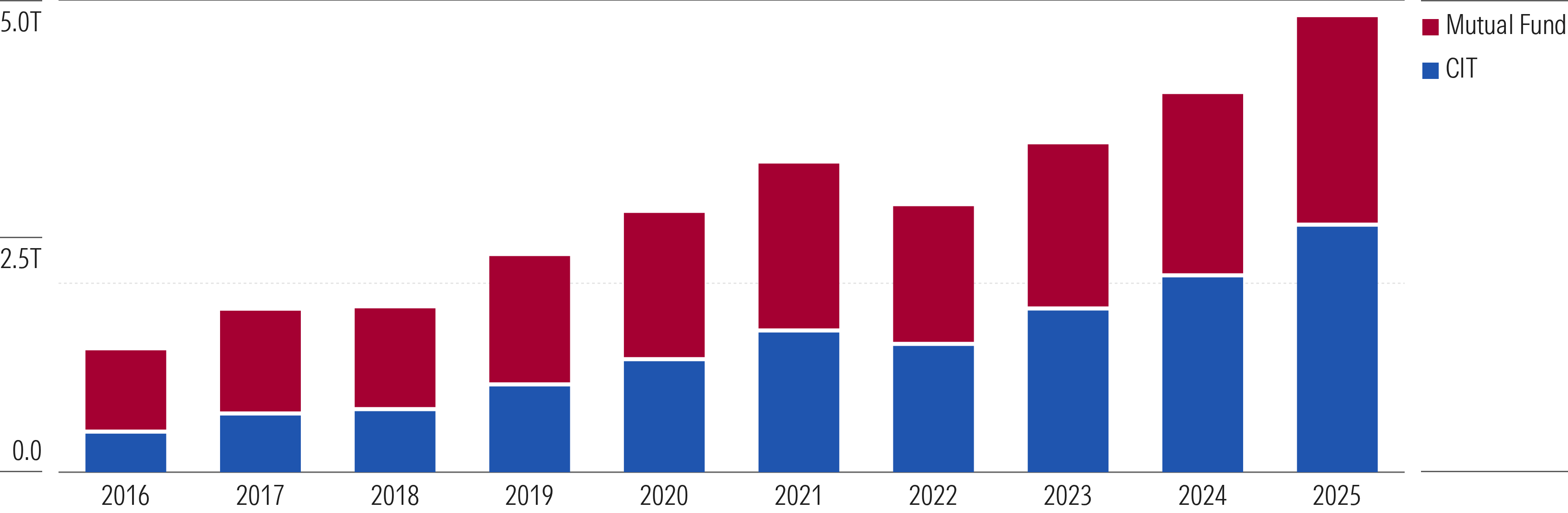
Target-date strategies have grown into one of the largest segments of the US retirement market.
In 2025, assets in target-date strategies climbed to $4.8 trillion, expanding 20.3% over the prior year as strong equity markets lifted portfolio values. Over the past decade, the industry has grown 11.9% annualized, reflecting both market appreciation and steady retirement-plan contributions. We explore these market trends and more in the recently released 2026 Target-Date Fund Landscape.
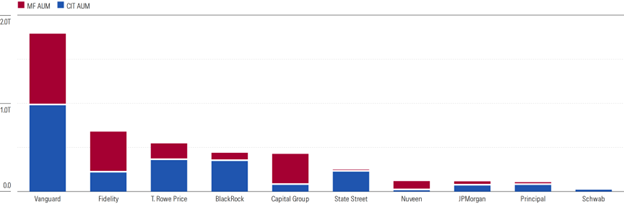
Although the category has expanded rapidly, the market remains highly concentrated among a small group of asset managers. The five largest providers control roughly 80% of all target-date assets, underscoring the dominance of established firms in employer-sponsored retirement plans.
Vanguard remains the industry leader by a wide margin, overseeing $1.8 trillion, or 37% of all target-date assets. Other major players hold strong positions in different vehicle types. Fidelity and Capital Group dominate in mutual fund offerings, while State Street and BlackRock have carved out leadership positions in collective investment trusts.
Target-Date Market Evolves Through CITs and Conversions
Target-date collective investment trusts surpassed mutual funds as the dominant vehicle in 2024, and the trend continued in 2025. By year-end, CITs held 54% of total target-date assets, up from 52% the prior year, fueled by lower costs and greater flexibility in large retirement plans. Target-date mutual funds are publicly available, highly regulated, and transparent, while target-date CITs are lower-cost, more flexible pooled vehicles mainly used inside large employer retirement plans (like 401(k)s), so someone might choose target-date mutual funds for accessibility and transparency even though CITs are often cheaper for big plans.
All 21 new target-date series launched in 2025 were CITs, many based on existing mutual fund lineups from managers such as T. Rowe Price. Closures were modest, with six mutual fund series and four CIT series shutting down, most under $1 billion.
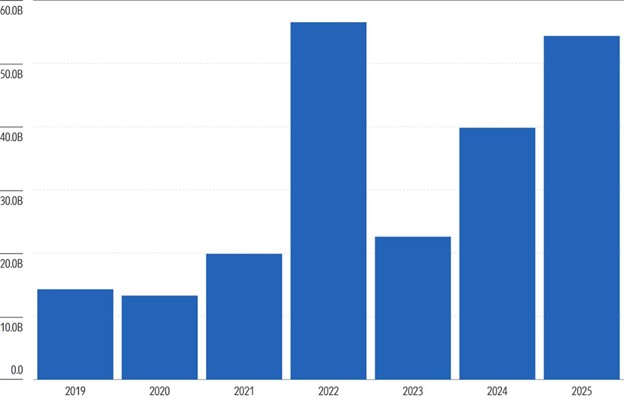
Asset flows continued to favor the largest providers. Vanguard led in target-date asset growth in 2025, adding $35.9 billion in new assets, followed by Capital Group ($24.0 billion) and State Street ($22.2 billion). Conversions from mutual funds to CITs also played a key role, reflecting the ongoing shift toward lower-cost institutional vehicles and reinforcing CITs’ growing dominance in the market.
Fee Competition Benefits Investors—Without Hurting Managers
Fee competition continued to reshape the target-date market in 2025. The asset-weighted average expense ratio for target-date mutual funds fell to 27 basis points, down from 29 basis points in 2024 and roughly half the level from a decade ago.
Lower fees directly benefit investors by leaving more of their retirement savings invested and compounding over time.
Even small changes can add up. The 2-basis-point decline across more than $2 trillion in target-date mutual funds saved investors over $80 million in 2025.
Despite lower fees, asset managers still saw revenue rise as assets continued to increase. Strong markets and steady retirement plan contributions pushed total target-date assets to $4.8 trillion, allowing managers to collect about $580 million more in revenue in 2025.

The dynamic underscores a key feature of the asset management industry: In a rising market, falling fees don’t necessarily mean falling revenue. Investors benefited from lower fees, while asset managers still saw increased revenue.
Glide Paths Become More Equity-Heavy
Target-date portfolio construction has also evolved over the past decade. Managers have gradually increased equity allocations during the early saving years, reflecting longer time horizons and the goal of boosting long-term returns. By the end of 2025, the median equity allocation for investors 45 years from retirement reached 93%, up from 89% a decade earlier.
As starting allocations have risen, glide paths for younger investors have become more similar across strategies, while differences remain more pronounced during the midcareer years. Managers have also modestly increased US equity exposure within global portfolios as US stocks have expanded to represent a larger share of global markets since the global financial crisis.
Strong Market Returns Boost Target-Date Performance
Target-date investors enjoyed strong performance in 2025 as global equities posted robust gains.
Across vintages, most target-date strategies produced double-digit returns for the year. Portfolios with higher equity exposure and larger allocations to non-US stocks tended to perform particularly well.
Global markets also played a major role. US stocks, represented by the S&P 500, rose 17.9% last year, while developed international stocks, measured by the MSCI EAFE Index, surged 31.2%.
Several Fidelity target-date series stood out for their strong results. The firm’s funds claimed the top performance spots in both the 2060 and 2030 target-date categories, highlighting the impact of portfolio positioning during a year of strong equity performance.
New Strategies and Analyst Coverage
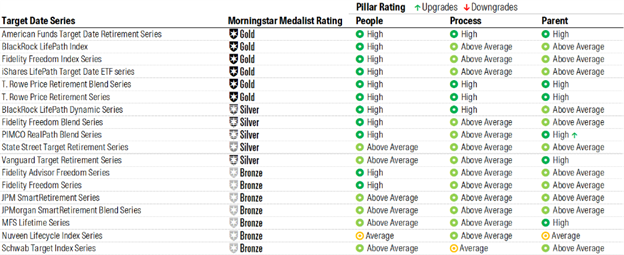
Morningstar Manager Research continues to expand its coverage of the target-date universe. As of December 2025, analysts assigned Medalist Ratings to 29 target-date mutual fund and ETF series and 33 target-date CIT series.
Three new strategies entered coverage during the year, including the Gold-rated BlackRock LifePath Index Growth series. This strategy features a fully index-based design and maintains a 50% equity allocation at retirement, which is higher than the allocation used in the firm’s flagship LifePath Index lineup.