A: Yes. The exhibition will examine the multi-faceted images of Britain presented on banknotes.
Q: When did bank notes first come into use?
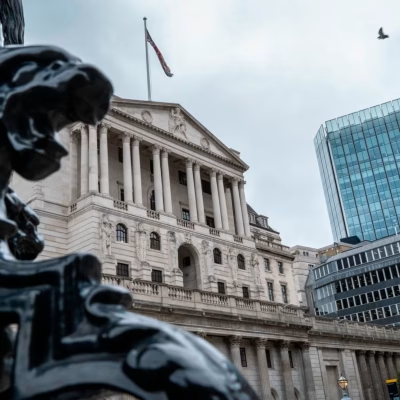
A: In Britain, in 1694, when the Bank of England was established and almost immediately began issuing notes in return for deposits. The promise to pay the bearer the sum of money written on the note on demand made the bank’s notes a means of exchange. The Bank of Scotland followed a year later by issuing its own notes.
Q: What did these notes look like?
A: They were written on bank paper and signed by a cashier. The first notes were bound in books and were cut out when needed. The Royal Bank of Scotland pioneered the use of colour in 1777 but the first fully-printed notes did not appear until 1855.
Q: What is the oldest known banknote in the world?
A: China produced the first paper note in the ninth century. In the period up to roughly 1450 so much paper money was produced that the value greatly depreciated and inflation soared. As a result, the Chinese stopped using notes for several hundred years.
Q: Were there other types of banknote?
A: Yes. The Chinese started using leather money about 100 years BC. It took the form of 1ft-square pieces of white deerskin embellished with a colourful border.
Q: What about other types of money?
A: Cattle are considered to be the oldest form. Starting in about 9000 BC they became a standard form of barter along with sheep and camels. With the advent of agriculture grain, plants, and vegetables took their place in many cultures. Of all the currencies, the cowrie has been more widely and continuously used than any other.
Q: What is it?
A: The shell of a mollusc found in the Pacific and Indian oceans. It was first used as money about
1200 BC and did not die out until the 1950s (in parts of Africa).
Q: What about coins?
A: The Chinese produced bronze and copper imitations of cowrie shells about 1000 BC. Elsewhere, round coins were first made from silver in Lydia (in present-day Turkey) about 500 BC. The technique was refined by the Greeks, Persians, Macedonians, and Romans.