Has the time come to consider phasing out anonymous paper currency, starting with large-denomination notes? Getting rid of physical currency and replacing it with electronic money would kill two birds with one stone.
First, it would eliminate the zero bound on policy interest rates that has handcuffed central banks since the financial crisis. At present, if central banks try setting rates too far below zero, people will start bailing out into cash. Second, phasing out currency would address the concern that a significant fraction, particularly of large-denomination notes, appears to be used to facilitate tax evasion and illegal activity.
Yes, there are some important arguments in favour of the status quo. These include a likely loss of seigniorage revenue – the profit central banks make by printing money – even if anonymous paper currency is replaced with purportedly anonymous electronic government currency. Even though central bank “profits” are turned over to national treasuries, the ability to skim off expenses without having to beg can help insulate central banks from political pressures. But the real costs to governments would be much less than the loss of seigniorage revenues might indicate, because they would gain revenue by making tax evasion more difficult. There would also be savings from crime reduction.
Another issue is that society may want to preserve the right for individuals to make anonymous payments in certain activities, even if it is desirable to strip away the cloak of anonymity from those engaged in tax evasion and crime. Anonymity, for example, facilitates experimentation at the fringes of society with activities that might ultimately become legal (buying marijuana, for instance).
The idea of finding creative ways to get around the zero bound on interest rates has been championed for more than a decade by Willem Buiter, a former UK Monetary Policy Committee member. Phasing out paper currency is by far the simplest. With electronic payments mechanisms becoming increasingly prevalent even in small transactions, and with the supply of paper currency overwhelmingly top-heavy with large-denomination notes, the case for keeping the currency status quo has weakened.
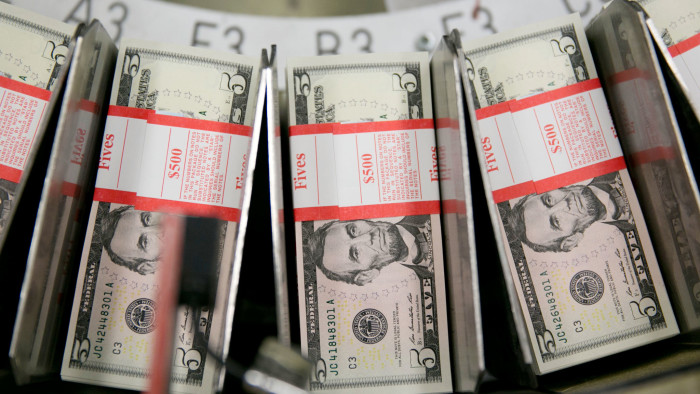
Without going into gory detail, in both the eurozone and the US there is roughly $4,000 in circulation for every man, woman and child, and it is not easy to find. In Japan the figure is almost double that. In the US and Japan, more than 75 per cent of currency is held in the largest denomination notes, the $100 bill and the Y10,000 note. The situation in the eurozone is different only in that there is a larger range of high-denomination notes going all the way to €500, but the basic point is similar.
True, it is likely that a significant share – perhaps half – of dollars and euros circulates internationally. Some portion of this is surely abetting illegal activity and tax evasion. (In arresting Joaquín “El Chapo” Guzmán, the Mexican drug lord, two months ago, authorities found a room containing more than $200m, and this was not a first.) Then again, dollars and euros, including large-denomination notes, are also used for legal purposes. Even so, there still appears to be a very large share circulating in domestic underground economies, estimated to be at least 7-8 per cent of gross domestic product for the USand considerably higher for Europe.
Of course, if governments could credibly issue an anonymous electronic currency, the problem of the zero bound would still be solved and central banks could keep pushing their product. Even if this outcome is feasible, however, it is hardly desirable. Note that if governments do stop issuing anonymous currency, then they would probably have to ensure that the private sector did not proffer a Bitcoin-like substitute. Otherwise, illegal activities would proceed unabated, and the government would forfeit even the small inflation tax revenue it gets now. Finally, a shift away from anonymous paper currency would ideally involve co-operation among governments.
Perhaps the right place to begin is by phasing out large denomination notes. This might be enough to accomplish the main objectives. It is time to consider whether paper currency is vestigial, or worse.
The writer is a professor of economics at Harvard
——————————————-
Letters in response to this article:
Paper money has its advantages / From Alex J Pollock
Electronic currency isn’t free from crime / From Ms Janet Tavakoli