In this interview, AZoMaterials speaks with Pete Anzalone, North American Sales Director at Thermo Fisher Scientific, about how Niton XRF analyzers are driving accuracy, speed, and confidence in precious metals analysis.
Can you please introduce yourself and your role at Thermo Fisher Scientific?
My name is Pete Anzalone, and I’m the North American Sales Director for Niton handheld XRF analyzers at Thermo Fisher Scientific. I’ve been with Thermo Fisher for over 30 years and have spent the last eight focusing on our XRF product line, helping customers across industries apply this technology for fast, accurate materials analysis – especially in the precious metals market.
What types of industries or professionals are using handheld XRF for precious metals analysis?
We’re seeing strong demand from jewelry manufacturers, gold buyers and sellers, pawn shops, estate managers, and scrap metal recyclers. Right now, gold prices are driving intense interest, especially from those transacting high-value metals who want instant, reliable verification of purity and composition.
How accurate are Niton handheld XRF analyzers when it comes to identifying gold purity?
They’re extremely accurate. Compared to acid testing or ultrasonic density methods, XRF provides a non-destructive, quantitative breakdown of a sample’s elemental composition – right down to a fraction of a percent. With gold prices where they are, those decimal points can make a real financial difference.
Can you explain how Niton’s AuDIT technology works in identifying gold plating?
AuDIT stands for “Au (Gold) Detection and Identification Technology.” It uses an algorithm to compare expected karat values – like 58.3 % gold for 14K – to what the analyzer actually detects. It’s incredibly useful for spotting discrepancies, whether it’s due to plating, poor alloying, or even outright counterfeits.
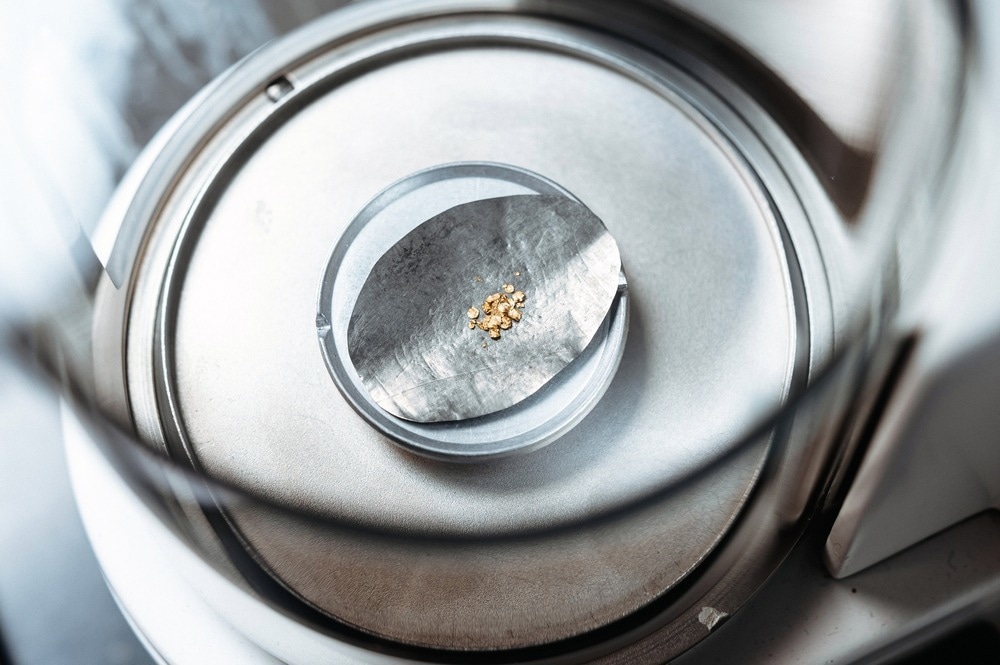
Image Credit: Mark Agnor/Shutterstock.com
Have you encountered real-world examples of counterfeit detection with Niton analyzers?
Absolutely. One memorable example came from a major jewelry show, where two brothers brought in a bag of gold bracelets. One of them had purchased the bag off the street for $15,000 and was concerned about its authenticity. Using the DXL analyzer, we immediately detected that the karat values were non-standard. After further analysis, it became clear that there was no gold present at all. So while the purchase was made for $15,000, the actual value was effectively zero. It was a tough lesson, but a perfect illustration of why verifying precious metals with XRF is so essential.
What concerns do new users typically have when considering handheld XRF, particularly around safety?
Safety is an important topic. While handheld XRF uses X-rays, our devices are built with rigorous safety features. The benchtop DXL 800 has a closed-beam system for maximum safety, while the handheld units require basic radiation training. When used correctly, the risk is minimal – comparable to a dental X-ray.
Beyond the Shine: Handheld XRF Analyzers in Gold Analysis
Is the analysis truly non-destructive, especially when testing valuable jewelry?
Yes, the technology is entirely non-destructive. The XRF beam excites atoms in the material without altering or damaging the sample. This is crucial when you’re testing heirlooms, antiques, or any item where preserving value and appearance is essential.
What are the key differences between the benchtop and handheld Niton XRF analyzers?
Both use the same core technology. The main difference is form factor. The benchtop DXL includes a camera for fine targeting and is ideal for controlled environments like pawn shops or jewelry stores. The handheld XL2 100P is better suited for mobile applications, such as estate valuations or onsite inspections. You can even combine it with a test stand for benchtop-style use.
Beyond gold, what other precious metals can Niton analyzers detect?
Our analyzers are calibrated to detect 22 elements, including platinum, palladium, rhodium, silver, and titanium. This makes them highly versatile across applications such as catalytic converter recycling, PCB manufacturing, and more – wherever precious metals are involved.
What is the typical ROI for someone investing in a Niton XRF analyzer?
With gold prices currently reaching over $5,000 an ounce, the return on investment is incredibly fast. What used to require dozens of ounces to justify the cost now takes as little as five. That’s why we’re seeing explosive adoption growth. The ability to instantly and confidently value metals pays off almost immediately.
About Pete Anzalone
Pete Anzalone is the North American Sales Director for Niton handheld XRF analyzers at Thermo Fisher Scientific. With over three decades of experience at Thermo Fisher, Pete has deep expertise in scientific instrumentation, particularly within materials analysis. He has spent the last eight years focused on X-ray fluorescence (XRF) technology, helping to drive adoption across a range of industries, including precious metals, recycling, manufacturing, and mining. Based in Boston, Massachusetts, Pete works closely with clients to demonstrate how Niton analyzers provide rapid, accurate, and non-destructive analysis for high-value applications. His work supports Thermo Fisher’s mission to enable customers to make the world healthier, cleaner, and safer.

This information has been sourced, reviewed and adapted from materials provided by Thermo Fisher Scientific – Handheld Elemental & Radiation Detection.
For more information on this source, please visit Thermo Fisher Scientific – Handheld Elemental & Radiation Detection.
Disclaimer: The views expressed here are those of the interviewee and do not necessarily represent the views of AZoM.com Limited (T/A) AZoNetwork, the owner and operator of this website. This disclaimer forms part of the Terms and Conditions of use of this website.