
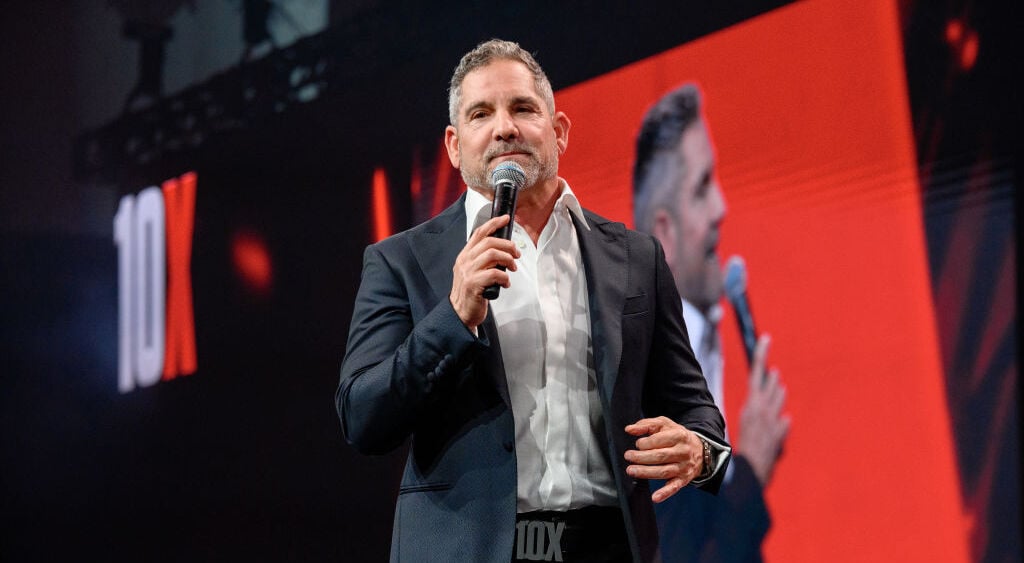

Grant Cardone speaks during the 10X Growth Conference in Hollywood, Florida.
This article adheres to strict editorial standards. Some or all links may be monetized.
Homeownership has long been a cornerstone of the American dream. It symbolizes independence, financial security and prosperity — but is it a dream worth chasing in 2026?
Real estate investment guru Grant Cardone seems conflicted. Speaking on his YouTube channel in 2024, Cardone said, “The average mortgage today is double the rent in America (1).”
Top Picks
-
New 2026 IRA rules are here. See how to protect your nest egg from inflation before the next tax deadline with physical gold. Get your free guide from Priority Gold
He went on to say that you’d have to be “crazy” to buy a home.
“Buying a home without a doubt is the WORST investment people can make, yet it’s also the most common one,” he also wrote in the caption to a video posted on Instagram in that same year (2).
Fast-forward to 2026, and Cardone appeared on Fox Business in February to promote his 10X Space Coast Bitcoin Fund, a hybrid investment that claims to combine the stability of multifamily real estate with the liquidity of Bitcoin — the best of both worlds, according to Cardone.
“I love real estate,” Cardone told Fox Business (3). “But I don’t like that real estate is very heavy, it’s very slow to move, and it’s very expensive to fix.”
The $87.5 million hybrid investment combines a 300-unit multifamily asset in Melbourne, Florida, with $15 million in Bitcoin. Cardone Capital also plans to use the monthly income from its real estate to purchase additional Bitcoin (4).
So, has Cardone really changed his tune about real estate? And more importantly, is buying a home to live in yourself still a good financial move?
Let’s take a look at what he thinks is the right real estate move for you — and how you can make it.
What Cardone typically advises
When it comes to buying a house to live in, Cardone is all about the numbers.
“A $576,000 home will have to be sold for $1.2 million in 10 years,” Cardone said on Instagram (2). Does he think that’s realistic?
“You’re not going to sell it for that, to break even,” he said.
He then described the exercise as “dead money” — a term used for an investment that has shown little increase in value or is locked up for a long time with little yield.
Cardone, instead, typically prefers real estate investments that aren’t tied to your own living situation.
“Rather than buying one house, rent where you live … go buy a piece of real estate where other people live,” he explained.
In other words, rather than own your own housing, own somebody else’s — and make a profit. But how feasible is it for most Americans?
Read More: How to put Dave Ramsey’s popular 7 Baby Steps into action
Read More: 5 essential moves to make once you’ve saved $50,000
Invest in properties you don’t live in
Perhaps the biggest obstacle for many Americans who rent their homes is that they feel that they can’t afford a down payment to buy their own property — much less an investment property to rent.
In fact, a CNN poll found that 86% of American renters would like to buy a home, but they simply can’t afford one (5).
This is coming on top of more bad news for potential homebuyers in 2026, as interest rates rose due to the war in Iran and the risk of oil shortages.
“High oil prices are not good for mortgage rates,” Lawrence Yun, chief economist for the National Association of Realtors, told CNBC (6).
Interest rates are also increased due to the potential for further inflation, a major contributor to unaffordability across the country since 2020.
Moreover, the supply of available homes still hasn’t met pre-pandemic levels, so competition for properties is still fierce in many markets, even though interest rates have fallen compared to previous years.
And so, whether you want to buy your own home or invest in real estate, this mix of high interest rates and competition for housing is making it difficult.
That’s why crowdfunding platforms — a process championed by Cardone — offer a way around it, even for those without a massive down payment available. They allow everyday investors to pool their money to purchase property (or a share of property) as a group.
So, if you’re keen on getting into the real estate game and agree that renting the space you live in is the smarter financial move, here’s what you should know if you’re looking for an opportunity to invest in property without owning your own home.
Break into the vacation rental market
One way of tapping into this market is by investing in shares of vacation homes or rental properties through a platform such as Arrived.
Backed by world-class investors, including Jeff Bezos, Arrived allows you to invest in shares of vacation and rental properties, earning a passive income stream without the extra work that comes with being a landlord of your own rental property.
To get started, simply browse through their selection of vetted properties, each picked for their potential appreciation and income generation. Once you choose a property, you can start investing with as little as $100, potentially earning quarterly dividends.
Consider long-term rentals
There are also platforms that allow you to invest in longer-term rentals with the potential for steadier returns.
That’s where mogul comes in. This real estate investment platform offers fractional ownership in blue-chip rental properties, which gives investors monthly rental income, real-time appreciation and tax benefits — without the need for a hefty down payment or late-night tenant calls.
Founded by former Goldman Sachs real estate investors, the mogul team handpicks the top 1% of single-family rental homes nationwide for you. Simply put, you can invest in institutional quality offerings for a fraction of the usual cost.
Each property undergoes a vetting process, requiring a minimum 12% return even in downside scenarios. Across the board, the platform features an average annual IRR of 18.8%. Their cash-on-cash yields, meanwhile, average between 10 to 12% annually. Offerings often sell out in under three hours, with investments typically ranging between $15,000 and $40,000 per property.
Every investment is secured by real assets, not dependent on the platform’s viability. Each property is held in a standalone Propco LLC, so investors own the property — not the platform. Blockchain-based fractionalization adds a layer of safety, ensuring a permanent, verifiable record of each stake.
Getting started is a quick and easy process. You can sign up for an account and then browse available properties. Once you verify your information with their team, you can invest like a mogul in just a few clicks.
Invest in industrial real estate
In addition to single-unit assets, multifamily and industrial real estate have long been touted as wise investments for adding stability to your portfolio.
In particular, factory construction in America is seeing an “unprecedented boom,” according to The Manufacturer (7). This is in part thanks to mechanisms like build-to-suit (BTS) financing.
BTS financing lets manufacturers make use of purpose-built facilities without actually having to buy the site. Instead, a developer or investor buys the property and pays for construction — following specifications of the manufacturer — while the manufacturer rents it out as a long-term tenant.
According to The Manufacturer, arrangements like this are unlocking billions in investment for industrial real estate.
If diversifying into industrial or multifamily rentals appeals to you, you could consider investing with Lightstone DIRECT, a new investing platform from the Lightstone Group, one of the largest private real estate companies in the country with over 25,000 multifamily units in its portfolio.
Since they eliminate intermediaries — brokers and crowdfunding middlemen — accredited investors with a minimum investment of $100,000 can gain direct access to institutional-quality multifamily opportunities. This streamlined model can help reduce fees while enhancing transparency and control.
And with Lightstone DIRECT, you invest in single-asset multifamily deals alongside Lightstone — a true partner — as Lightstone puts at least 20% of its own capital into every offering. All of Lightstone’s investment opportunities undergo a rigorous, multi-stage review before being approved by Lightstone’s Principals, including Founder David Lichtenstein.
How it works is simple: Just sign up with your email, and you can schedule a call with a capital formation expert to assess your investment opportunities. From here, all you have to do is verify your details to begin investing.
Founded in 1986, Lightstone has a proven track record of delivering strong risk-adjusted returns across market cycles with a 27.6% historical net IRR and 2.54x historical net equity multiple on realized investments since 2004. All told, Lightstone has $12 billion in assets under management — including in industrial and commercial real estate.
As such, even if industrial or multifamily rentals don’t appeal to you, Lightstone could still serve you well as an investment vehicle for other real estate verticals.
Get started today with Lightstone DIRECT and invest alongside experienced professionals with skin in the game.
You May Also Like
-
Turning 50 with $0 saved for retirement? Most people don’t realize they’re actually just entering their prime earning decade. Here are 6 ways to catch up fast
Join 250,000+ readers and get Moneywise’s best stories and exclusive interviews first — clear insights curated and delivered weekly. Subscribe now.
Article sources
We rely only on vetted sources and credible third-party reporting. For details, see our editorial ethics and guidelines.
@GrantCardone (1); @grantcardone (2); Fox Business (3); GlobeNewswire (4); CNN (5); CNBC (6); The Manufacturer (7)
This article provides information only and should not be construed as advice. It is provided without warranty of any kind.