
LONDON, Nov. 06, 2025 (GLOBE NEWSWIRE) — Analysis from an investor with 60,000+ hours trading under his belt and a degree in Economics from Harvard examines the current valuation landscape of U.S. equities.
DayTrading.com’s Dan Buckley started by looking at basic metrics, namely the forward Price-to-Earnings (P/E) ratio. This evaluates how much today’s investors are paying for each dollar of next year’s expected profit.
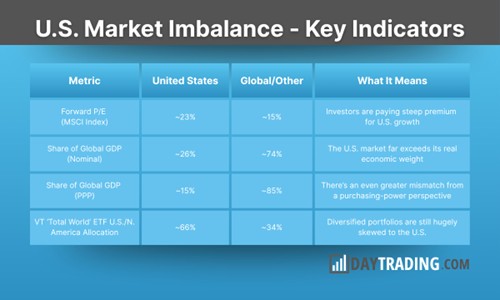
The U.S. market is trading at roughly 23x forward earnings, which is far above the 15x times level seen in international markets.
“This is an extreme gap, representing a roughly 51% void,” Buckley says. “When valuations stretch this far, future returns are often modest at best and downright negative at worst.”
The last times the U.S. hit these sorts of valuations were:
Buckley noted that since the 2021 peak, the U.S. stock market has delivered a compound annual return of around 9%, but before that, it went nearly a decade without making substantial, sustained gains.
After the downturn in early 2022, U.S. equities took nearly two years just to get back to previous highs.
A Market Bigger Than Its Economy
Analysis from DayTrading.com reviewed several metrics highlighting a familiar pattern: global investors maintain a significant weighting in U.S. assets compared with the scale of the underlying economy.
This imbalance reflects how influential U.S. markets have become within global portfolios and index benchmarks.
U.S. Market Imbalance
The research highlighted that the U.S. currently represents around 65% of the MSCI All Country World Index. This is a benchmark that guides billions in global investment flows.
Yet by comparison, America produces only around 26% of the world’s economic output in nominal dollar terms, and it’s actually more like 15% when adjusted for the cost of living.
Buckley noted that even investment vehicles labelled as “global” reflect this outsized concentration. For example, Vanguard’s Total World Stock ETF (VT), is often used as a diversified core holding by many institutions. That still invests around 66% of its assets in the U.S., with 4% just in Nvidia.
“When one single chipmaker accounts for more in a portfolio than many entire countries, diversification is merely a slogan – not a reality,” Buckley added.
The Outsized Impact Of AI
DayTrading.com’s research took aim at AI, pointing out that roughly half of the S&P 500’s gains in 2025 stem from companies tied to artificial intelligence – semiconductor leaders, mega-cap platforms, and infrastructure providers. These include now household names like Nvidia (NVDA), Microsoft (MSFT), Advanced Micro Devices (AMD), and Palantir (PLTR).