
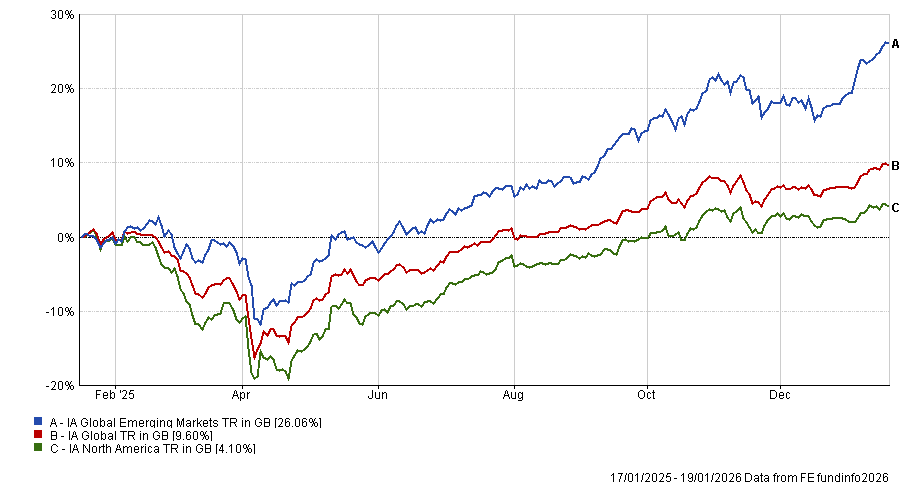
US tariffs might have been expected to be a negative for emerging market assets, but 2025 was the first year in around a decade that the IA Emerging Market index outperformed the IA Global sector.
Tariffs might have been expected to hinder the progress of emerging market assets as they are essentially a geared investment in global trade, so anything that disrupts global trade or makes it more expensive would be negative for emerging market economies.
Sentiment towards the asset class was hampered by the tighter monetary policy of developed market central banks, which raised base rates rapidly in the aftermath of the pandemic.
In the US, this led to a strengthening of the dollar, which is negative for emerging market assets.
The negativity comes from the fact that most emerging market companies and countries typically have to borrow in dollars, so a rise in the value of the dollar leads to higher debt repayment costs, with the consequence of less cash available for shareholder distribution or to invest for future growth.
Emerging market performance in recent years
Another aspect is that if US rates rise, that would be expected to push up the value of the dollar. Many emerging market policymakers fear that a relative weakening of their own currency versus the dollar would have the effect of importing inflation into the emerging market.
The response from the emerging market policymaker is thus to put rates up, which may have the capacity to reduce the level of economic growth in the emerging market.
The third factor to consider is that if US rates are rising, then the yield available on US government bonds will likely be rising, increasing the appeal of that ‘risk-free’ investment, relative to all riskier assets, including emerging market equities, and prompt US-based allocators to move money back home.
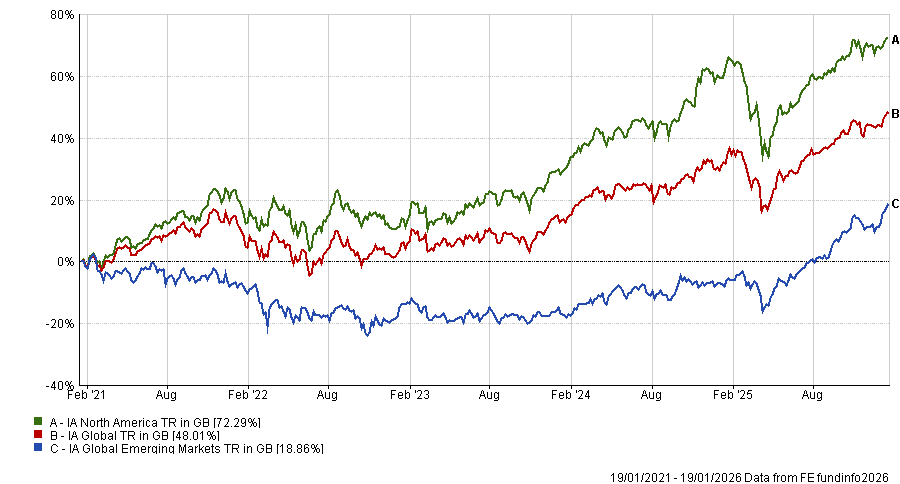
So if higher rates were a major contributor to the underperformance in the years prior to the pandemic, was the strong run enjoyed by the asset class in 2025 merely a function of rates coming down (a cyclical swing), or could there be more at play?
Emerging market equity performance relative to rivals
Marcelo Assalin, head of emerging market debt at William Blair Asset Management, says there was more than a developed market economic cycle at play, as emerging market central banks proved effective in implementing their own monetary policies, putting rates up in a timely manner, and having the capacity to cut rates when needed.