

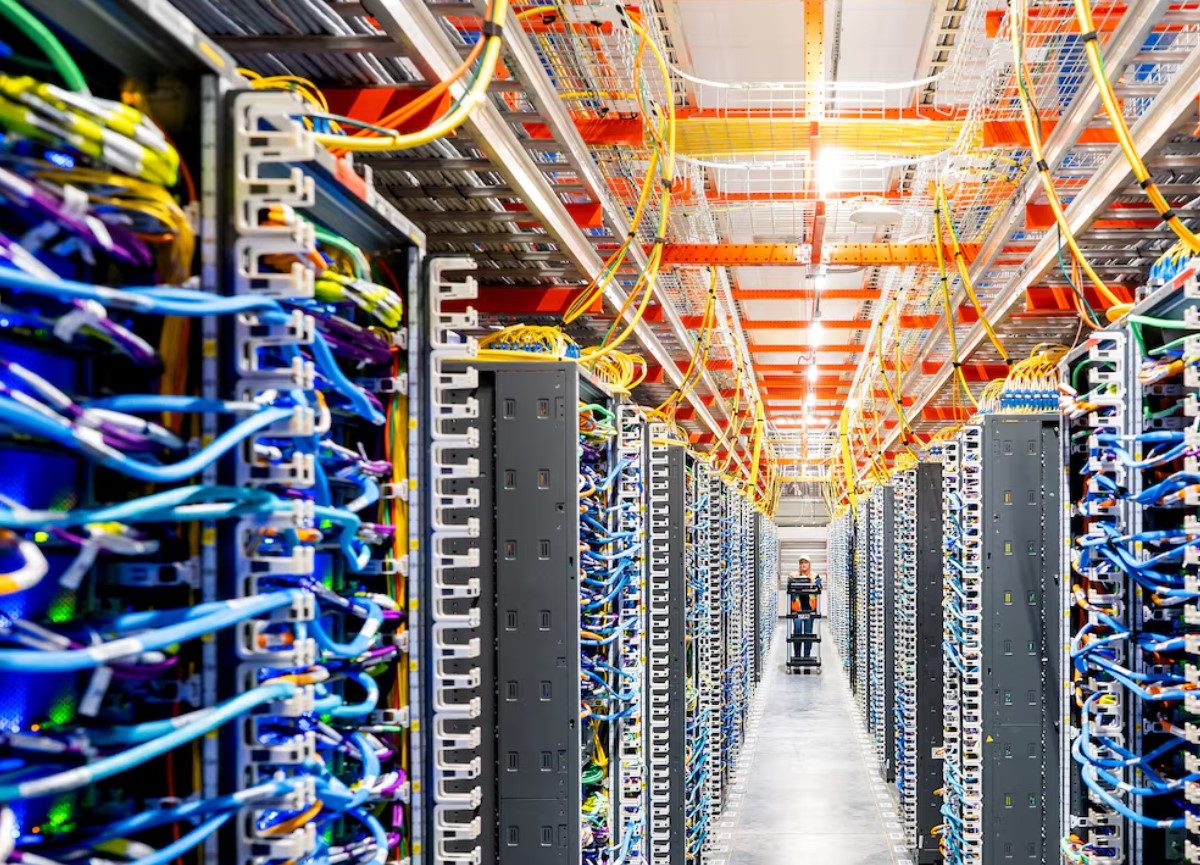
AI factories evolve into primary digital product manufacturing centres
Global investment in data centres is expected to approach $1.6 trillion by 2030, while leading technology companies are forecast to spend more than $600 billion on AI infrastructure capital expenditure in 2026 alone, according to a new report from Omdia.
The research firm said that the scale of spending indicates that the AI Factory market has passed an irreversible turning point and is evolving into a new form of industrial organisation characterised by extremely high capital intensity, significant geopolitical considerations and complex engineering requirements.
According to Omdia, an AI Factory is a new category of heavy industrial infrastructure designed with a single objective, namely the production of intelligence.
The company explained that the fundamental unit of output in this model is the token, reflecting the growing importance of generative artificial intelligence systems.
The report stated that data centres are undergoing a major transformation, shifting from their traditional role as business support facilities into digital product manufacturing centres regardless of their size.
Omdia said that AI Factories are organised around a four-layer architecture comprising energy and physical infrastructure, hardware and network fabric, scheduling and virtualisation orchestration, and a Model as a Service (MaaS) and AI application ecosystem.
The broader ecosystem now encompasses four distinct solution models.
These include full-stack public AI cloud hyperscalers, compute-native AI cloud specialists, turnkey private AI foundation providers, and regional or industrial AI infrastructure operators.
Based on a survey of more than 200 companies, Omdia identified long deployment timelines and return-on-investment validation, digital sovereignty concerns, shortages of AI talent, and system-wide engineering complexity as the most significant challenges facing the market.
The report also highlighted five major developments expected to shape the AI Factory industry during 2026.
The first trend involves a shift away from measuring success primarily through raw computing power.
Omdia said that enterprise spending on accumulating large quantities of computing resources has slowed as companies confront what it described as the “Zombie GPU” effect, where costly graphics processors remain idle while waiting for data input and output processes.
As a result, performance evaluation is increasingly focusing on Time-to-First-Token (TTFT) and vector retrieval speed.
Vendor case studies cited in the report showed improvements including a 12-fold increase in vector indexing speed and cost reductions of up to 75 per cent through lower API and computing redundancy.
The second trend centres on the effort by hyperscale cloud providers to balance operational flexibility with sovereignty requirements.
Omdia described two emerging delivery approaches.
One is a full-stack deployment model, used by providers such as Amazon Web Services, Huawei, Google Cloud Platform, and Oracle Cloud Infrastructure, which enables public cloud-level AI capabilities to be installed directly within a customer’s own data centre.
The other involves separating software and hardware layers, allowing software capabilities to be localised while hardware development is driven by broader ecosystem participation.
The third trend concerns the evolution of compute-native AI cloud providers.
According to Omdia, average rack power density has increased dramatically from 10 to 15 kilowatts in 2024 to between 40 and 250 kilowatts in 2026.
At the same time, workloads are progressing from proof-of-concept projects to full production deployments.
The report cited Nebius and SenseTime as examples of companies that have shifted from bare-metal infrastructure leasing towards Model as a Service offerings.
Omdia said that SenseTime has adopted an integrated strategy combining Infrastructure as a Service (IaaS), Model as a Service (MaaS) and close coordination between energy and computing resources.
The fourth trend relates to what Omdia called the “last mile” of AI industrialisation.
The report said that vertical integrators, domain operators and independent software vendors are increasingly capturing value through long-term data governance, integration with legacy systems and the assembly of specialised AI agents tailored to specific use cases.
Omdia highlighted Inspur Cloud as an example of a company pursuing an integrated strategy combining heavy AI infrastructure investment with intensive operational deployment of AI industrial systems.
The fifth trend identified by the report is the emergence of sovereign data factories.
Omdia said that regulatory frameworks such as the EU AI Act and Digital Operational Resilience Act are increasing pressure for sensitive information to remain within physically isolated facilities.
As a result, regional infrastructure operators are becoming increasingly important.
The report pointed to G42 as an example of an operator evolving from a provider of physical space into a guardian of nationally significant data assets.
“Future competition will no longer be defined by model parameters or GPU counts, but by a comprehensive contest of energy, liquid cooling, chips, autonomous software stacks, sovereign compliance and long-term capital endurance,” said Raymond Zhan, Senior Principal Analyst for Cloud and AI at Omdia.
“For enterprise clients, the provider landscape for AI factory is not a one-size-fits-all game; choices should be tailored to actual business scale and the balance between steady-state and innovative workloads,” Zhan added.
Looking ahead, Omdia expects 2026 and 2027 to represent the most critical period for AI Factory development.
The company believes that regional and industrial AI operations will emerge as the segment with the highest level of growth certainty over the next five years.
The findings underscore how AI infrastructure is increasingly being viewed not merely as a technology investment, but as a strategic industrial asset shaped by energy availability, regulatory compliance, engineering expertise and long-term financial commitment.