The committee makes 12 recommendations on energy security
Representational Photo: Collected
“>

Representational Photo: Collected
Highlights
- Committee recommends three-month strategic fuel reserve
- Calls for diversification of fuel import sources
- Urges faster implementation of Dhaka–Chattogram pipeline SPM and ERL-2
- Emphasises LNG renewable energy and rooftop solar expansion
- Flags risks from global price shocks and supply disruptions
- Opposition adds 10 recommendations on demand forecasting and diversification
A special parliamentary committee has recommended expanding Bangladesh’s strategic fuel reserves to ensure a minimum three-month storage capacity and diversifying import sources to strengthen the country’s energy security.
The committee also made 12 recommendations to address the recent energy situation and prevent similar crises in the future.

It emphasised introducing comprehensive digital monitoring of the supply system, expanding the use of renewable energy, and accelerating the implementation of key infrastructure projects.
Power and Energy Minister Iqbal Hasan Mahmud presented the committee’s report in parliament today (7 June).
The report also incorporated 10 recommendations submitted by opposition members.
The committee stressed the need to increase the use of LNG and renewable energy as alternative energy sources. It also recommended the swift implementation of the Dhaka-Chattogram pipeline, the Single Point Mooring (SPM) project and the second unit of Eastern Refinery (ERL-2).
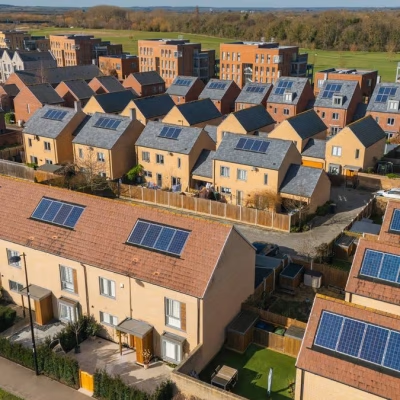
In addition, the committee highlighted the importance of making rooftop solar installations mandatory and ensuring regular monitoring of their effectiveness. It also advised adopting necessary plans and effective measures to reduce system losses in electricity distribution.
According to the report, pressure on the country’s fuel supply system has been created by rising international fuel prices, the war situation in the Middle East, disruptions to shipping through the Strait of Hormuz, instability in global supply chains, and domestic factors such as panic buying, illegal stockpiling and black-market activities. As a result, concerns and uncertainty have emerged among the transport, agriculture and industrial sectors, as well as the general public.
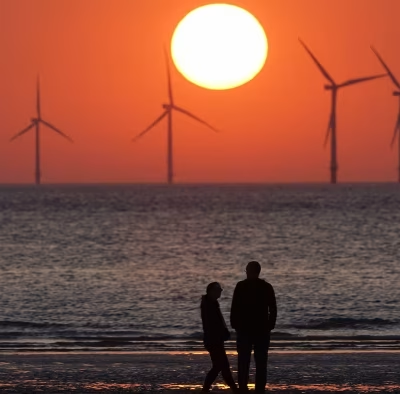
The committee recommended adopting an integrated plan for power generation from a variety of sources, including oil, gas, coal, solar and wind energy.
The report stated that a study should be conducted to determine whether opportunities can be created for private companies, alongside Bangladesh Petroleum Corporation (BPC), to import fuel products.
It also recommended strengthening public awareness campaigns to reduce irrational stockpiling and panic buying during periods of crisis.
According to the report, in the context of volatility in global energy markets and prevailing geopolitical realities, there is a pressing need to make the country’s long-term energy policy, infrastructure and supply system more stable, diversified and technology-driven.
The special committee believes that the recent situation has created an important opportunity to reassess Bangladesh’s energy security framework.
Opposition’s 10 recommendations
The opposition proposed conducting demand assessments for power and energy through an independent committee of experts free from political influence.
According to them, realistic planning is needed to avoid exaggerated demand forecasts.
They also recommended maximising the utilisation of coal-fired power plants, increasing domestic gas production, undertaking new gas exploration both onshore and offshore, continuing crude oil exploration, and accelerating the implementation of the SPM and Eastern Refinery-2 projects.
The opposition’s recommendations also included large-scale expansion of solar power, assessing the feasibility of micro-hydro projects in the hill regions, exploring the potential for river-flow-based power generation, and reducing the use of government vehicles during energy crises.
They further proposed research into the potential of hydrogen fuel technology, biogas and waste-to-energy generation. According to the opposition, it is essential to diversify the power and energy sector and reduce excessive dependence on any single energy source.
On 26 April, the 10-member special committee comprising parliament members from both the government and opposition was formed to review the country’s energy security and determine future actions in the national interest.