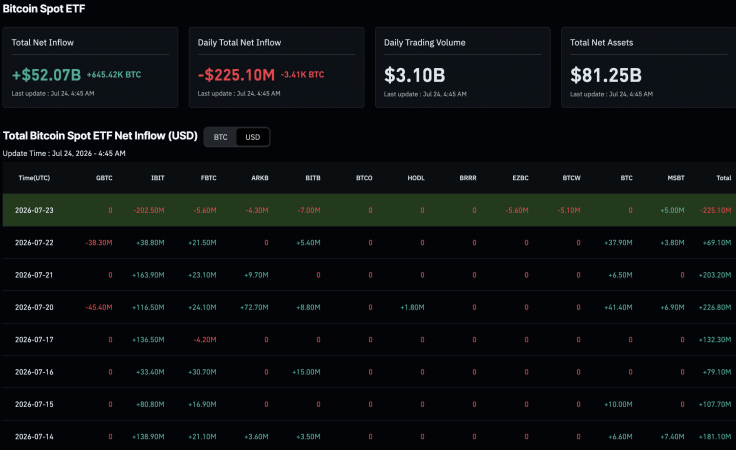
US spot Bitcoin ETFs just posted their best stretch in 11 weeks, stringing together seven straight inflow sessions worth nearly $1 billion through July 22.
BlackRock’s IBIT swallowed $319.16 million of the $499.05 million added this week alone, topping every single session.
Then the music stopped. Yesterday’s session closed with roughly $225 million in outflows, snapping the streak cold.
That entire seven-day rally recovered just 15% of what June took out, and Bitcoin ETFs remain down $4.76 billion in net outflows for 2026. June alone bled $4.7 billion, the largest monthly exodus since these products launched.
The CLARITY Act Was the Whole Catalyst
The two biggest days tell you exactly what institutions are actually trading. July 20 logged $226.92 million and July 21 added $203.14 million, both on reports that President Trump had agreed to the ethics rules that stalled the CLARITY Act. Bitcoin punched above $66,000 for the first time since June 17.
The bipartisan bill would finally split regulatory jurisdiction between the SEC and CFTC, removing the compliance ambiguity that keeps pension funds and insurers on the sidelines. Money moved on the headline, not on Bitcoin.
The deceleration afterward is the tell. Inflows faded to $68.99 million on July 22, the weakest day of the streak, then flipped negative. No fresh regulatory news, no fresh buying. Polymarket still prices the odds of CLARITY becoming law in 2026 at roughly 48%, which is not passage. It’s just enough hope to justify a position.
Why IBIT Keeps Eating Everyone’s Lunch
IBIT isn’t even the cheapest option and it doesn’t matter. Fidelity’s FBTC charges no management fee and holds $11.38 billion. IBIT charges 0.25% and holds $48.86 billion.
The edge is distribution. BlackRock is already inside every pension committee and RIA platform in America, so buying IBIT clears compliance without a fight. On July 22, IBIT accounted for nearly 79% of the $1.11 billion traded across all 13 spot Bitcoin ETFs. It alone holds 3.70% of every Bitcoin in existence, while the other twelve funds combined hold 2.38%.
Its CEO is talking his book, loudly:
“There were too many leverage players in it. That’s why we had the washout, and I think there’s more stability at these levels. I’m very bullish on the markets over the next 12 months.” — Larry Fink, CEO, BlackRock
The Grayscale Anchor Nobody Can Cut Loose
There’s a reason the headline numbers look worse than the demand actually is. GBTC has hemorrhaged $27.42 billion since converting to an ETF, including another $38.30 million on July 22.
The cause is brutal and simple. Grayscale charges 1.50% against IBIT’s 0.25%. On $100,000 held for five years, that gap compounds to roughly $6,500 in extra fees before performance even enters the conversation. Total net inflows across all 13 funds sit at $51.85 billion, but IBIT alone has pulled $60.81 billion. Strip out GBTC’s drag and the complex looks considerably healthier than the tape suggests.
Corporate adoption of Bitcoin is “necessary” and “inevitable” for BTC to succeed as a global monetary network. — Michael Saylor, executive chairman, Strategy
IBTimes US
Bitcoin is holding above $65,000 on July 24, which is quietly impressive given yesterday’s outflow. Reclaim $65,500 with conviction and $70,000 comes into view. Fail, and the chop toward $64,000 continues.
So the question worth arguing: is a seven-day, billion-dollar streak the start of institutional re-entry, or just traders front-running a bill that still has a coin-flip’s chance of passing?