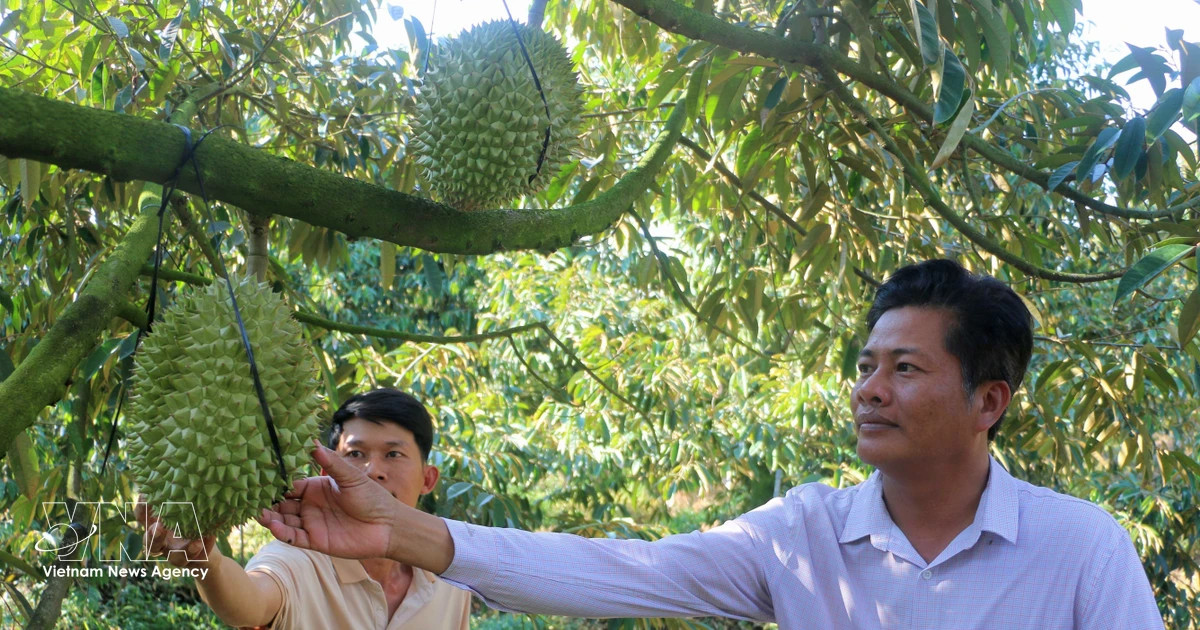
However, limited financing mechanisms remain a major obstacle, leaving most agricultural producers slow to transition, operating on a small scale, with fragmented approaches and low efficiency.
Positive signals
Over the past five years, Vietnam has developed and gradually implemented a green finance system to support low-emission and environmentally friendly production, including agriculture. Based on the State Bank of Vietnam’s Directive No. 03/CT-NHNN dated March 24, 2015, banks including BIDV, VCB, HDBank and Agribank have introduced green credit packages for waste treatment, high-tech agriculture, digital transformation, regional linkages and emission reduction across production chains.
By 2025, outstanding green agricultural loans from domestic banks had reached about 150 trillion VND (5.77 billion USD). Vietnam has also attracted significant funding from international organisations such as the Green Climate Fund (GCF), World Bank (WB) and Asian Development Bank (ADB), as well as bilateral support from developed countries including Japan, Germany, the Republic of Korea and the Netherlands.
State Bank of Vietnam statistics show that around 50 financial institutions have introduced green credit packages. Examples include BIDV’s “Green credit for sustainable agriculture” programme, implemented with GIZ of Germany, which has financed 78 low-carbon rice farming and bioenergy projects in the Mekong Delta with total funding of about 1.2 trillion VND; HDBank’s IoT- and solar-powered farm projects worth 2 trillion VND; Agribank’s pilot preferential lending programme for cooperatives; and ICF and ADB support for developing green finance criteria, risk assessment frameworks and green project lists.
Experts say green finance still accounts for a small share of agricultural financing compared with its potential. Small agricultural businesses, cooperatives and farming households struggle to access green credit because they often fail to meet requirements relating to collateral, credit records and carbon credit pricing mechanisms.
According to the WB, Vietnam will need about 368 billion USD by 2050 to achieve net zero, with agriculture accounting for around 20% of the total. This underscores the need to urgently complete a green finance framework for agriculture, including institutional mechanisms, investment funds, tax and interest-rate incentives, collateral valuation and climate risk insurance.
Mechanisms to address bottlenecks
Green finance for agriculture still faces barriers ranging from institutional to technical issues. The lack of unified criteria for identifying green projects makes appraisal and risk management difficult, while existing financial mechanisms are not sufficiently attractive to encourage businesses to transition.
Most credit institutions and agricultural businesses also have limited capacity to assess environmental, social and governance (ESG) impacts. Meanwhile, credit institutions face difficulties related to the legal framework, national data systems for the green economy and databases of green projects, as well as a shortage of high-quality ESG-related human resources.
According to expert Nguyen Dinh Dap of the Vietnam Academy of Social Sciences, Vietnam needs criteria for identifying high-tech, low-emission agricultural projects and preferential credit mechanisms, particularly for capital-intensive projects involving solar-powered farming, large-scale IoT and AI applications, and supply-chain digitalisation. Such measures will create stronger incentives for private investment.
The authorities should also complete the system for measuring, reporting and verification (MRV) of emissions as a basis for issuing green bonds and pricing carbon credits. This will help small businesses, cooperatives and farmers qualify for green credit.
The Institute of Agricultural Strategy and Policy under the Ministry of Agriculture and Environment has proposed developing national criteria for green agricultural projects covering emissions, energy, water and resource efficiency, circularity and ESG; issuing specific guidelines on green credit and agriculture-specific green bonds; and considering a green agricultural finance action framework by the State Bank of Vietnam to provide a legal basis for commercial banks to design suitable financial products.
Difficulties faced by entities seeking green financing also need to be addressed through stronger support to improve their capacity to prepare environmental dossiers and ESG reports. Businesses should be encouraged and facilitated to join value chains to strengthen management capacity, reduce risks and improve sustainability.
At the same time, the State’s role in mobilising resources, guiding and shaping the market should be strengthened. Appropriate financial instruments can serve as “seed funding” to encourage businesses to adopt high-tech and green technologies, while climate finance should be integrated into national target programmes and a diverse range of green financial products and green capital markets developed.
Capacity to access green finance and engage in international cooperation should also be enhanced through expert-level training for personnel in credit institutions and green businesses. International PPP models should be developed and replicated, particularly in green credit, climate insurance and clean technology transfer, alongside stronger capacity to manage, appraise and supervise high-tech projects./. VNA