
Nikkei Futures Day Trading Diary | September 2026 Summary +69,402 yen (Monthly +17.4%)
One month has passed since I started day trading Nikkei 225 Micro futures with a capital of 400,000 yen. My plan is to build up wealth with a compound interest target of +2 million yen per year, or +16.1% per month.
To start with the conclusion, in September I exceeded my goal with +69,402 yen, a monthly return of +17.4%. Looking only at the numbers, it was a good performance. But the substance is not clean at all. I committed 5 rule violations, and there was one day where I lost 22,158 yen.
Since I have the records for the entire month, I will lay out both the good and the bad.
September Overview
-
Business days 22 / Days traded 21
-
283 trades, 174 wins, 109 losses (Win rate 61.5%)
-
Profit/Loss +69,402 yen Capital 400,000 yen → 469,402 yen
-
Winning days 14 / Losing days 7
-
Average profit 1,776 yen / Average loss 2,198 yen Profit/Loss ratio 0.81
My win rate is over 60%. But the profit/loss ratio is 0.81, meaning that a single loss is larger than a single win. I am being supported by my win rate, and this remained a challenge throughout this month.
Weekly Progress
-
Week 1 (9/1–9/4) 56 trades +57,568 yen
-
Week 2 (9/7–9/11) 97 trades +6,010 yen
-
Week 3 (9/14–9/18) 69 trades +26,578 yen
-
Week 4 (9/21–9/25) 40 trades −20,162 yen
-
Week 5 (9/28–9/30) 21 trades −592 yen
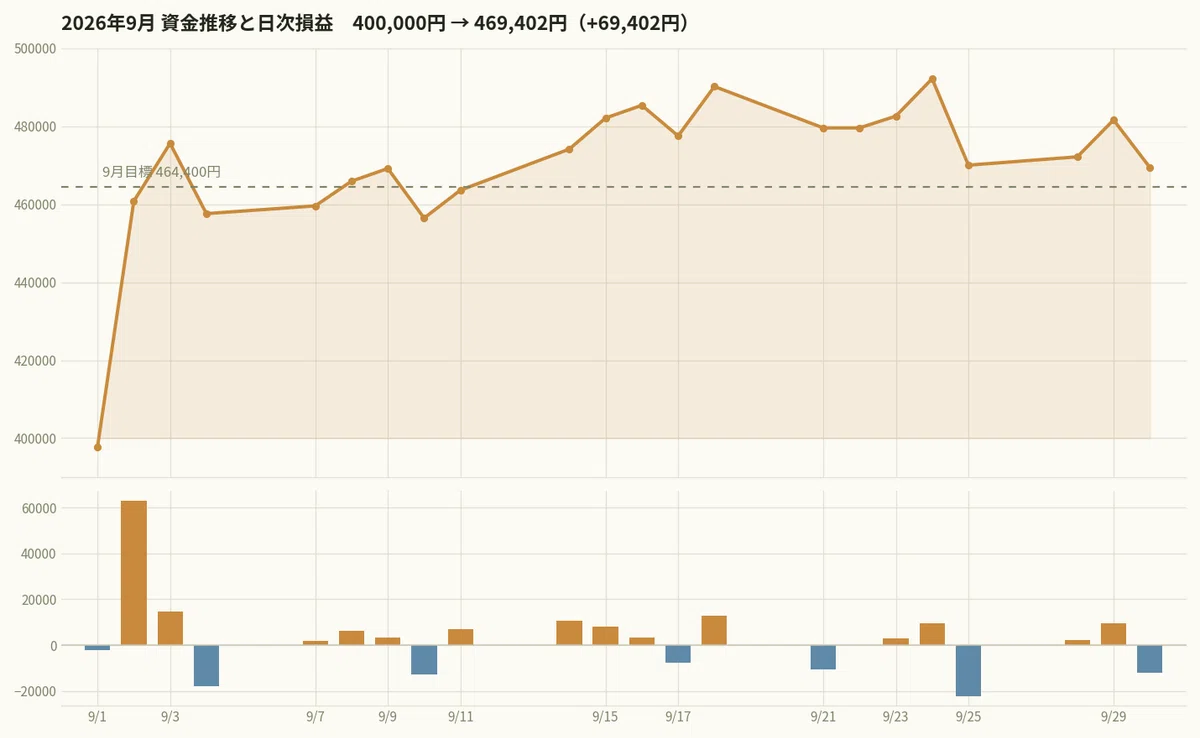
I made almost all of my profit in the first week. The majority of the +57,568 yen came from +62,984 yen on 9/2, a day when I was able to ride a large move on the daily chart. You could say the remaining three weeks were just me protecting or slowly chipping away at those savings.
In the second week, I made +6,010 yen after 97 trades.It clearly shows that I didn’t have much left despite the high number of trades.
Long vs. Short Ratio
-
Long 118 trades / 346 shares / 65 wins 53 losses / +11,038 yen
-
Short 165 trades / 538 shares / 109 wins 56 losses / +58,364 yen
84% of my profit came from shorts. The ratio of shares is also skewed toward shorts at 6:4.
This was surprising even to me. There was a period where I was convinced that “longs are a net loss and I’m only making a living off shorts,” but due to a calculation error (days that should have been excluded were mixed in), it turned out that longs were actually profitable too.I learned that it is important to both doubt the numbers and trust the numbers.
However, it is a fact that I have had better results with shorts as a trend. Since drops are fast, they might fit my target of 6 to 12 five-minute candles better.
The 5 times I messed up
There’s no point in hiding it, so I’ll write it all down.
1. 9/2 Position of 8 shares (limit is 5 shares)
I settled 8 shares in one order, meaning I held 8 shares at once. I lost sight of the rules in the momentum of the first week.
2. 9/10 5 new trades after reaching a daily loss of -15,000 yen
I kept trading after crossing the line where I should have stopped, trying to win back what I had lost.
3. 9/25 12 new trades after reaching a daily loss of -15,000 yen (-4,770 yen)
The worst day of the month. From the opening, I watched US index futures and high-priced semiconductor stocks to try and capture price movement, but it didn’t work out. From there, I tried to win it back by getting involved in consolidation, repeating entries that were close to gambling. Ultimately, I ended up at -22,158 yen.
When I won, it was +112 to +534 yen; when I lost, it was -3,000 to -6,500 yen.I was winning small and losing big, which was the exact opposite of my usual pattern.
4. 9/29 Position of 6 shares
This was an accident where a position was opened unintentionally because I forgot to delete a limit order. The profit/loss was only -132 yen, but my order management was sloppy.
5. 9/30 Stop-loss of -3,816 yen
I exceeded the new stop-loss limit I had set. On the last day of the month, I lost 5 times in a row, totaling -12,180 yen.
Things I tried through trial and error
1. Tried “holding until the scenario breaks” → Failed (hindsight)
On 9/21, I decided to hold until the 1-hour chart scenario broke. The result was -13,544 yen with 2 lots. This was my largest loss per trade for the month.
The problem wasn’t the decision to hold itself, but that I hadn’t decided where to admit I was wrong. As a strategy, it’s not bad, but it doesn’t work unless it’s paired with exit conditions.
2. Made my rules my smartphone wallpaper
On the afternoon of 9/29, I set my rules as my lock screen wallpaper. I see them many times while trading.
The effect was immediate. On the day I set it (9/29), I had 10 wins and 2 losses in 12 trades, +9,452 yen. My stop-losses were only two, at -132 yen and -2,166 yen, both cut within my limits. It was a different experience from how I dragged out losses on 9/21 and 9/25.
Rather than relying on willpower, it’s faster to put them where you can see them.
3. Redesigned my stop-loss rules
At first, I used a fixed amount of “within -3,000 yen.” But when I actually tried it, there were times when I was forced to cut just because of the amount, even though the basis for my entry hadn’t broken. I was force-cutting profits that should have been captured if I had followed the scenario, just because of a stop-loss order.
So, I tallied up all my losing trades for the month.
-
Up to 1,000 yen: 38 cases
-
Up to 2,000 yen: 26 cases
-
Up to 3,000 yen: 23 cases
-
Up to 5,000 yen: 16 cases
-
Up to 10,000 yen: 4 cases
-
Over 10,000 yen: 2 cases
80% of my 109 losses were already within -3,000 yen. In other words, this rule didn’t restrict anything in most situations. The problem was the remaining 22 cases, which accounted for 52% of my total losses all by themselves.
If that’s the case, instead of cutting mechanically every time, I just need to stop those 22 cases.
So, this is what I am doing now.
-
The primary criterion for a stop-loss is the basis for the entry. If that breaks, I cut it immediately regardless of the amount.
-
I only use the amount as an upper limit. I reconfirm the basis at -3,000 yen and definitely close the position by -3,500 yen.
-
Since I cut with market orders, there is a difference due to slippage. That is why I made 3,500 the actual line instead of exactly 3,000.
Looking at the numbers, losses in the -3,000 to -3,500 range only account for 6 cases per month, totaling -19,440 yen. On the other hand, the 16 cases that exceeded -3,500 totaled -105,810 yen. Even with a 500 yen buffer, there is little to lose, and I realized this is where I should be targeting.
My habits that have become apparent
When I line up the whole month, the difference between winning days and losing days is quite clear.
I win on days when there is a clear direction. On 9/24 (downtrend) I was +9,588 yen, and on 9/29 I was +9,452 yen. Positions taken along the trend grew, and only the positions that went against it lost.
I lose on sideways days. On 9/16, I made 21 trades for +3,260 yen. On 9/25, I dabbled in the consolidation and lost -22,158 yen. On 9/30, it was also sideways and I had 5 consecutive losses. Even though my method is trend following, I am trading more frequently and with larger sizes on days without a trend.
In other words, rather than a problem of skill, trading on days when I should not be trading accounts for the majority of my losses. This looks like it will be the biggest theme for October.
Another thing that became clear is that the number of trades and the profit/loss are not proportional. On 9/16, I had +3,260 yen from 21 trades, and on 9/23, I had +3,018 yen from 2 trades. I made almost the same profit with one-tenth the number of trades.
Looking toward October
My goal for the end of October is 539,168 yen. I need to accumulate almost the same amount again as I did in September.
I will not increase the things I do. I will only plug the 3 holes found in September.
-
Do not trade on days without a trend. Even if I do, I will reduce the size. There are too many patterns where I lost in sideways markets.
-
Do not open a second position to try and win back losses. If I lose one, I will wait at least 10 minutes until the next entry. Both 9/10 and 9/25 fell apart from here.
-
Stop-losses are based on the entry rationale, with -3,500 yen as the absolute upper limit. -105,810 yen for the month was concentrated here.
Rather than chasing numbers, I feel that not making the same mistake twice is ultimately the shortcut. After doing this for a month, I realized that how I lose is much more reproducible than how I win.
I will continue to keep records at this pace in October as well.
I hope this is helpful for your trading!