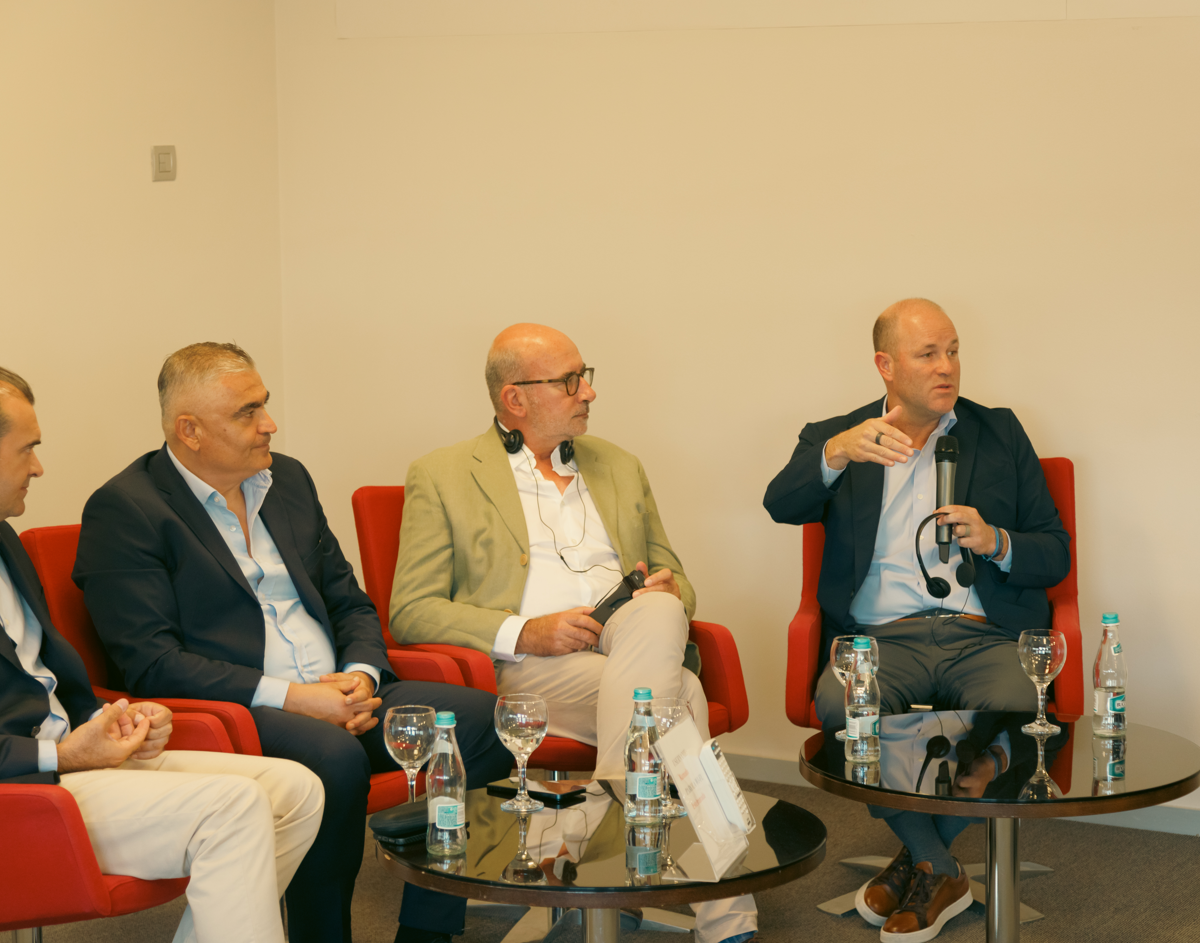
Romanian agriculture has the potential to support Europe’s growing sustainable aviation fuel (SAF) market while creating additional opportunities for farmers and contributing to the European Union’s decarbonization objectives. This opportunity was the focus of an expert panel discussion hosted by the international science and technology company Corteva Agriscience earlier this week, bringing together representatives from the industry to explore how intermediate crops can contribute to a more sustainable biofuel value chain.
Moderated by Cristina Cionga, Deputy Executive Director of the Forum of Professional Farmers and Processors in Romania (APPR), the discussion examined the role of agriculture in supporting the ReFuelEU Aviation initiative, which requires a growing share of SAF to be blended into jet fuel at EU airports, starting at 2% in 2025, rising to 6% by 2030 and reaching 70% by 2050. Speakers explored how intermediate crops can help supply feedstock for this market while creating economic opportunities for farmers.

One example discussed was short-cycle sunflower grown after winter cereals on land that would otherwise remain idle between two main harvests. Such crops can generate an additional revenue stream on existing farmland, help maintain soil cover, and increase the supply of sustainable oilseed feedstocks without displacing food production.
Etienne Bouquet, Regional Portfolio Leader at Corteva Europe, highlighted the importance of aligning regulatory frameworks with practical farming conditions: “ReFuelEU Aviation has created long-term demand for sustainable aviation fuel. What determines whether a crop grown on a European farm can count towards that demand is the regulation, specifically Renewable Energy Directive, RED III, and Annex IX, which lists the feedstocks eligible for advanced biofuels. Intermediate crops sown between two main harvests on existing cropland are already recognized in that annex, but the technical definition and the certification rules still need to reflect how farmers work in practice. If eligibility is drawn too narrowly, growers lose the flexibility to choose short-cycle cultivars that fit their climate and their rotation. Corteva’s role is to provide those hybrids, so that an additional oilseed harvest can become a stable source of farm income and a reliable feedstock for SAF.”

The discussion also addressed the development of feedstock supply chains needed to support Europe’s SAF ambitions. Speakers highlighted the role of Etlas, the joint venture established by Corteva and bp to connect agricultural production with biofuel markets. The venture plans to begin supplying initial volumes in 2027 and targets one million tonnes of oil feedstock annually by the mid-2030s, equivalent to approximately 800,000 tonnes of biofuel.
Discussing the opportunity for Romania within this emerging value chain, Ignacio Conti, CEO of Etlas, said: “The model starts with the farmer and runs through aggregators, crushers and energy partners. By combining Corteva’s seed technology with bp’s refining and logistics capabilities, Etlas is building a traceable, scalable supply of agricultural feedstock. Romania already has the agricultural base for this market. It ranked first in the EU in 2025 for both sunflower area and sunflower production, and its energy strategy sets a 3.5 percent share of advanced biofuels by 2030. The potential is there if growers have the right seed, agronomy and a reliable route to market. Some Romanian farmers are already running second-crop sunflower and many others should look at the opportunity. Our role is to help orchestrate the chain so that farmers, crushers and energy partners all have a traceable supply to work with.”

From a market perspective, Cezar Gheorghe, founder of AGRIColumn, emphasized Romania’s potential to become an important contributor to Europe’s biofuel feedstock supply: “The oil market now splits between food and biofuels, and second-crop sunflower is a stage we do not use today. Romania has to be on this map. The point is to keep more added value for the farmers.”
Providing a farmer’s perspective, Costin Telehuz, farmer and President of the Ialomița Association of Cereal and Technical Crop Growers, noted that short-cycle sunflower can fit into existing crop rotations when agronomic conditions are right: “Sunflower as a second crop after barley or wheat has a place in the system if the hybrid is early enough not to compromise the next main crop. The first harvest already carries a large part of the fixed costs, so this extra crop is judged on what it adds, not on whether it replaces wheat or other main crops. Whether it works is decided when you sell it, like any other harvest.”

Speakers agreed that intermediate cropping can complement, rather than compete with, food production. While the main cereal crop remains the foundation of the rotation, intermediate oilseed crops can utilize otherwise idle periods between harvests. In addition, the sunflower meal produced remains available as a valuable source of protein feed for livestock production.
Following the panel discussion, participants visited short-cycle sunflower demonstration plots at TOTAGRO Farm in Giurgiu County, owned by Cătălin Corbea. The plots featured sunflower grown after a winter cereal crop, demonstrating how intermediate cropping can be integrated into commercial farming systems. Reflecting on his experience, Corbea said: “This interval is the window for short-cycle sunflower. What changes is the continuity of the system. The land stays occupied, the soil is not left bare, and the following crop starts from a field that has been covered rather than idle. We have been doing this after barley for years. If you look at the farm overall, it’s working.”
As demand for sustainable aviation fuel continues to increase across Europe, intermediate crops such as short-cycle sunflower could provide Romanian farmers with new market opportunities while supporting the development of locally sourced feedstock supply chains. Through seed innovation, agronomic expertise and collaboration across the value chain, agriculture can play an important role in helping meet both sustainability objectives and farm economic needs.