“I want to trade Japanese stocks, but I can’t win. I still don’t know which methods, styles, or time horizons suit me…” I think many Japanese stock beginners feel this way.
In this note article, I will look at things from the perspective of “How to fight by time frame, such as scalping, day trading, and swing trading in Japanese stocks, and which one is right for you?”
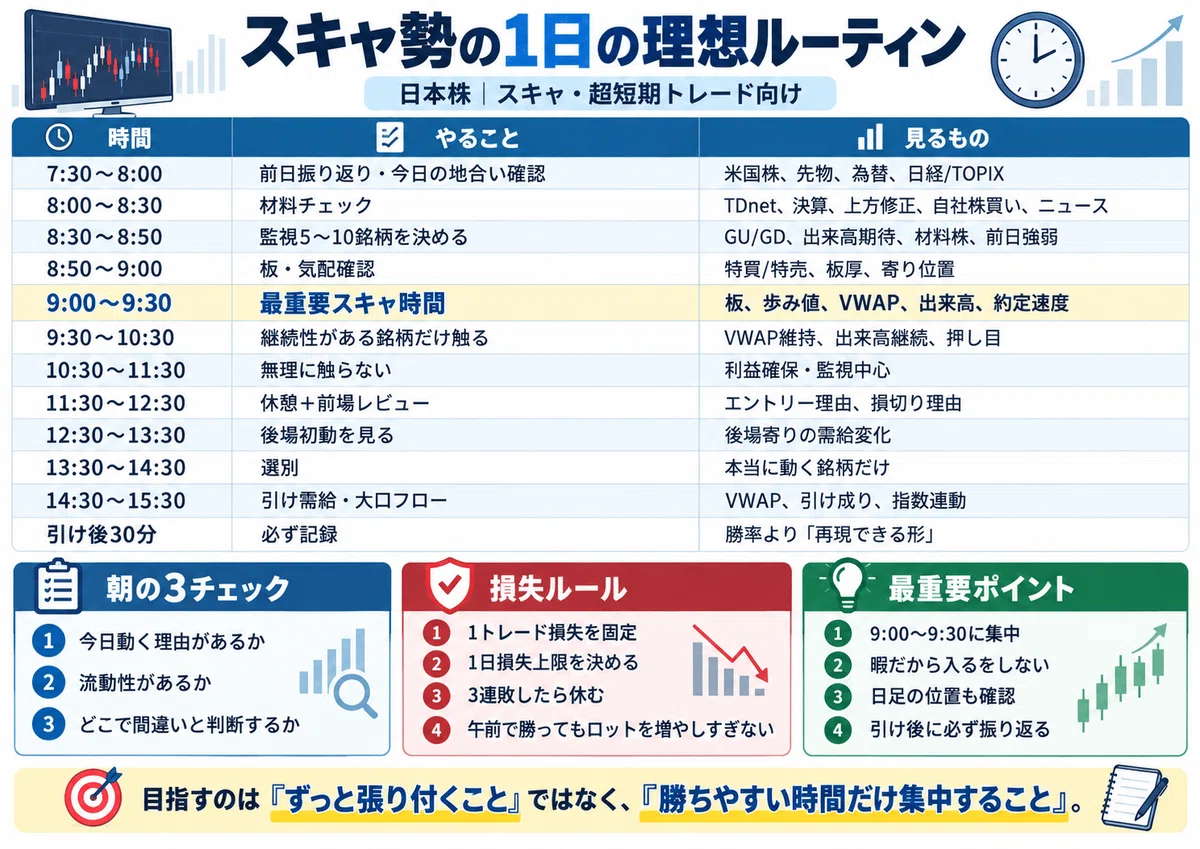
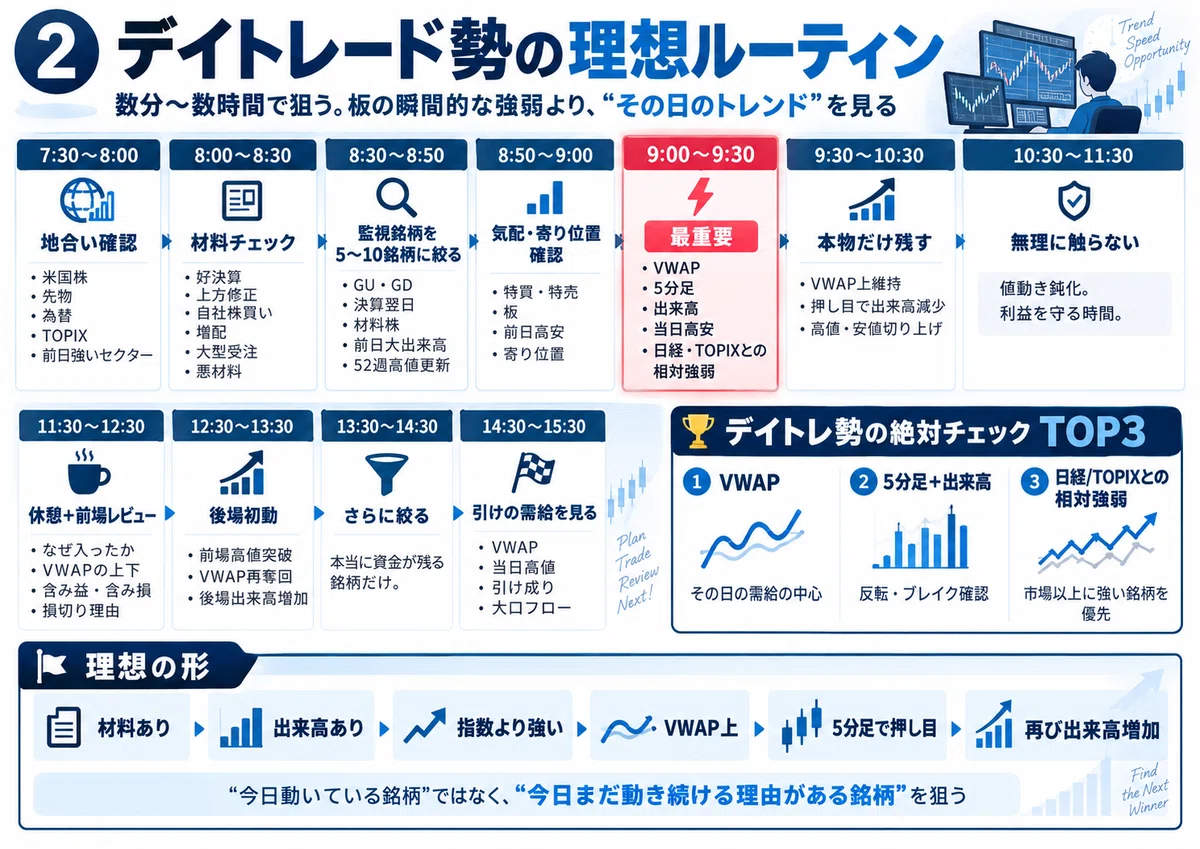
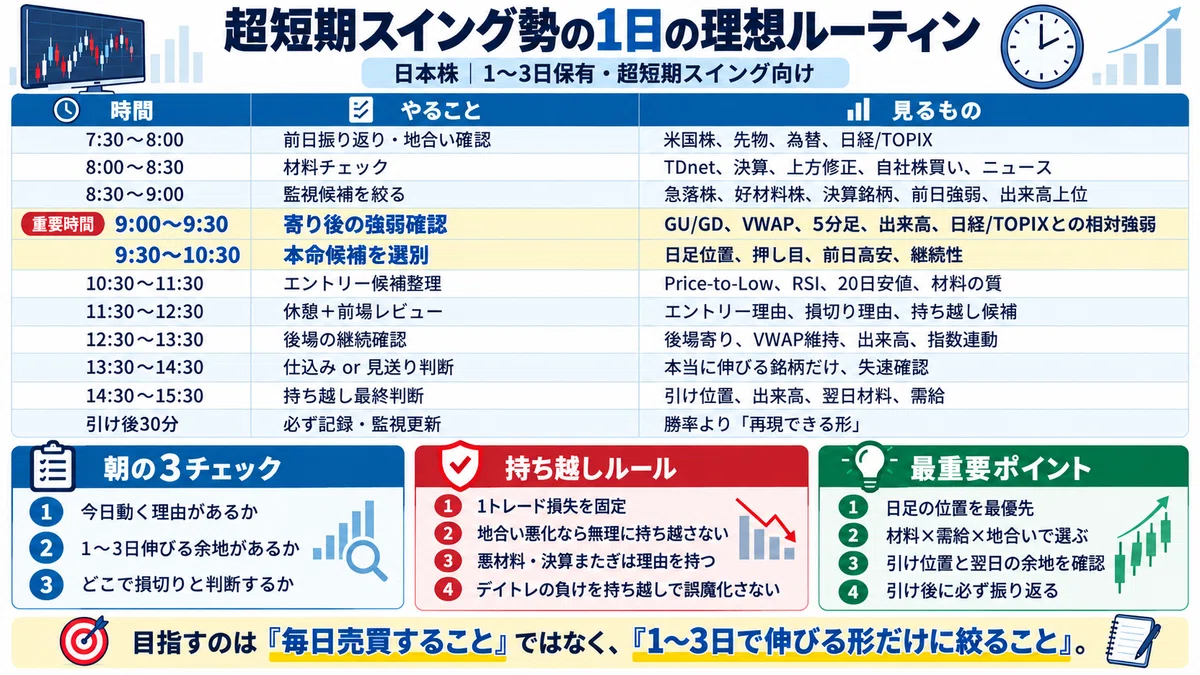
I would like to summarize the characteristics, pros and cons, fighting methods, and routines for each time horizon.
How to Win at Japanese Stocks Changes with the ‘Time Horizon’
In stock investment, I believe it is much more important to decide “which time horizon to fight in” before deciding what to buy.Deciding which time horizon to fight in is quite important.
Scalping and swing trading require completely different indicators to watch, different skills, and different approaches to stop-loss.
Nevertheless,
“It’s a buy on the daily chart, but I get scared looking at the 5-minute chart and sell”
“I intended to invest long-term, but I cut my losses on the next day’s decline”
…there are many people who mix up their time horizons like this.
First, know which battlefield you are fighting on.
And, which battlefield is suitable for you.
I think it is better to be aware of this at an early stage.
Scalping, Day Trading, Swing Trading: Investment Style Diagnosis for You
First, let’s do a simple diagnosis.
Please choose the one closest to you from the following questions.
Q1. How much can you watch the market in a day?
A. I can stay glued to it for several hours
B. I can watch it partially, such as at the opening or during lunch break
C. I can only watch it in the morning and at night
D. It is enough if I can check it a few times a week
Q2. How much unrealized loss can you endure?
A. I hate even a few minutes
B. I can endure it if it’s within the same day
C. I can tolerate it for a few days to a few weeks
D. I’m fine even for a few months if the business performance hasn’t collapsed
Q3. What is your ideal profit margin?
A. Take 0.2–1% gains repeatedly
B. Take 1–3% gains within the same day
C. Take 3–10% gains over several days to weeks
D. Aim for 20–100% or more over several months to years
Q4. What are you good at?
A. Instant decision-making
B. Chart analysis
C. Charts + fundamentals + supply and demand
D. Corporate analysis, earnings, and theme analysis
Q5. What is the most stressful for you?
A. Carrying a position overnight
B. Holding an unrealized loss for days
C. Watching the screen all day
D. Constantly chasing small price movements
Diagnosis Guidelines
Mostly A
→ Suited for scalping
Mostly B
→ Suited for day trading
Mostly C
→ Suited for swing trading
Mostly D
→ Suited for medium-to-long-term position trading
Of course, you don’t have to stick to just one type.
However, you should at least be clear about ‘what the purpose of this current position is.’ only.
Japanese Stock Styles by Time Horizon
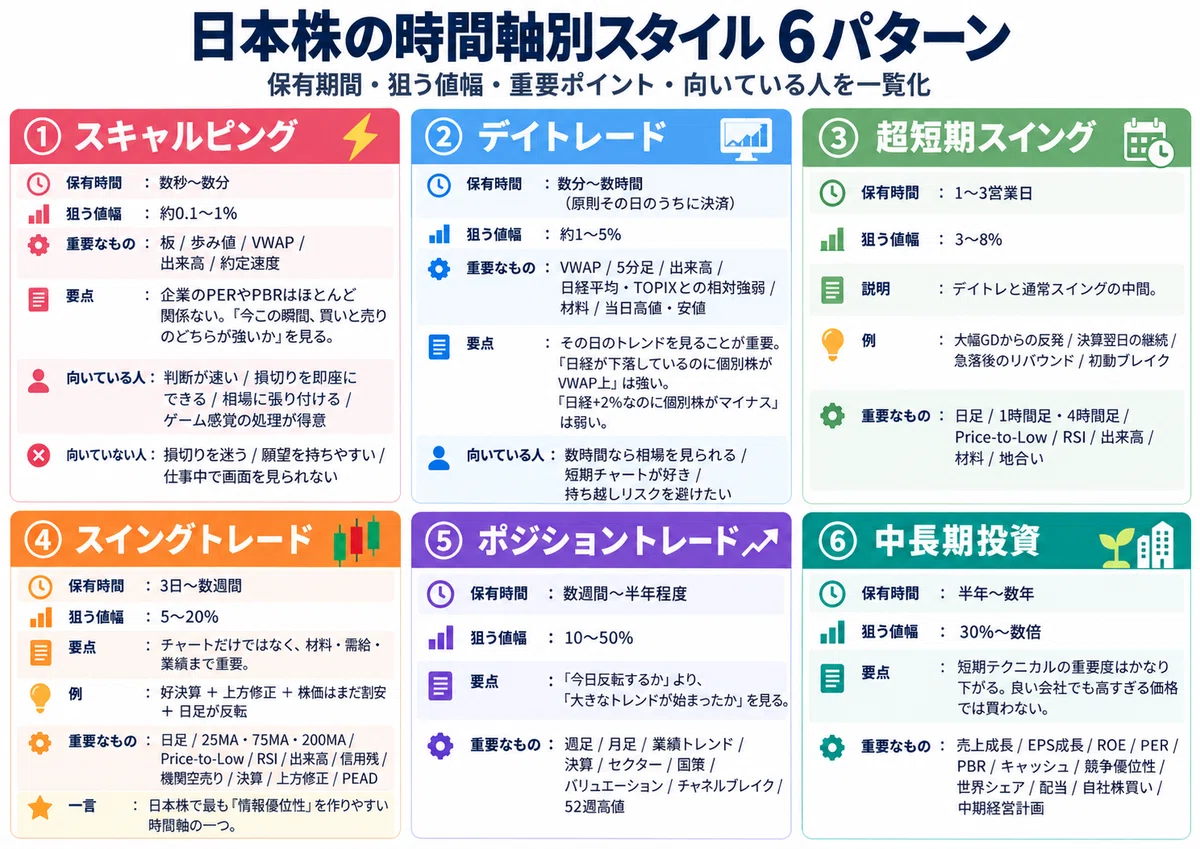
① Scalping
Holding time
Several seconds to several minutes
Target price range
Approx. 0.1–1%
Important factors
-
Order book
-
Time and Sales
-
VWAP
-
Trading Volume
-
Execution Speed
A company’s PER or PBR is almost irrelevant.
What matters is ‘which is stronger right now, buying or selling?’.
People suited for this
-
Quick decision-makers
-
Able to cut losses immediately
-
Able to stay glued to the market
-
Good at game-like processing
People not suited for this
② Day Trading
Holding period
Several minutes to several hours
In principle, settle within the same day.
Target price range
Approx. 1-5%
Important items
Since it is slightly longer than scalping, it is important to look at the trend of the day. For example, if the Nikkei is falling but an individual stock is above VWAP, it is quite strong. Conversely, if the Nikkei is up 2% but an individual stock is in the negative, it is quite weak.
People suited for this
3. Ultra-short-term swing
Personally, I think this could be treated as a separate category.
Holding period
1 to 3 business days
Target price range
3 to 8%
The middle ground between day trading and regular swing trading.
For example,
-
Rebound from a significant gap down
-
Continuation on the day after earnings
-
Rebound after a sharp drop
-
Initial breakout
etc.
Important items
-
Daily chart
-
1-hour/4-hour chart
-
Price-to-Low
-
RSI
-
Trading volume
-
News/Catalysts
-
Market sentiment
4. Swing Trading
Holding period
3 days to several weeks
Target price range
5-20%
At this time horizon, not only charts, but also catalysts, supply and demand, and financial performancebecome important.
For example, combinations like the following.
Strong earnings
+
upward revision
+
stock price still undervalued
+
daily chart reversal
Important factors
Personally, I think this is one of the time horizons where it is easiest to create an ‘information advantage’ with Japanese stocks.
⑤ Position trading
Holding period
Several weeks to about half a year
Target price range
10–50%
Aiming for an even larger trend than swing trading.
Important factors
-
Weekly Chart
-
Monthly Chart
-
Earnings Trend
-
Financial Results
-
Sector
-
National Policy
-
Valuation
-
Channel Breakout
-
52-Week High
Here, we look at ‘whether a major trend has begun’ rather than ‘whether it will reverse today’.
⑥ Medium- to Long-Term Investment
Holding Period
Six months to several years
Target Price Range
30% to several times over
At this point, the importance of short-term technicals decreases significantly.
What is important is:
-
Revenue Growth
-
EPS Growth
-
ROE
-
PER
-
PBR
-
Cash
-
Competitive Advantage
-
Global Market Share
-
Dividends
-
Share Buybacks
-
Mid-term Management Plan
and so on.
However, it is important not to buy even a good company at too high a price as well.
Differences by Time Horizon
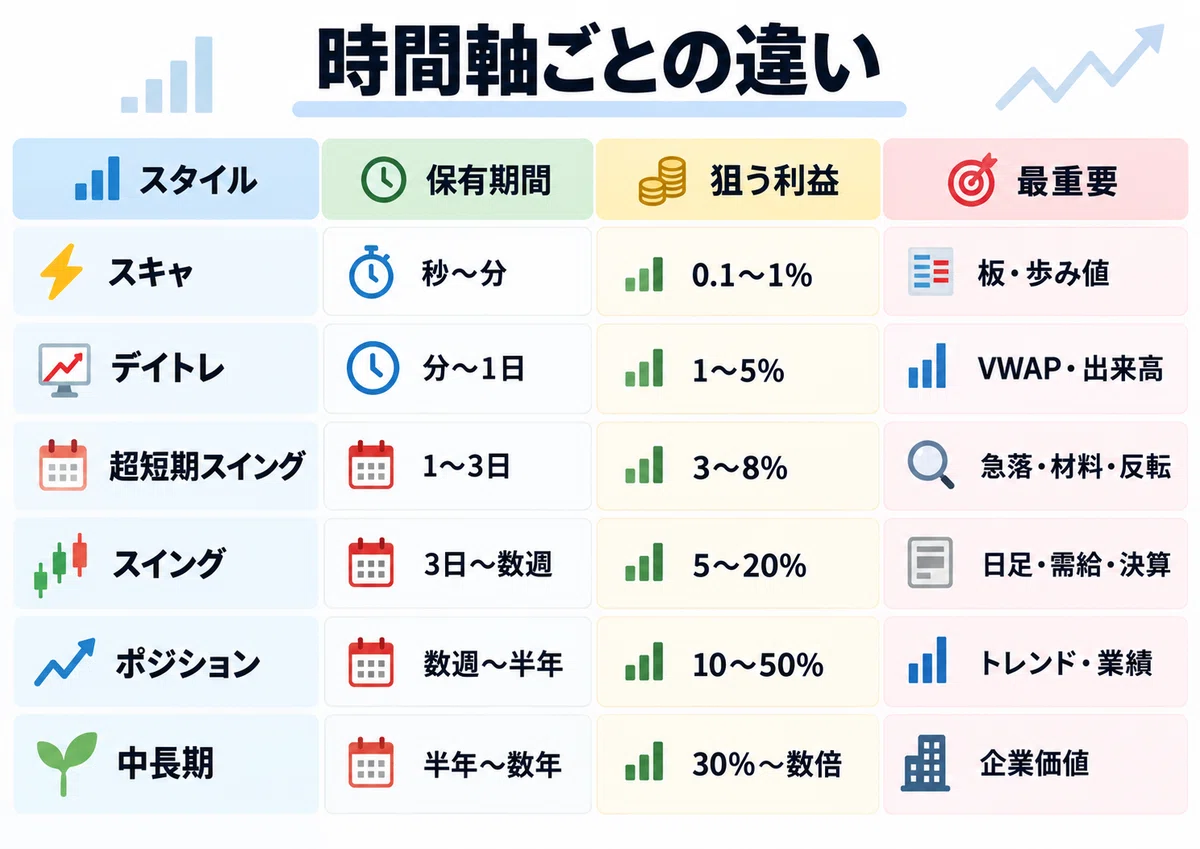
Mixing time horizons makes it easy to lose
There are common mistakes.
Entering as a scalper but failing to cut losses, turning it into a long-term investment
At first, you thought, ‘I’ll take a +0.5% gain,’ but it becomes -1%… -3%… -10%, and you start saying, ‘This company has future potential.’ This is quite dangerous.
The opposite also happens.
You bought it as a long-term investment, but you get scared and sell after just a -3% drop the next day. This is also mixing time horizons.
Three things to decide before buying
At the very least,
1. How many days to hold
2. What percentage to target
3. What triggers a stop-loss
decide these before you buy.
I think just doing this will make a big difference.
Finding the time horizon that suits you
Ultimately, the most important thing is not the most profitable investment method, but choosing an investment method you can replicate yourself.
Someone who is good at scalping is not necessarily good at corporate analysis.
Conversely, even if you are good at corporate analysis, it does not mean you can win by reading the order book.
The required skills are different.
If you can watch the market all day and are good at split-second decisions, go for scalping or day trading
If you like both charts and corporate analysis and can wait a few days, go for swing trading
If you like thinking about a company’s future potential and don’t mind short-term fluctuations, go for medium- to long-term investing
is an easy way to categorize it.
Summary
In Japanese stocks, there are
seconds
minutes
hours
days
weeks
months
years
separate battlefields for each.
And depending on the time horizon, the information you should look at and how you win are completely different.
Therefore, first, decide “What time horizon am I competing in?”.
And then,
only look at things that truly have an expected value for that time horizon.
I think this is quite important.
If you know your own area of expertise, the amount of unnecessary information you need to look at will decrease, and your trading will become much simpler.
Finally, as a bonus, I have included the ideal routine for each time horizon.