Today I’m in Tenroku. At the seat (seat?) next to me at a standing bar, two salarymen are getting excited talking about stocks.
Man A: “Man, stocks are scary, aren’t they? The stock I bought last year doubled, but I’m starting to think it’s gone up a bit too much lately.”
Man B: “Then why don’t you sell it?”
A: “But it might still go up, and the dividends are good, so I want to keep holding it.”
B: “Then why don’t you just keep holding it?”
A: “But man, I’d hate it if it crashed.”
B: “Then why don’t you sell it?”
🐤: “There is a way. A way to prepare for a price drop without selling your stocks.”
A+B: “Huh?”
🐤: “There is. Options trading is insurance to prepare for a stock decline.”
“What’s that? Is it something dangerous?”
🐤: “No, no, it acts like insurance. I’m a money expert, so if you’d like, I’ll explain it for the price of one highball.”

Now, today’s theme is options trading and margin trading.
Both have an image of being things that will make you go bankrupt if an amateur gets involved, or that they are more gambling than investing.
However, these two are actually tools that can be used to control investment risk.
Today, I will explain how they work as simply as possible.
Insurance against stock price drops (Put Options)
For example, suppose you own 1,000 shares of Company A.
The current stock price is 1,000 yen. That’s a total of 1 million yen.
The dividends are good, and you think it will probably trend upward in the future, so you want to keep holding it. However, you think the stock price increase over the last few years has gone a bit too far, and for some reason, it looks like it might drop in the short term.
You think it would be nice to sell it temporarily and buy it back later, but it’s not that simple. If your prediction of a drop fails and it skyrockets the moment you sell, you’ll be so frustrated you won’t be able to sleep at night.
I don’t want to let go of the stocks I own, but even if it’s only temporary, I hate knowingly sitting on an unrealized loss.
This is where insurance against a stock market crash comes in: put options.
For those who have studied for the FP exam, an “option” is simply a “right” to buy or sell at a set price in the future. (The fact that it is a “right” is important; in other words, you don’t have to exercise it.)
What fits here is a put option, which is the right to sell.
For example, you buy the “right to sell Company A’s stock at 1,000 yen three months from now” for 50 yen per share, totaling 50,000 yen for 1,000 shares.
Then, no matter what happens to the stock price in three months, you hold the right to sell it at 1,000 yen. (The point is that you don’t have to sell it.)
If the stock drops as expected to 500 yen, you can sell it at 1,000 yen and buy it back at 500 yen, resulting in a profit of 500 yen x 1,000 shares = 500,000 yen.
Even after subtracting the 50,000 yen insurance premium paid initially, that is a profit of 450,000 yen.
Isn’t that amazing?
Even if the stock price crashes to 500 yen, your loss is capped at 50,000 yen (when combined with the stock you originally held).
Furthermore, if it then goes back up on an upward trend as you hoped, you’ll be happy.
You can insure against a price drop without selling your stocks. This is an investment strategy called protective put.
Gambling at the bubble’s peak = Margin short selling
Next is the topic of margin short selling.
In June 2026, our Kioxia recorded an all-time high of 112,700 yen per share. I believe the PBR at that time was either 30x or 40x. It was a frenzied stock price.
Since high-priced semiconductor stocks have a strong influence on the Nikkei 225, the Nikkei also rose significantly that day, hitting a record high and exceeding 70,000 yen.
That’s double compared to just one year ago. It’s reminiscent of a bubble. Or perhaps it is a bubble.
If you think so, one investment method is “margin short selling”.
Usually, stock investment is about buying low and selling high to make a profit, but there is also a way to sell high first and buy back low later.
The method is surprisingly simple; you just press ‘Margin Sell’ on your usual online brokerage trading screen.
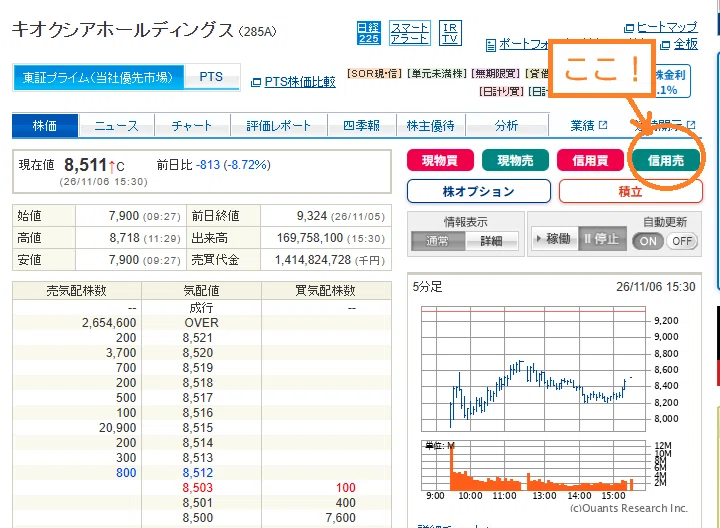
With margin selling, you can enter from the sell side even if you don’t originally own Kioxia. The day after the news, I sold 100 shares when they were at 100,000 yen.
The mechanism is like borrowing shares to sell and depositing one-third of the amount as collateral. In other words, a transaction worth 10 million yen (100,000 yen x 100 shares) becomes possible with 3.33 million yen.
After that, if you buy them back when the stock price drops to around 70,000 yen, it’s 70,000 yen x 100 shares = 7 million yen, so you get the same effect (excluding commissions and stock lending fees) as buying at 7 million yen and selling at 10 million yen.
In short, that’s a profit of 3 million yen.
This is margin selling.
It is effective for stocks you are certain will go down, but if your prediction is wrong, there is a possibility of losing more than the initial 3.33 million yen. (Rules seem to vary by brokerage, but since forced liquidation often occurs above a certain amount, it is not necessarily an unlimited loss.)
Unlike options, it is more of a gambling approach than insurance, but when market conditions are unique, this way of trading is also an option.
Other ways to use this
There are other interesting ways to use options and margin trading.
1. I want to buy if the stock price drops
‘I want this stock, but it’s expensive right now. I want to buy it if it drops to 1,000 yen.’
In such cases, there is a method of selling a right to sell at 1,000 yen (a put option) and receiving the option premium in advance.
If the stock price does not drop, the option premium remains in your hands.
If the stock price drops and the right is exercised, you buy the stock at the agreed price.
If it drops as you hoped, you can buy it cheaply. If it doesn’t drop, you earn the option premium. Either way, there is a benefit.
However, since you have an obligation to buy at 1,000 yen even if the stock price crashes to 500 yen, it is by no means free money.
2. I want to buy stocks, but I don’t have the money right now
‘I plan to buy stocks when I get my bonus next month. But I’m worried if the price goes up before then.’
In such cases, there is a method of purchasing the right to buy at a fixed price (a call option).
Even if the price rises, a portion of those profits can cover the increased purchase cost.
However, if the price does not rise, the option premium you paid becomes a loss.
Why is there a dangerous image?
Having read this far, don’t you think that both options trading and margin trading are actually quite useful?
So, why is there an image of them being ‘investments that ruin your life’?
I believe the biggest reason is leverage.
Being able to aim for large profits with a small amount of capital is attractive, isn’t it?
But that also means there is a possibility of incurring large losses.
In particular, option sellers have limited potential to earn premiums, while they face the possibility of suffering large losses.
In other words, even within the same options trading,
-
someone buying a put to prepare for a decline in their stock holdings
-
someone buying a call to aim for a quick fortune with little capital
-
someone selling a large volume of options without sufficient preparation just to earn premiums
are doing things that are completely different.
A kitchen knife can be used for cooking, but it can also be a dangerous tool if not used correctly. Options and margin trading are the same; it is important to understand and use them correctly.
Summary: Investing not to win, but to avoid losing
When people talk about investing, it tends to be about ‘which stock will go up’ or ‘what should I buy to make money,’ but options trading is about incorporating the concept of insurance into that.
And margin trading is about changing the order of buying and selling. It’s like borrowing first and then selling. Furthermore, you can also apply leverage.
-
I think it will go up in the long term, but it looks like it might go down in the short term
-
I think the stock price will definitely go down
-
I want this stock, but I don’t want to buy it at the current price
-
I have enough assets, so rather than making a huge profit, I want to avoid a crash
Option trading and margin trading are what allow you to handle diverse patterns like these. There are also futures contracts, which allow you to reserve future buying and selling prices.
However, to actually use these, you need to understand the mechanisms and check the costs. You also cannot necessarily trade every stock exactly as you wish.
But, I tried option trading and margin trading for the first time this year, and I think it really broadened my horizons. The stock market has a major crash about once every 10 years. Recently, there was the Lehman Shock in 2008 and the Corona Shock in 2020, so it might be time, or a crash might come in a few years.
Of course, for those who aren’t very interested in money games, I think it’s fine to just focus on long-term growth, stop thinking about money, and just keep automatically investing in All Country via NISA.
But, for those who like it, why not try it? Or even if you don’t, isn’t it good to at least know about it?
In investing, rather than trying to guess whether prices will go up or down, it is important to think about how to secure a certain profit whether they go up or down. I think if you can think that way, your life will surely become more relaxed.
Well, my highball is empty now.
Man A: “Hey, Hiyokoro-san. In the end, what is the most profitable option trade?”
🐤: “First, I think it’s best to start from the side that buys options, like buying puts or buying calls. It’s easy to understand, and you won’t lose more than a certain amount.”
“I see. Well then, maybe I’ll try buying a put option first.”
🐤: “Oh, what kind of prediction is that?”
“If it goes down, I make money, right?”
🐤: “That’s true, but… that’s far from being insurance, isn’t it? Were you listening to today’s talk?”
So that’s it for today. Stay safe out there today!
END