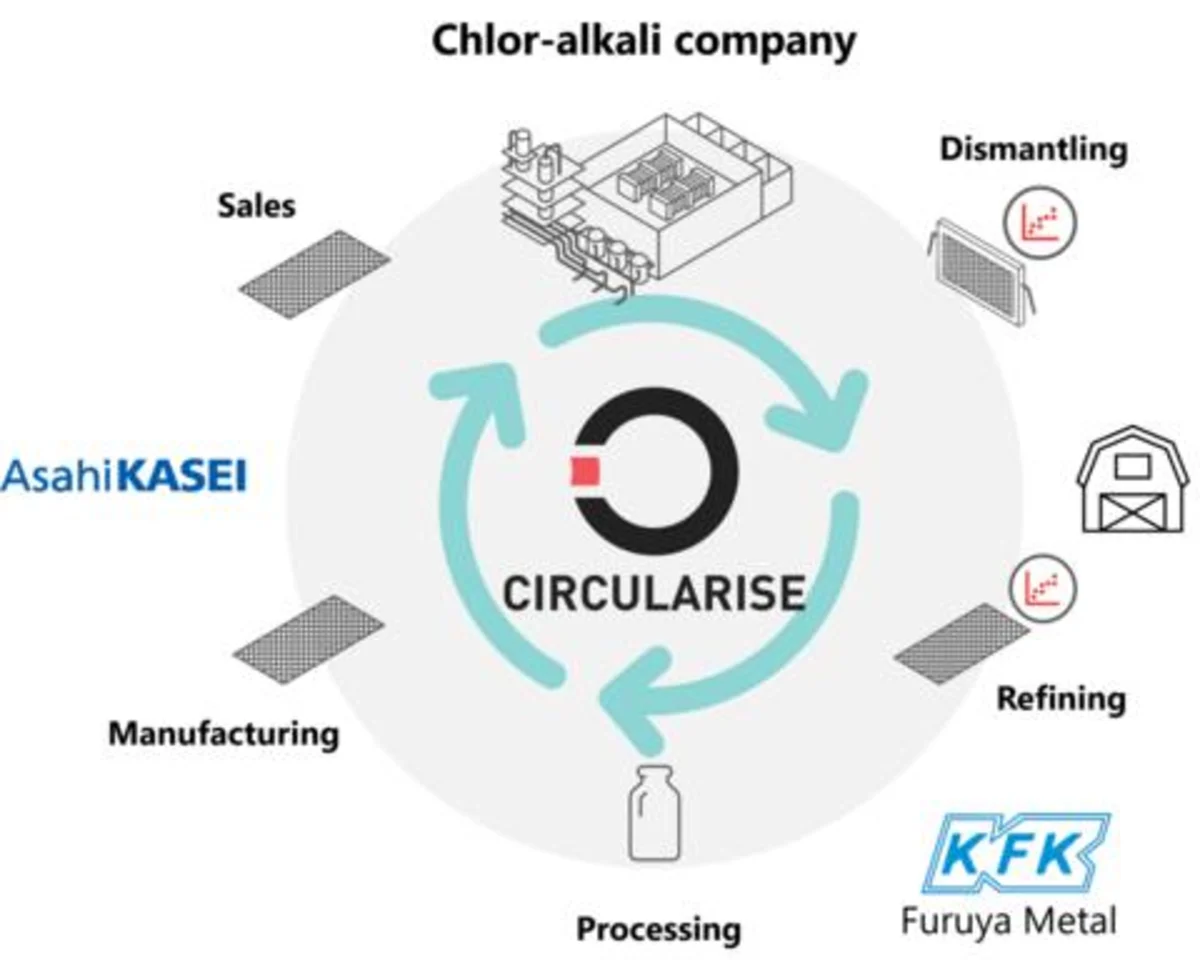
TOKYO, November 12, 2026–(BUSINESS WIRE)–Asahi Kasei, Dutch software and blockchain company Circularise, and Furuya Metal have launched a joint demonstration project to establish traceability for precious metals used in chlor-alkali electrolysis electrodes and evaluate the issuance of Digital Product Passports (DPPs). The initiative aims to digitally track the origin, recovery, refining, and reuse of critical precious metals, supporting both circular resource utilization and greater supply chain transparency.
Precious metals such as iridium and ruthenium are essential materials for electrodes in chlor-alkali electrolysis as well as semiconductors, electronics, and advanced chemical applications. Demand is expected to further increase as hydrogen production technologies, including proton exchange membrane (PEM) electrolyzers, continue to scale globally. According to the International Platinum Group Metals Association, global annual primary iridium production is estimated at only around 7 metric tons, while annual ruthenium supply is estimated at approximately 30 metric tons. Both are among the world’s most supply-constrained critical metals, with production concentrated in a small number of mining regions and largely obtained as a by-product of platinum extraction.
This supply-demand imbalance has contributed to pronounced price volatility and heightened focus on recycling and circular resource management across industries. While companies can sometimes identify where end-of-life materials are collected and where metals are refined, tracking the materials throughout intermediate processing, refining, and subsequent reuse remains challenging. Without trusted traceability mechanisms, verifying recycled content and demonstrating circularity at scale can be difficult. Digital Product Passports (DPPs) offer a way to overcome this challenge.
The demonstration project builds on the metal recycling initiative launched in 2025 to recover and recycle precious metals from end-of-life chlor-alkali electrolysis cells and electrodes. That collaboration marked an important step toward creating a circular ecosystem for valuable metals within the chlor-alkali industry. By adding digital traceability and data-sharing capabilities, the new demonstration seeks to make the entire lifecycle of recycled precious metals visible, from recovery through reintegration into newly manufactured electrodes.
Circularise has spent nearly a decade developing supply chain traceability and secure data-sharing solutions for global industries including chemicals and battery materials. Between February and September 2025, Asahi Kasei and Circularise conducted an initial proof of concept using a simulated recycling scenario. The results showed that the Circularise platform could securely manage data on precious metals recovered from end-of-life electrodes and reused in new products.
Building on these findings, the partners are now moving into a real-world demonstration with Furuya Metal. The project will first focus on establishing traceability across the recycling chain, from the collection of spent electrodes through precious metal extraction, refining, and the production of recycled metal. It will then extend traceability downstream by linking material data to the manufacture of new electrodes, enabling the evaluation of DPPs.
“For Asahi Kasei, the sustainable utilization of precious metal resources is a critical priority,” said Yoshifumi Kado, Senior General Manager of Asahi Kasei’s Ion Exchange Membrane & Electrolysis System Division. “Building a truly circular system requires close collaboration among companies involved in collection, refining, and manufacturing. By bringing together Asahi Kasei’s experience in chlor-alkali electrolysis, Furuya Metal’s expertise in precious metal recycling, and Circularise’s digital traceability capabilities, we can develop a solution that would be otherwise difficult to do alone—pushing the entire industry forward.”
The initiative will contribute to higher recycling rates for precious metals used in chlor-alkali electrolysis while improving transparency across the value chain. Looking ahead, the companies see potential applications beyond chlor-alkali production, including electrolysis systems for hydrogen production and other industries that depend on critical minerals. By combining material recovery with trusted digital traceability, the partners will establish a scalable model that helps industries secure access to strategic resources while accelerating the transition toward a more circular economy.
About Circularise Circularise is a Netherlands-based product traceability platform, established in 2016, specialising in compliance and sustainability across supply chains. With Circularise, companies can efficiently collect supply chain data and trace materials & products to meet regulatory requirements (like ESPR) and certification standards (like ISCC EU, ISCC PLUS). The AI powered platform enables end-to-end product traceability beyond tier-1 suppliers including Chain-of-Custody & Mass Balance automation, supports Digital Product Passports, and allows secure data collection, management, and sharing. Circularise’s patented technology ensures sensitive information remains protected, providing both transparency and data security.
In January 2025, Circularise launched Circularise Japan K.K. to deepen its engagement with the Japanese market. With the backing of the Tokyo Metropolitan Government and partnerships across industry, the company is committed to advancing the circular economy in Japan. For more information, visit https://www.circularise.com/.
About Furuya Metal Furuya Metal, established in 1968, is a manufacturer that processes platinum group metals (PGMs) into industrial products. Among various PGMs, we especially engage in the business of iridium and ruthenium over 40 years and boast a high global market share. Our competency in the procurement of raw materials, high purity refining technology, advanced fabricating techniques, recycling technology and its large capacity have contributed to technological development of many customers. As demand for iridium and ruthenium is expanding in various industries and yet their output is quite limited, Furuya Metal have worked on recycling of these metals for the stable supply. We are contributing to the development of society by supplying them to various industries.
About Asahi Kasei Asahi Kasei is a diversified global company that contributes to life and living for people around the world. Since its foundation in 1922, with businesses in ammonia and cellulose fiber, Asahi Kasei has consistently grown through proactive portfolio transformation to meet the evolving needs of every age. With 50,000 employees worldwide, the company contributes to sustainability by providing solutions to the world’s challenges across its three business sectors: Healthcare, Homes, and Material. For more information, visit https://www.asahi-kasei.com/.